The identification of patients with acute myeloid leukemia (AML) who may have resistant disease when treated with standard induction chemotherapy is still challenging: Murphy and colleagues present the first prospective, multicenter study aiming to evaluate the prognostic value of the leukemic stem cell 17-gene (LSC17) score in patients with newly diagnosed AML.
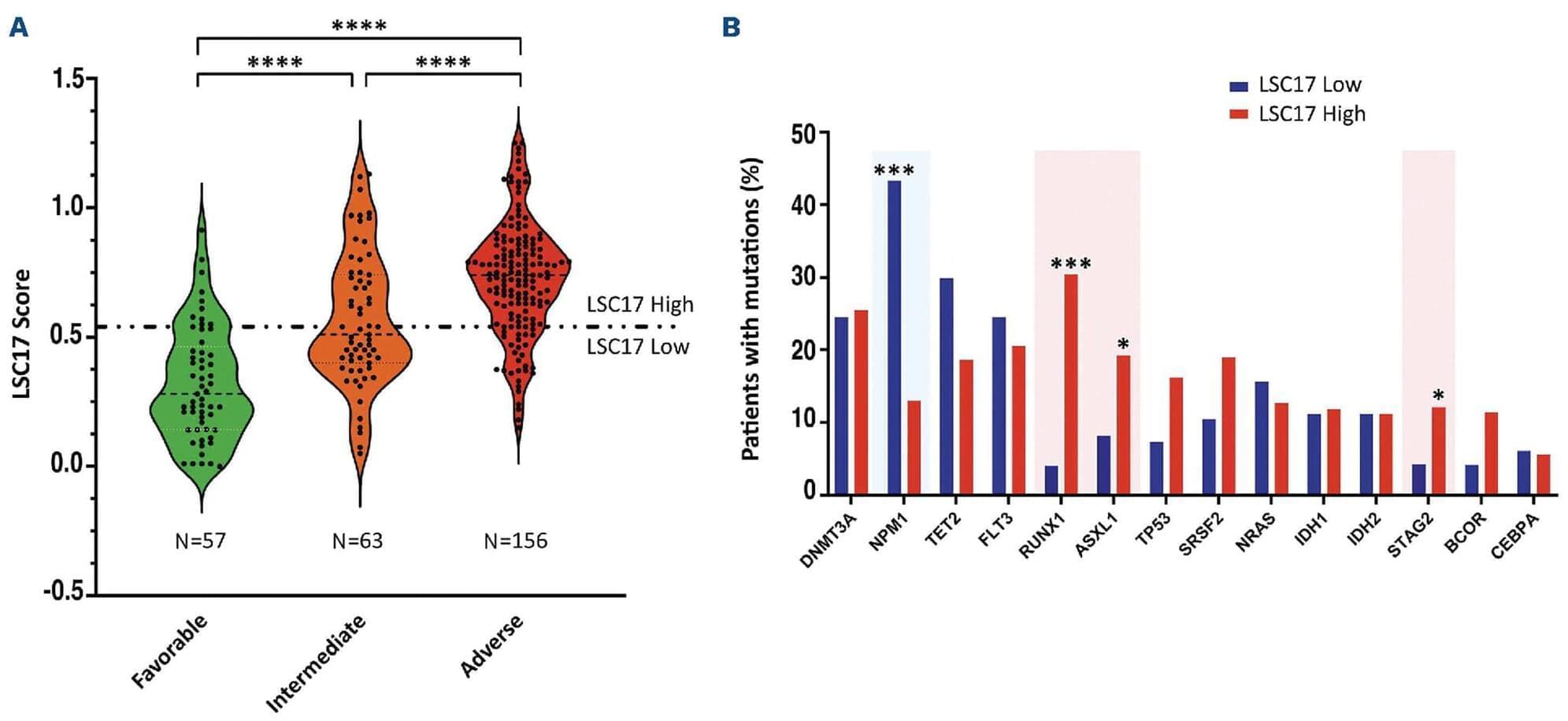
Acute myeloid leukemia (AML) patients exhibit diverse molecular and cytogenetic changes with heterogeneous outcomes. The functionally-derived LSC17 gene expression score has demonstrated strong prognostic significance in retrospective analyses of adult and pediatric AML cohorts, where above-median scores are associated with worse outcomes compared to below-median scores in intensively-treated patients. Here we used a laboratory-developed clinically-validated NanoString-based LSC17 assay to test the prognostic value of the LSC17 score in a prospective multicenter study of 276 newly-diagnosed AML patients. Each patient’s score was classified as high or low by comparison to a previously-established reference score. In the entire cohort, a high LSC17 score was associated with poor risk features, including advanced age and unfavorable genetic mutations. In the subset of 190 patients treated intensively, a high LSC17 score was associated with lower remission rates (63% vs. 94% after induction; P0.0001), presence of measurable residual disease (46% vs. 10%; P0.0001), and shorter overall survival (OS, 606 days vs. not reached; P=0.0004; hazard ratio
=2.16; 95% confidence interval [CI]: 1.39−3.35) and relapse-free survival (RFS, 541 days vs. not reached; P=0.001; HR=1.99; 95% CI: 1.29−3.08). In multivariable analysis considering age, white blood cell count and European LeukemiaNet 2022 risk groups, the LSC17 score remained an independent predictor of RFS and OS. Allogeneic stem cell transplantation improved OS for patients with a high but not a low LSC17 score. This study establishes the real-world value of the LSC17 score as a robust tool for risk assessment in AML and paves the way for its incorporation into routine clinical practice.
Acute myeloid leukemia (AML) is a heterogeneous malignancy with multiple subtypes and variable clinical outcomes driven by disease characteristics as well as the clinical status of the patient.1 2,3 While genomic classification has further rationalized risk stratification in AML, many challenges remain.4 The accurate assessment of survival outcomes in AML subtypes driven by various combinations of driver mutations and cytogenetic abnormalities presents a challenge to the treating physician.5
AML is sustained by a rare subpopulation of leukemia stem cells (LSC) believed to drive therapy resistance and relapse.6,7 The LSC17 gene expression score was developed based on functionally-defined LSC populations across the spectrum of AML subtypes.8 In multiple independent retrospective cohorts, the LSC17 score has been found to robustly discriminate between patients with significantly different outcomes.9–12 Higher-than-median LSC17 scores were associated with poor treatment response and survival outcomes in both uni-and multi-variable survival analyses, independent of commonly used prognostic factors including cytogenetic and molecular risk groups.