Toggle light / dark theme

Get the latest international news and world events from around the world.

Log in for authorized contributors

Exercise triggers memory-related brain ‘ripples’ in humans

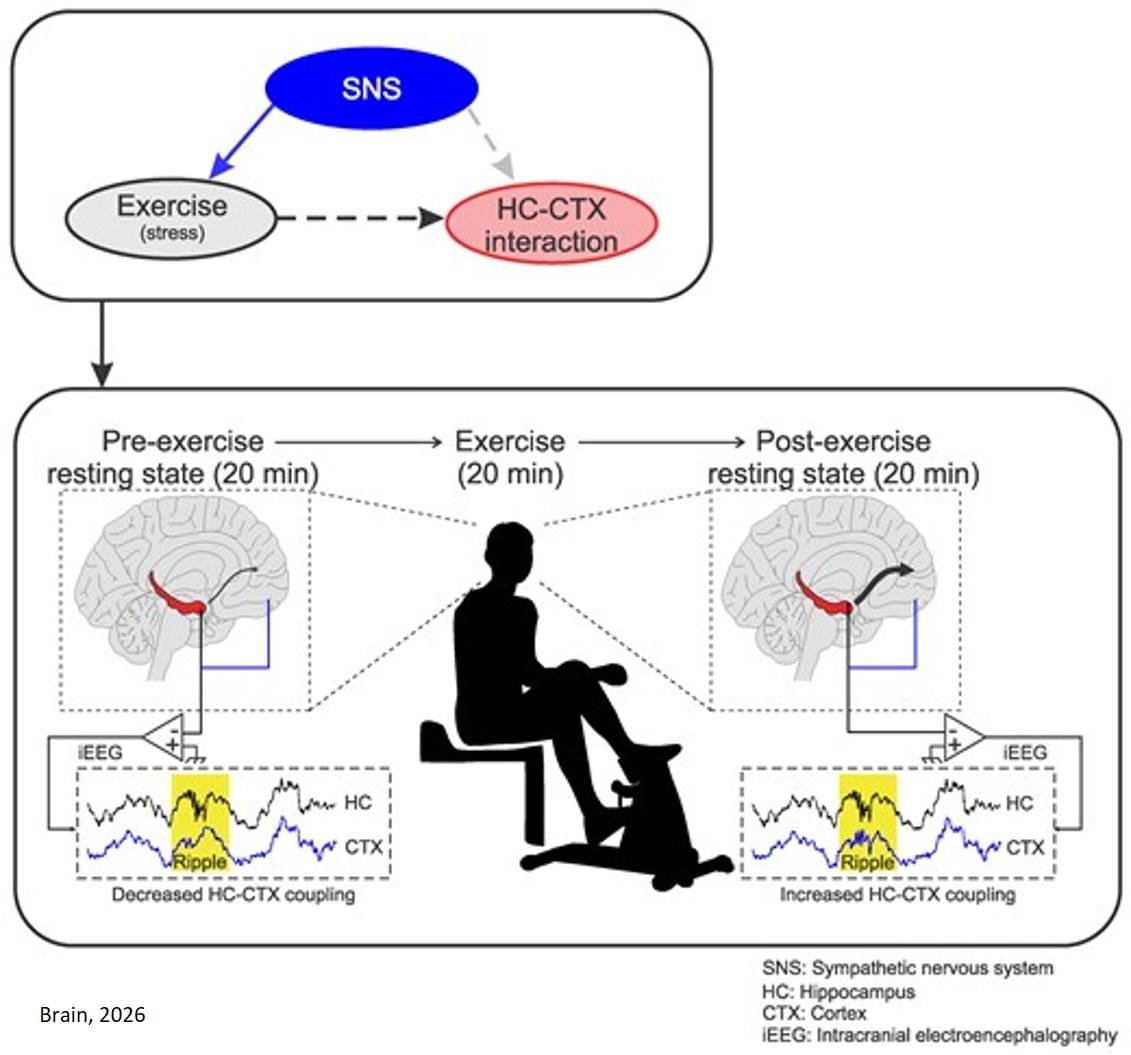
The team recruited 14 patients between 17 and 50 years of age, to participate. After a brief warmup, participants rode a stationary bike for 20 minutes at a pace they could maintain for the duration. Researchers recorded the participants’ brain activity before and after the cycling session using intracranial electroencephalography (iEEG), which utilizes implanted electrodes to measure neural activity in the brain. The recordings showed an increased rate of ripples originating in the hippocampus and connecting with cortical regions of the brain known to be involved in learning and memory performance.

“We’ve known for years that physical exercise is often good for cognitive functions like memory, and this benefit is associated with changes in brain health, largely from behavioral studies and noninvasive brain imaging,” says the study’s corresponding author. “By directly recording brain activity, our study shows, for the first time in humans, that even a single bout of exercise can rapidly alter the neural rhythms and brain networks involved in memory and cognitive function.”

The author says the results apply beyond the epileptic patients who participated. ScienceMission sciencenewshighlights.


A single session of physical exercise can spawn a boost of neural activity in brain networks that underlie learning and memory, according to a new study.

The researchers measured neural activity in the brains of patients with epilepsy before and after they completed a bout of physical exercise. The results showed that a single exercise session produced in the participants a burst of high-frequency brain waves, called ripples, emanating from the hippocampus to areas of the brain involved in learning and recall.

Neuroscientists have documented ripples relevant to memory in mice and rats, but they had not confirmed the link in humans, mainly because electrodes need to be implanted in the brain to obtain recordings. Instead, researchers had theorized the ripples’ role in humans, based on studies in people that measured changes in oxygenated blood in the brain after exercise. This new study marks the first time researchers have been able to see the neurons in action in people following exercise, the authors report.

Are Faster-Than-Light Messages Already Reaching Us?

What if the universe is already sending messages faster than light… and humanity has been too primitive to recognize them?

In this episode of Divergent Files, we investigate one of the most disturbing possibilities in modern physics: that information may already be moving beyond the speed limit we were taught could never be broken.

Quantum entanglement. Nonlocality. Unexplained cosmic bursts. Declassified research into remote viewing, anomalous cognition, and consciousness. Different fields. Different languages. Same uncomfortable pattern.

Something may be traveling farther, faster, and stranger than our current models can fully explain.

This is not a claim of proof.

It’s a grounded investigation into the science, the anomalies, and the classified edges of research that all point toward the same question:

Ben Goertzel responds

As part of Future Day 2026, we hosted a conversation between two of the most provocative minds in AGI – Ben Goertzel and Hugo de Garis (with Adam Ford as moderator/provocateur) – to tackle the ultimate existential question: Is an Artilect War inevitable, and should humanity accept becoming the “number two” species?

The discussion will build upon last years discussion between Ben and Hugo on AGI and the Singularity.

It will explore the idea of human transcendence. If we can’t beat them, do we join them?

Will humanity transcend into a Jupiter brain quectotech utility fog?

Is the Artilect War the inevitable conclusion of biological intelligence? Or can we find a path toward existing in a universe that still finds us aesthetically pleasing?

0:00 Intro.

💡 We talk about the past as if it’s gone forever — erased, unreachable, finished

But according to Richard Feynman and the laws of physics, that intuition is deeply misleading.

At the fundamental level, the equations that describe reality don’t care which way time flows. The same mathematics behind Quantum Electrodynamics — the most precisely tested theory in science — work just as well forward in time as they do backward.

In this video, we explore why the past may not be as “gone” as it feels.

🎥 *In this video, we explore:*
→ Why the laws of physics don’t distinguish past from future
→ How particles can be treated as moving backward in time in calculations
→ What time symmetry really means — and what it doesn’t
→ Why our experience of time is not fundamental
→ How Feynman explained time without mysticism.

This isn’t philosophy or speculation.
This is how physicists actually calculate the universe.

📚 *Based on the work of:*

Nanoengineered spintronic device can store data in four different ways

Over the past decades, electronics engineers have been trying to develop increasingly smaller devices that can store information reliably, even when they are not powered on. A promising type of non-volatile memory device is spintronics, solid-state systems that store and process information leveraging the spin (i.e., an intrinsic form of angular momentum) of electrons.

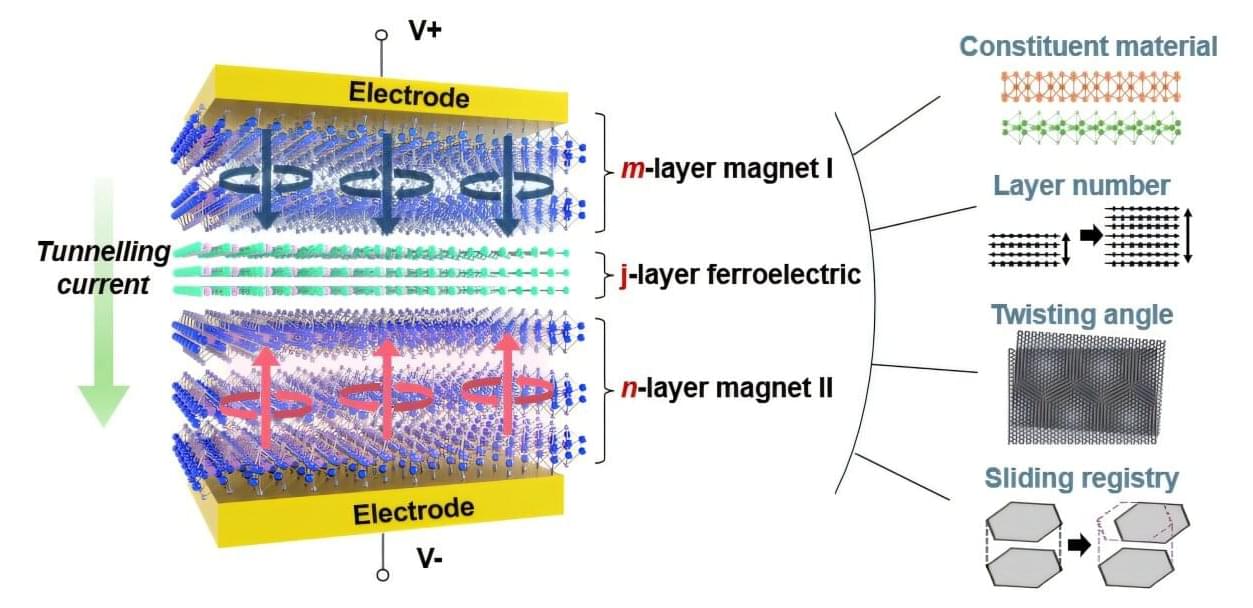
Researchers at University of Maryland and other institutes recently introduced a new spintronic device based on nanoscale structures based on materials that exhibit ferromagnetism (i.e., a permanent yet switchable magnetic order) and ferroelectricity (i.e., a permanent yet switchable electric polarization). This device, presented in a paper published in Nature Nanotechnology, can switch between four stable resistance states and could thus serve as a multistate memory.

The system that was nanoengineered by the researchers combines two different types of devices, known as magnetic tunnel junctions (MTJs) and ferroelectric tunnel junctions (FTJs). An MTJ consists of two magnetic thin films separated by an insulating thin film, while an FTJ is composed of two different metal electrode layers separated by a thin ferroelectric film. Both these types of devices have proved to be promising information storage solutions.

Perovskite crystals can host qubits, challenging long-held assumptions

For the first time, researchers have demonstrated that the properties of the perovskite family of materials can be used to create so-called quantum bits. The findings, published in the journal Nature Communications, pave the way for more affordable materials in future quantum computers.

According to the researchers from Linköping University, Sweden, behind the study, few within the field believed it would be possible. The reason is that the atoms in perovskite materials should, in theory, interact so strongly that the qubit would collapse before the calculation could be completed. However, the experiments conducted by the Linköping team show that it works.

“Our findings open up an entirely new research field,” says Yuttapoom Puttisong, associate professor at Linköping University.

Joscha Bach: Galactic Game Theory

Joscha Bach on the possibility that advanced / mature civs converge on strategy and value, and join the cosmic collective. https://www.scifuture.org/transparency-of-history-in-galactic-game-theory/ Many thanks for tuning in! Please support SciFuture by subscribing and sharing! Buy me a coffee? https://buymeacoffee.com/tech101z Have any ideas about people to interview? Want to be notified about future events? Any comments about the STF series? Please fill out this form: https://docs.google.com/forms/d/1mr9PIfq2ZYlQsXRIn5BcLH2onbiSI7g79mOH_AFCdIk/ Kind regards, Adam Ford — Science, Technology & the Future — #SciFuture — http://scifuture.org

Read more

Why You Should Question Genetic Risk Scores

Whole genome sequencing is powerful but still very new. Many companies offer genetic predictions for diseases without clearly explaining how those models are built or validated. Most people don’t ask basic questions like: How accurate is this? What data was used? What are the limitations? In this video, we break down why transparency matters and why you should always question genetic risk scores before trusting them. Youtube Video: https://www.youtube.com/LongevityScienceNews/membership Patreon: https://www.patreon.com/posts/polygenic-scores-152170836?utm…=join_link https://www.herasight.com/

Three anesthesia drugs all have the same effect in the brain, MIT researchers find

When patients undergo general anesthesia, doctors can choose among several drugs. Although each of these drugs acts on neurons in different ways, they all lead to the same result: a disruption of the brain’s balance between stability and excitability, according to a new MIT study.

This disruption causes neural activity to become increasingly unstable, until the brain loses consciousness, the researchers found. The discovery of this common mechanism could make it easier to develop new technologies for monitoring patients while they are undergoing anesthesia.

“What’s exciting about that is the possibility of a universal anesthesia-delivery system that can measure this one signal and tell how unconscious you are, regardless of which drugs they’re using in the operating room,” says Earl Miller, the Picower Professor of Neuroscience and a member of MIT’s Picower Institute for Learning and Memory.

Miller, Edward Hood Taplin Professor of Medical Engineering and Computational Neuroscience Emery Brown, and their colleagues are now working on an automated control system for delivery of anesthesia drugs, which would measure the brain’s stability using EEG and then automatically adjust the drug dose. This could help doctors ensure that patients stay unconscious throughout surgery without becoming too deeply unconscious, which can have negative side effects following the procedure.

Miller and Ila Fiete, a professor of brain and cognitive sciences, the director of the K. Lisa Yang Integrative Computational Neuroscience Center (ICoN), and a member of MIT’s McGovern Institute for Brain Research, are the senior authors of the new study, which appears today in Cell Reports. MIT graduate student Adam Eisen is the paper’s lead author.

Excellent work Earl Miller and team!

Read More

/* */