Toggle light / dark theme

Get the latest international news and world events from around the world.

Log in for authorized contributors

Molecular ‘catapult’ fires electrons at the limits of physics

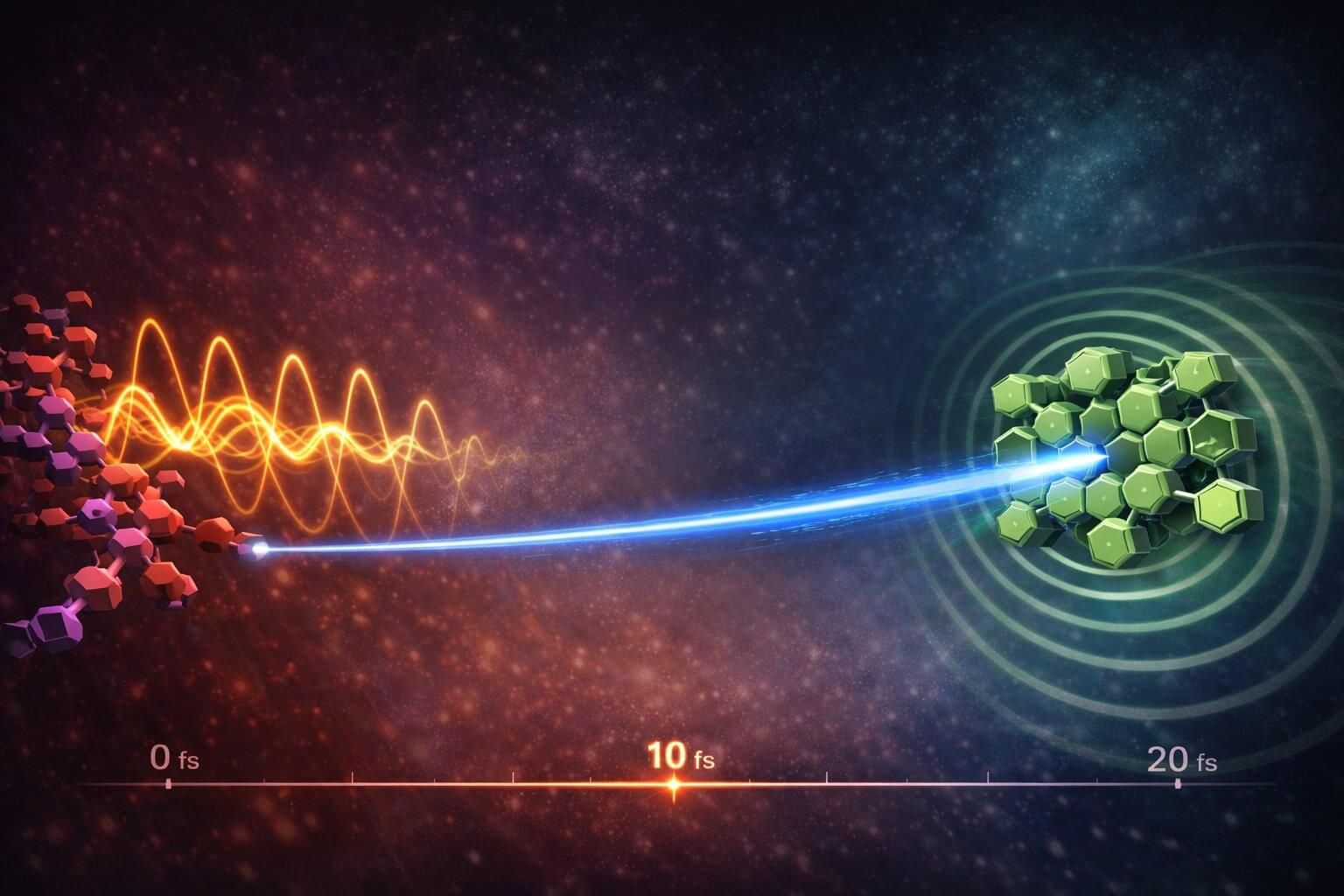
Electrons can be “kicked across” solar materials at almost the fastest speed nature allows, scientists have discovered, challenging long-held theories about how solar energy systems work. The finding could help researchers design more efficient ways of harvesting sunlight and converting it into electricity. The research is published in Nature Communications.

In experiments capturing events lasting just 18 femtoseconds —less than 20 quadrillionths of a second—researchers at the University of Cambridge observed charge separation happening within a single molecular vibration.

“We deliberately designed a system that—according to conventional theory—should not have transferred charge this fast,” said Dr. Pratyush Ghosh, Research Fellow, at St John’s College, Cambridge, and first author of the study. “By conventional design rules, this system should have been slow, and that’s what makes the result so striking.
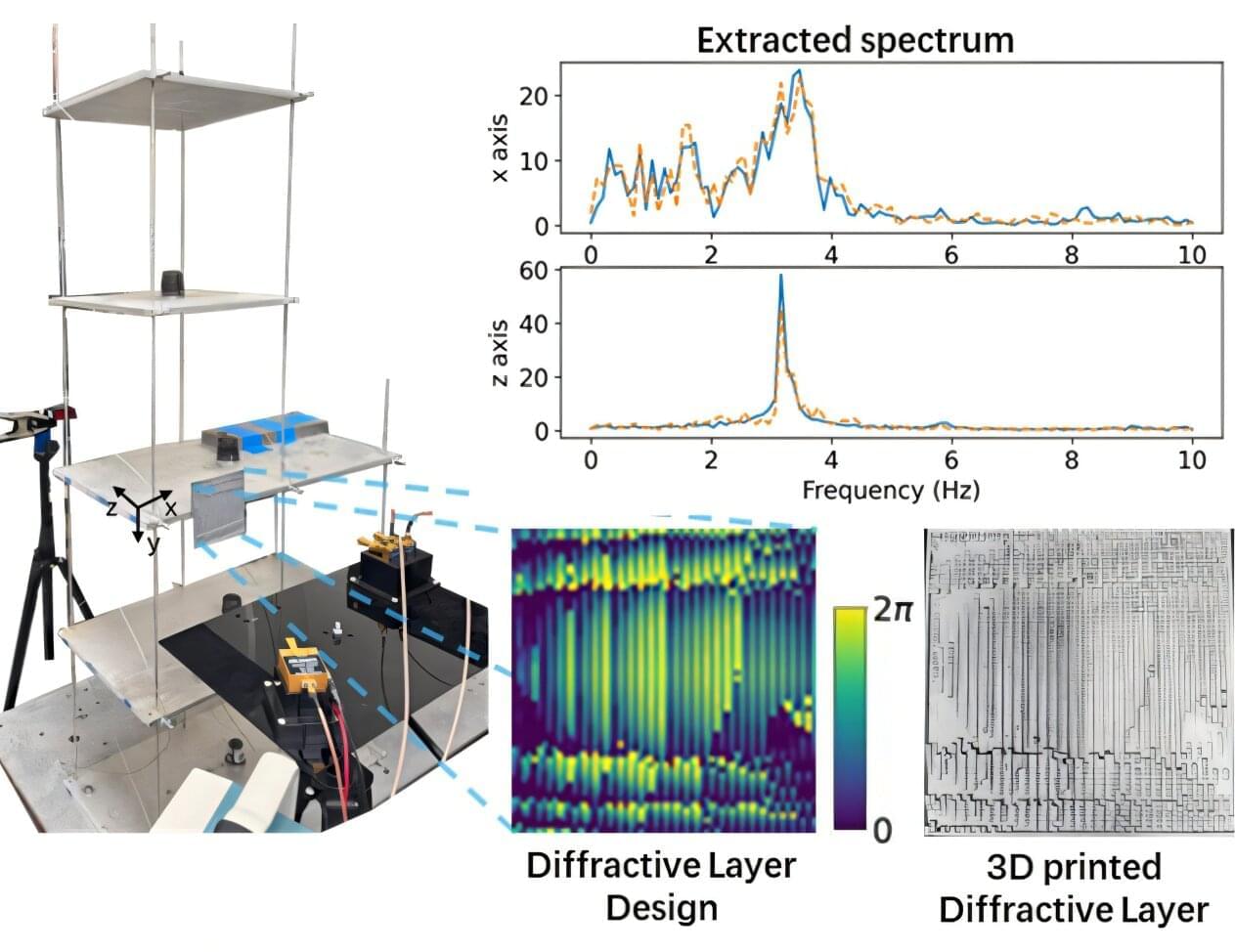
AI-designed diffractive optical processors pave the way for low-power structural health monitoring

A team of researchers at the University of California, Los Angeles (UCLA) has introduced a novel framework for monitoring structural vibrations using diffractive optical processors. This new technology uses artificial intelligence to co-optimize a passive diffractive layer and a shallow neural network, allowing the system to encode time-varying mechanical vibrations into distinct spatiotemporal optical patterns.

Structural Health Monitoring (SHM) systems are vital for assessing the condition of civil infrastructure, such as buildings and bridges, particularly after exposure to natural hazards like earthquakes. Traditional vibration-based methods rely on sensor networks of accelerometers and strain gauges, which demand significant power, generate large datasets requiring complex digital signal processing, and can be expensive to install and maintain.

Furthermore, achieving high spatial resolution for accurate damage localization often requires a costly, dense sensor deployment.

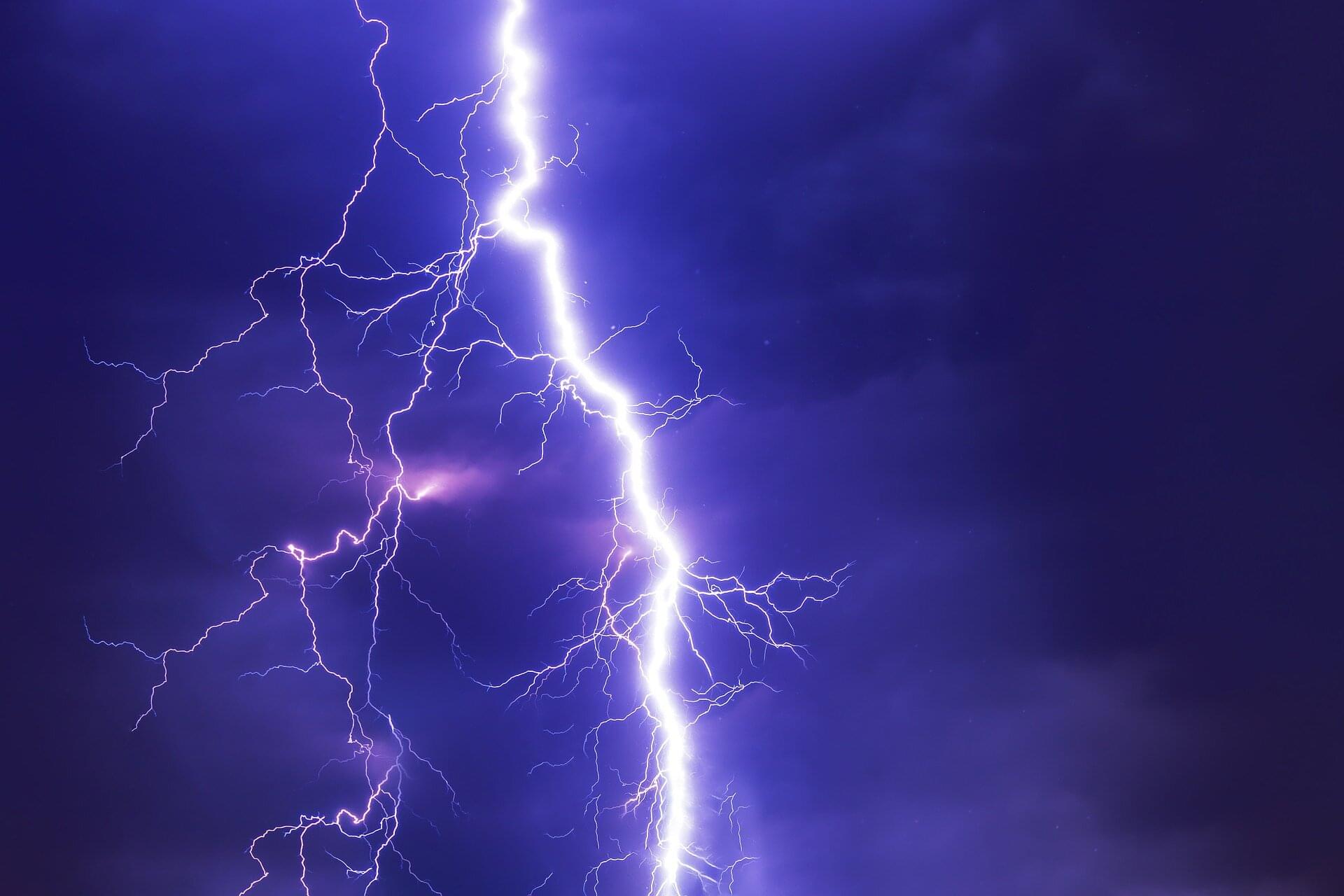
Making mini-lightning in a block of plastic

Lightning formation and the conditions triggering it have long been shrouded in a cloud of mystery, but new research led by Penn State scientists is lifting the fog. Using mathematical calculations, the researchers have discovered that lightning-like discharge doesn’t require a storm cloud—it could be made inside everyday material on a lab bench. The study is published in the journal Physical Review Letters.

“We applied the same exact models that we use for lightning research but shrank down the scale to slightly larger than a deck of cards,” said Victor Pasko, professor of electrical engineering at Penn State and lead author on the paper. “We calculated that when supplied with a high-powered electron source, lightning can be triggered in everyday insulating materials like glass, acrylic and quartz.”

The team used detailed numerical simulations to show that lightning-like radiation bursts could form inside small solid blocks, under conditions achievable in the lab. The work, if proven experimentally, could have implications for more compact and potentially safer X-ray sources in doctors’ offices and security checkpoints, the researchers said. The primary benefit, however, would be to enable the study of a powerful natural phenomenon on a lab bench.

Quantum Memory Isn’t What We Thought: Physicists Reveal a Hidden Duality

An international team of scientists has taken a closer look at how memory functions in quantum systems and their time evolution. Their study reveals that whether a quantum process appears to have memory depends on how it is examined. From one angle, the process may seem completely memoryless. From another, traces of past behavior remain visible. The findings open new paths for research in quantum science and emerging technologies.

In classical physics, memory is defined in a straightforward way. If a system’s future behavior depends only on its current condition, it is considered memoryless. If earlier states continue to influence what happens next, the system is said to have memory.

Quantum physics complicates this picture. Quantum systems can store and transmit information in ways that have no counterpart in classical science. In addition, measurement is not just a passive observation. It plays an active and fundamental role in how quantum systems evolve.

Google says 90 zero-days were exploited in attacks last year

Google Threat Intelligence Group (GTIG) tracked 90 zero-day vulnerabilities actively exploited throughout 2025, almost half of them in enterprise software and appliances.

The figure is a 15% increase compared to 2024, when 78 zero-days were exploited in the wild, but lower than the record 100 zero days tracked in 2023.

Zero-day vulnerabilities are security issues in software products that attackers exploit, usually before the vendor learns about them and develops a patch. They are highly valued by threat actors because they often enable initial access, remote code execution, or privilege escalation.

/* */