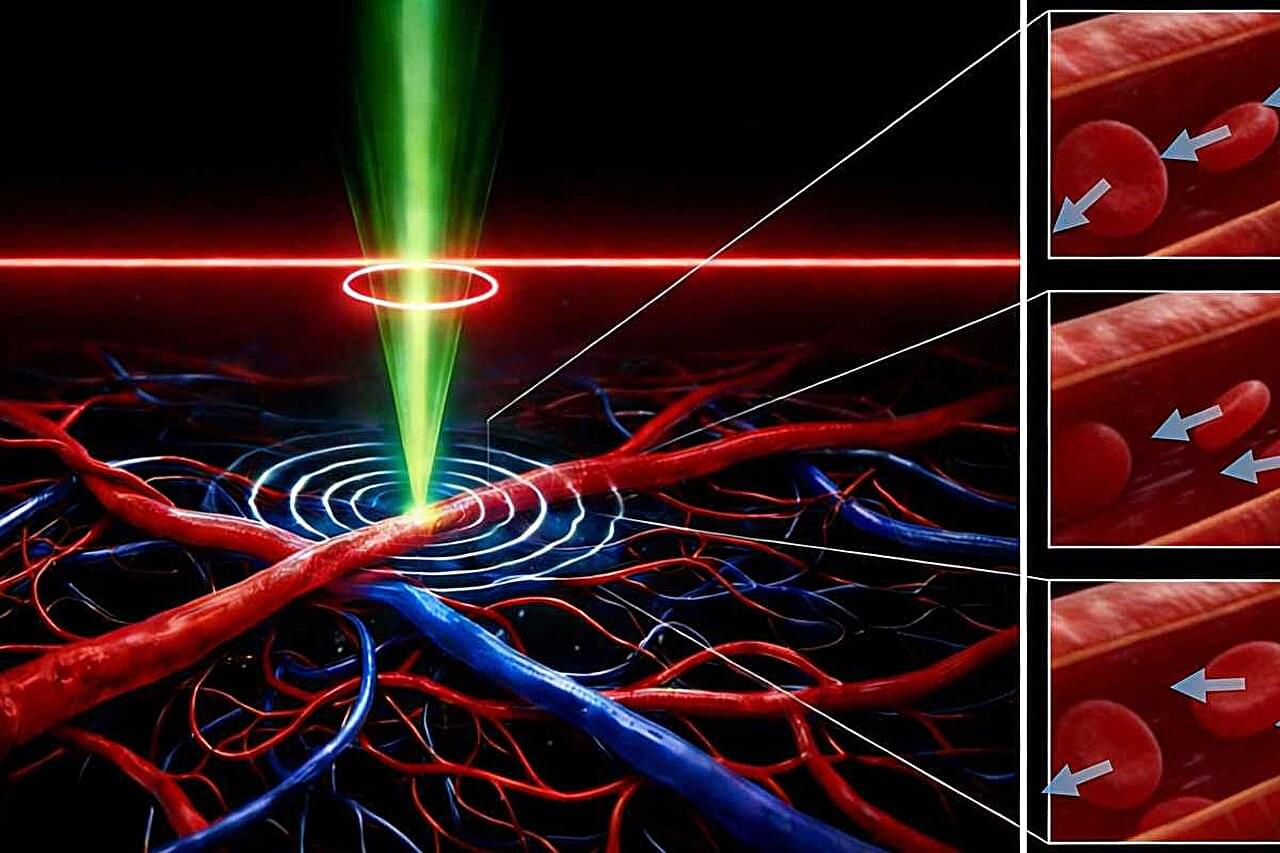
Caltech scientists have developed a method that detects tiny, imperceptible movements at the surface of objects to reveal details about what lies beneath. By analyzing the physics of waves traveling across the surface of an object—whether that be a manufactured product or the human body—the new technique can determine both the stiffness and thickness of the underlying material or tissue. This lays the groundwork for the project’s ultimate goal of enabling inexpensive, at-home health monitoring using little more than a smartphone camera.
“There is information scattered all around us in plain sight that we just haven’t learned to tap into. Our work is trying to leverage that information to recover material properties from inside objects by studying tiny movements on the surface,” says Katie L. Bouman, professor of computing and mathematical sciences, electrical engineering, and astronomy at Caltech and both a Rosenberg Scholar and a Heritage Medical Research Institute (HMRI) Investigator.
Bouman and her colleagues from Caltech presented the technique, called visual surface wave elastography, and its medical applications in a paper presented at the International Conference on Computer Vision in Honolulu last fall. The lead authors are Alexander C. Ogren, Ph.D., and Berthy T. Feng, Ph.D., who completed the work while at Caltech.