Toggle light / dark theme

Get the latest international news and world events from around the world.

Log in for authorized contributors

Topology helps build more robust photonic networks

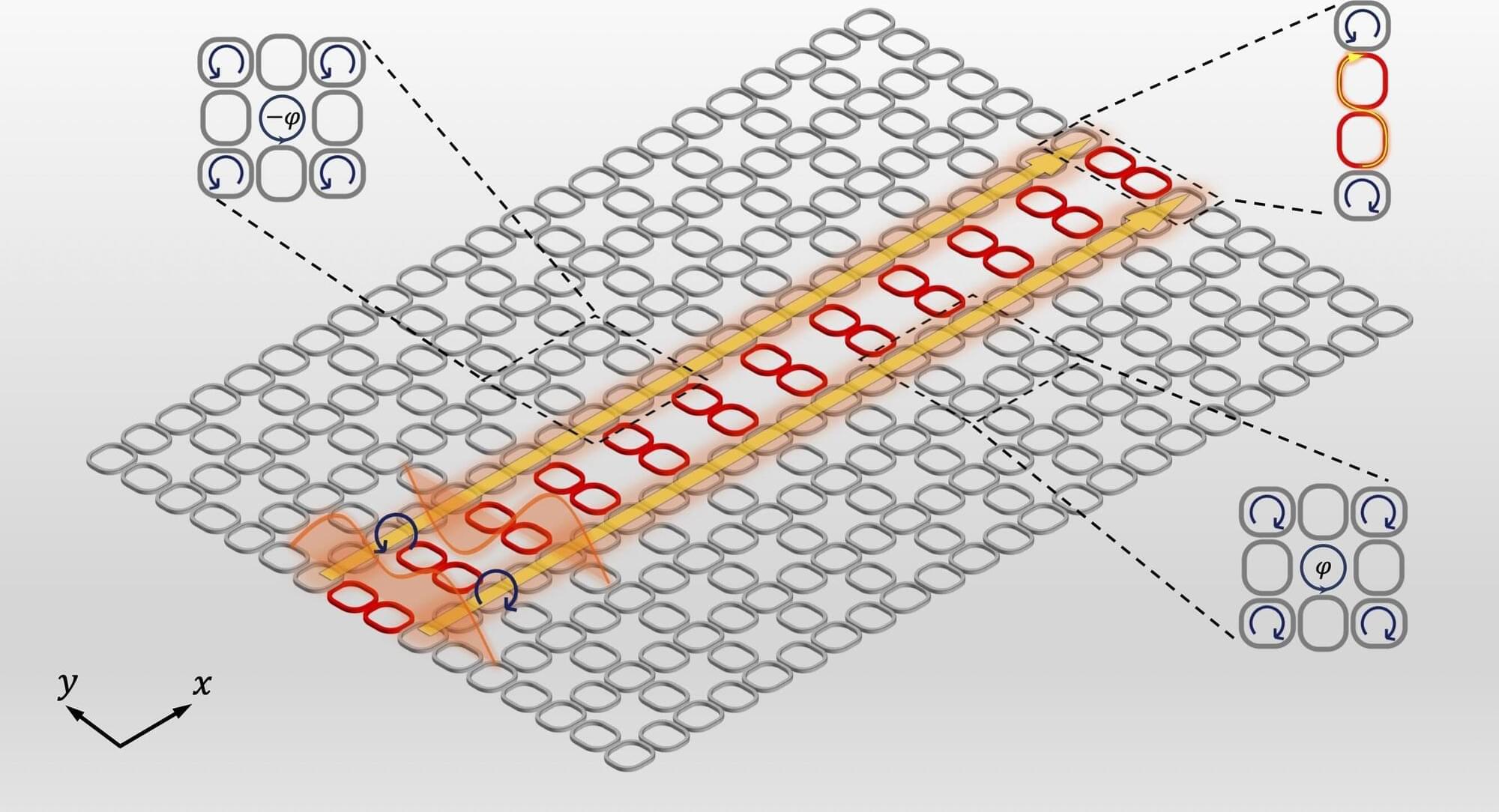
Penn-led researchers have shown for the first time that multiple, information-carrying light signals can be safely guided through chip-based, reconfigurable networks using topology, the esoteric branch of mathematics that says donuts and mugs are identical. Because topological properties remain stable even when objects are deformed—hence the field equating mugs and donuts, since both have one opening—the advance could help make light-based technologies for computing and communications more powerful and reliable.

“We already knew how to guide light using topology,” says Liang Feng, Professor in Materials Science and Engineering (MSE) with a secondary appointment in Electrical and Systems Engineering (ESE) within Penn Engineering and senior author of a study in Nature Physics describing the result. “But we had never been able to guide multiple, concurrent signals before.”

That opens the door to building networks of chips that communicate using light while taking advantage of the robustness topology provides. “Signals guided by these principles can be extremely reliable,” says Feng. “It’s like building a highway for light where even large potholes have no effect on traffic—it’s as if the defects simply aren’t there.”


This “Quantum” Material Fooled Scientists — but It’s Actually Something Even Stranger

A material thought to be a quantum spin liquid actually exhibits a newly identified magnetic state caused by competing ferromagnetic and antiferromagnetic interactions. Materials that enter a quantum spin liquid phase attract significant attention because of their unusual properties and potential

Navia discloses data breach impacting 2.7 million people

Navia Benefit Solutions, Inc. (Navia) is informing nearly 2.7 million individuals of a data breach that exposed their sensitive information to attackers.

An investigation into the incident revealed that the hackers had access to the organization’s systems between December 22, 2025, and January 15, 2026. However, the company discovered the suspicious activity on January 23.

Navia says that it responded immediately and launched an inquiry to determine the potential impact of the incident.

New ‘PolyShell’ flaw allows unauthenticated RCE on Magento e-stores

A newly disclosed vulnerability dubbed ‘PolyShell’ affects all Magento Open Source and Adobe Commerce stable version 2 installations, allowing unauthenticated code execution and account takeover.

There are no signs of the issue being actively exploited in the wild, but eCommerce security company Sansec warns that “the exploit method is circulating already” and expects automated attacks to start soon.

Adobe has released a fix, but it is only available in the second alpha release for version 2.4.9, leaving production versions vulnerable. Sansec says that Adobe offers a “sample web server configuration that would largely limit the fallout,” but most stores rely on a setup from their hosting provider.

Survey: What are neuroscience’s most transformative new tools?

A nicely organized list of what various investigators highlight as the most transformative neuroscience tools from the past 5 years!


Which new tools—including artificial intelligence, deep-learning methods, genetic tools and advanced neuroimaging—are making the largest impact?

Using mRNA to Fight Tau Aggregation in Alzheimer’s

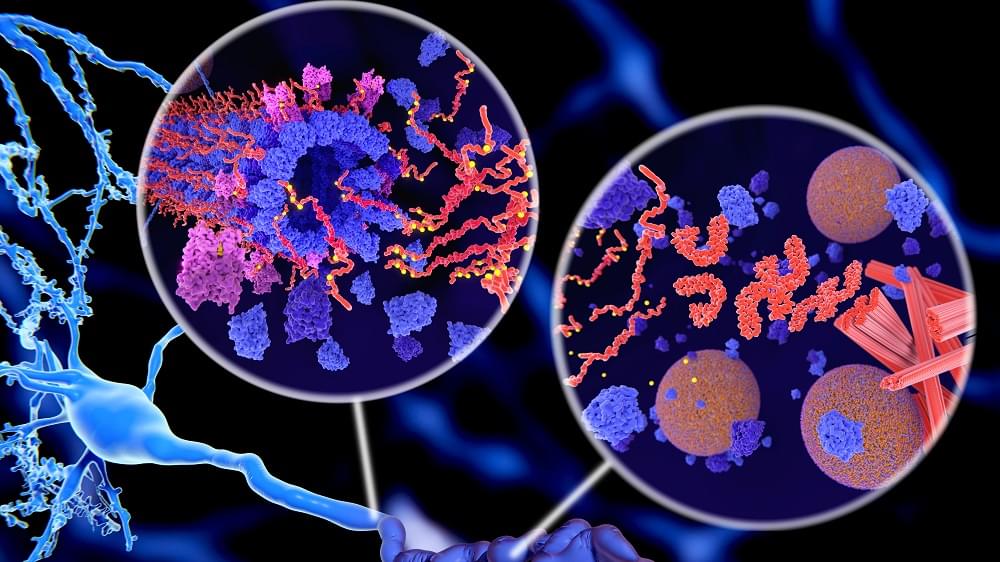
Researchers publishing in Cell Reports Medicine have described the development of a lipid nanoparticle (LNP) that delivers mRNA to neurons in order to stop the formation of tau aggregates and fight Alzheimer’s disease.

Tau and amyloids

Amyloid beta deposition between neurons and tau aggregation within neurons are both hallmarks of Alzheimer’s disease, and evidence suggests that the latter is potentially more significant than the former [1]. While some potential therapies have been discovered that may disaggregate these tau tangles after they have formed [2], no therapy has yet been approved by the FDA to do this.

/* */