Aug 26, 2024
DART Impact Reshapes Asteroid Moon Dimorphos, Alters Future Exploration Plans
Posted by Laurence Tognetti, Labroots Inc. in categories: evolution, space
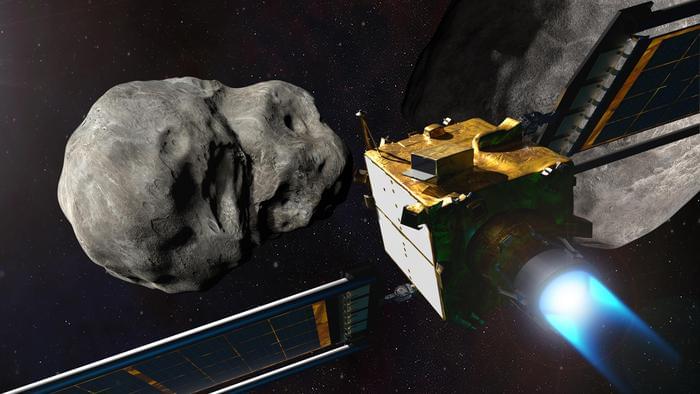
What did NASA’s Double Asteroid Redirection Test (DART) spacecraft on the asteroid moon, Dimorphos, teach astronomers about altering the trajectory of asteroids and asteroids’ formation and evolution? This is what a recent study published in The Planetary Science Journal hopes to address as an international team of researchers investigated the potential geological changes made to Dimorphos, which orbits its parent asteroid, Didymos, when DART impacted the former in September 2022. This study holds the potential to help scientists better understand the formation and evolution of asteroids throughout, and potentially beyond, the solar system, which could hold implications for the early history of the solar system, as well.
“For the most part, our original pre-impact predictions about how DART would change the way Didymos and its moon move in space were correct,” said Dr. Derek Richardson, who is a professor of astronomy at the University of Maryland, a DART investigation working group lead, and lead author on the study. “But there are some unexpected findings that help provide a better picture of how asteroids and other small bodies form and evolve over time.”
For the study, the researchers analyzed post-impact data of the DART spacecraft on Dimorphos based on predictions made prior to the impact, which could help in planning for the European Space Agency’s upcoming Hera spacecraft mission to Didymos, which is slated to launch in October 2024 and arrive at Didymos in December 2026. In the end, the researchers found that along with Dimorphos’ orbital parameters being influenced by the impact, its physical shape was altered, as well. This resulted in the small asteroid moon becoming elongated towards its poles, whereas its poles were squished prior to impact. This indicates varying formation and evolutionary processes regarding its geologic composition.