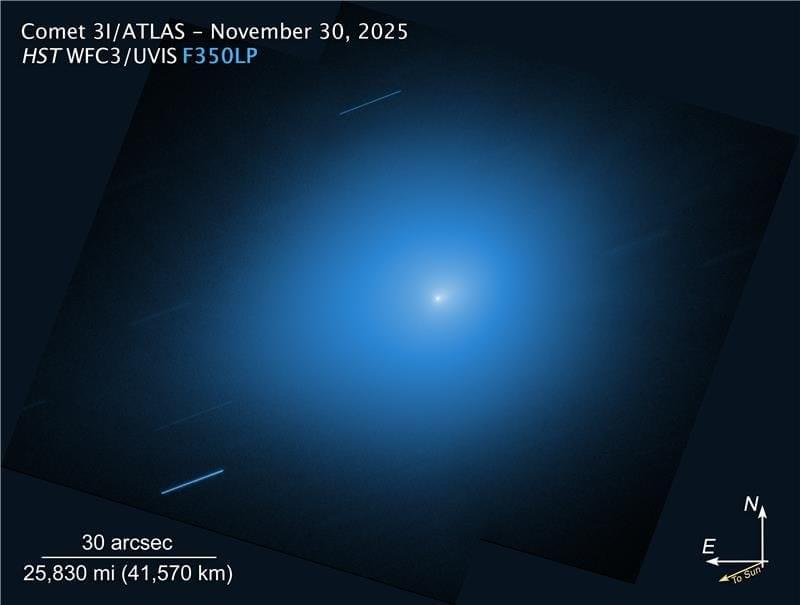
Planetary systems — which serve as the natural birth sites of interstellar objects — originate from debris disks that contain at least ten times less mass than the host star. In addition, one expects a mass spectrum of ejected interstellar objects to contain at least ten times more mass in objects with masses that are orders of magnitude different from that of 3I/ATLAS. When these additional factors are included, we find that low-metallicity stars miss the required mass budget by at least 3 orders of magnitude. They cannot account for the interstellar population of 3I/ATLAS-like objects unless they are capable of ejecting to interstellar space more than a thousand times the heavy-element content of their planetary disks.
In conclusion, either the inferred radius or number density of the population of 3I/ATLAS-like objects are overestimated or their association with metal-poor stars is incorrect.