Toggle light / dark theme

Get the latest international news and world events from around the world.

Log in for authorized contributors

Space Weather Could Be Hiding Alien Signals

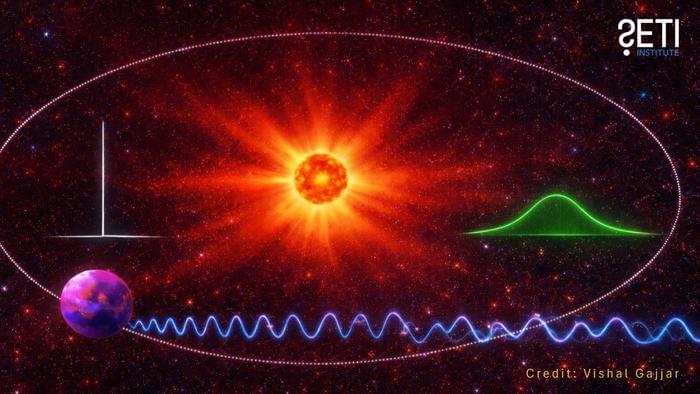
Dr. Vishal Gajjar: “If a signal gets broadened by its own star’s environment, it can slip below our detection thresholds, even if it’s there, potentially helping explain some of the radio silence we’ve seen in technosignature searches.”


What steps can be taken to identify why we haven’t received radio signals from an extraterrestrial intelligence, also called technosignatures? This is what a recent study published in The Astrophysical Journal hopes to address as a team of scientists investigated potential explanations regarding why humanity continues hearing silence from technosignatures. This study has the potential to help scientists and the public better understand the shortcomings and enhancements that can be made in the search for intelligent life beyond Earth.

For the study, the researchers used a series of computer models to simulate how radio signals leaving extrasolar star systems could be influenced by a myriad of factors, specifically space weather coming from the host star. This study comes as SETI and other researchers worldwide continue to come up empty regarding identifying technosignatures. The goal of the study was to ascertain potential reasons while putting constraints on both how and where to search for technosignatures.

In the end, the researchers ascertained that space weather plays a role in altering the outgoing radio signals by dispersing them, as opposed to the radio signals maintaining a fixed beam. The team ascertained that M-dwarf stars, which constitute approximately 75 percent of the stars in the Milky Way Galaxy while being smaller and cooler than our Sun, are prime targets for searching for technosignatures. This is due to their space weather, which is far more active than stars like our Sun, dispersing the radio signals.
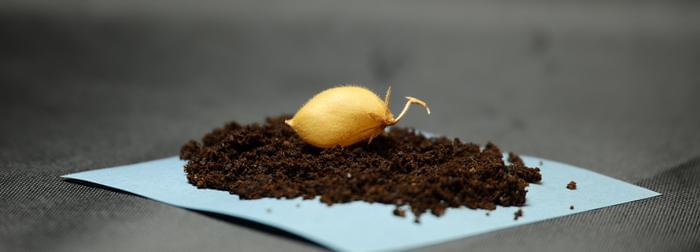

Lunar regolith simulant used to grow chickpeas

Dr. Sara Santos: “The research is about understanding the viability of growing crops on the moon. How do we transform this regolith into soil? What kinds of natural mechanisms can cause this conversion?” [ https://www.labroots.com/trending/space/30294/lunar-regolith…hickpeas-2](https://www.labroots.com/trending/space/30294/lunar-regolith…hickpeas-2)


How will astronauts grow food during long-term missions to the Moon? This is what a recent study published in Scientific Reports hopes to address as a team of scientists investigated the prospect of growing food on the Moon. This study has the potential to help scientists, mission planners, engineers, and astronauts develop new methods for growing food on the Moon, which could help advance such techniques when humans go to Mars.

For the study, the researchers grew chickpeas using simulated lunar regolith (often mistakenly called “soil”) and fungi, with the latter being used to test plant stress levels, decrease toxins, and enhance the mixture of regolith simulant and fungi. The team tested a variety of mixtures, including 25 to 100 percent regolith simulant and with and without the fungi. The goal of the study was to ascertain the plausibility of growing food on the Moon under climate-controlled conditions using lunar regolith and Earth-based products. In the end, the researchers found that the most promising mixture was 75 percent regolith simulant with fungi.

AI Research Symposium: The Next Frontiers | Keynotes by Demis Hassabis, Yoshua Bengio & Yann LeCun

Welcome to the Research Symposium on Enabling AI at Nation Scale, hosted by the Ministry of Electronics and Information Technology (MeitY).

This landmark event brings together the world’s leading pioneers in Artificial Intelligence to discuss the future of discovery, engineering, and national infrastructure. Featuring keynote addresses from Turing Award winners and industry visionaries, we explore how AI acts as a catalyst for scientific breakthroughs and the \.

Abstract: Glioblastoma remains profoundly resistant to current immunotherapeutic strategies

Here, Fanghui Lu & team report OLIG2, a master transcription factor in glioblastoma stem cells, enables immune evasion by suppressing CXCL10. And, targeting OLIG2 overcomes immunotherapy resistance and improves survival.


1Department of Cancer Center, The Second Affiliated Hospital of Chongqing Medical University, Chongqing, China.

2Department of Neurosurgery, Key Laboratory of Major Brain Disease and Aging Research (Ministry of Education), The First Affiliated Hospital of Chongqing Medical University, Chongqing, China.

3School of Basic Medical Sciences, Chongqing Medical University, Chongqing, China.

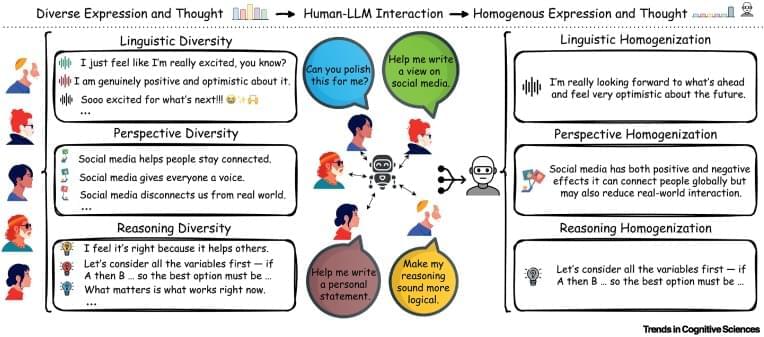
The homogenizing effect of large language models on human expression and thought

AI chatbots are homogenizing human expression and risk reducing humanity’s collective wisdom, computer scientists and psychologists say. http://spkl.io/6181AI6Jh.

TrendsInCognitiveScience.


Cognitive diversity, reflected in variations of language, perspective, and reasoning, is essential to creativity and collective intelligence. This diversity is rich and grounded in culture, history, and individual experience. Yet, as large language models (LLMs) become deeply embedded in people’s lives, they risk standardizing language and reasoning. We synthesize evidence across linguistics, psychology, cognitive science, and computer science to show how LLMs reflect and reinforce dominant styles while marginalizing alternative voices and reasoning strategies. We examine how their design and widespread use contribute to this effect by mirroring patterns in their training data and amplifying convergence as all people increasingly rely on the same models across contexts.

Robust Mouse Rejuvenation: Breaking the Ceiling of Longevity Research

For decades, the field of biogerontology has largely focused on a single strategy: manipulating metabolism to slow down the rate at which we age. While approaches like caloric restriction have produced fascinating results in short-lived organisms like worms and flies, they have shown clear limits in mammals. Slowing the accumulation of damage does not remove the damage that is already there. It merely delays (not prevents) the onset of disease, particularly when applied late in life.

This Spacetime Quasicrystal Could Solve Physicists’ Biggest Problem

Take your scientific understanding to the next level with Brilliant! Start learning for free at https://brilliant.org/sabine/ and get a 30-day free trial plus 20% off a premium subscription, which includes daily unlimited access!

What is space, really? That’s one of the biggest questions in science. According to a pair of researchers from the Perimeter Institute, the answer to that is: a quasicrystal. What is a quasicrystal, and how is space a quasicrystal? Let’s take a look.

Paper: https://arxiv.org/abs/2601.

👕T-shirts, mugs, posters and more: ➜ https://sabines-store.dashery.com/
💌 Support me on Donorbox ➜ https://donorbox.org/swtg.
👉 Transcript with links to references on Patreon ➜ / sabine.
📝 Transcripts and written news on Substack ➜ https://sciencewtg.substack.com/
📩 Free weekly science newsletter ➜ https://sabinehossenfelder.com/newsle… Audio only podcast ➜ https://open.spotify.com/show/0MkNfXl… 🔗 Join this channel to get access to perks ➜ / @sabinehossenfelder 📚 Buy my book ➜ https://amzn.to/3HSAWJW #science #sciencenews #spacetime #physicsteacher What is space? That’s one of the biggest questions, not just in the foundations of physics, but in all of science. According to a new paper, the answer may be a quasicrystal, an idea from researchers working on quantum gravity. This video explores the implications of this idea, touching on concepts like String Theory and Loop Quantum Gravity, to understand what it might mean for theoretical physics.
👂 Audio only podcast ➜ https://open.spotify.com/show/0MkNfXl
🔗 Join this channel to get access to perks ➜
/ @sabinehossenfelder.
📚 Buy my book ➜ https://amzn.to/3HSAWJW

#science #sciencenews #spacetime #physicsteacher.

What is space? That’s one of the biggest questions, not just in the foundations of physics, but in all of science. According to a new paper, the answer may be a quasicrystal, an idea from researchers working on quantum gravity. This video explores the implications of this idea, touching on concepts like String Theory and Loop Quantum Gravity, to understand what it might mean for theoretical physics.

/* */