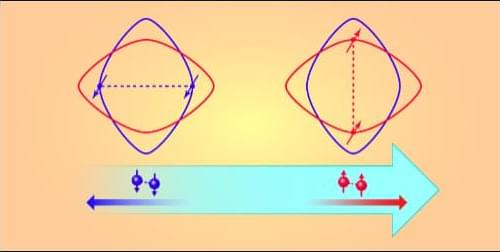
Materials from a new class of magnets could host permanent dissipationless spin currents when they enter a superconducting state.
Superconductors are famous for transporting electric charge with zero resistance. This ability underpins technologies such as MRI scanners, quantum computers, and sensitive magnetometers known as superconducting quantum interference devices. However, in the field of spintronics—which seeks to process information using electron spin rather than charge—achieving a similar long-range dissipationless transport has remained elusive. In ordinary metals, electron spins are highly susceptible to scattering and spin-orbit coupling, both of which cause spin currents to decay over short distances. Although research in superconducting spintronics based on ferromagnets has made progress [1, 2], ferromagnets produce stray magnetic fields that interfere with external circuit elements, and their internal magnetic fields tend to destroy superconductivity.