Toggle light / dark theme

Get the latest international news and world events from around the world.

Log in for authorized contributors

Energy crisis drives T cells to exhaustion in tumors

The immune system’s killer T cells do a commendable job of detecting and destroying cancer cells. But the harsh environment at the heart of tumors often saps them of their vitality, pushing them into a state of permanent lassitude called “terminal exhaustion.” The phenomenon accounts for why so many tumors resist routine immune clearance and even cancer immunotherapies devised to stimulate their lethal capabilities.

Terminal exhaustion is characterized by an accumulation of dysfunctional mitochondria—the bean-shaped energy generators in cells—and extensive genetic reprogramming that stalls proliferation and hobbles the cell-killing weaponry of T cells. Yet how mitochondrial dysfunction is linked to genetic reprogramming in the cells was unclear. No longer. Researchers in the journal Nature show that how the accumulation of useless mitochondria is linked to T cell exhaustion through a complex series of subcellular processes.

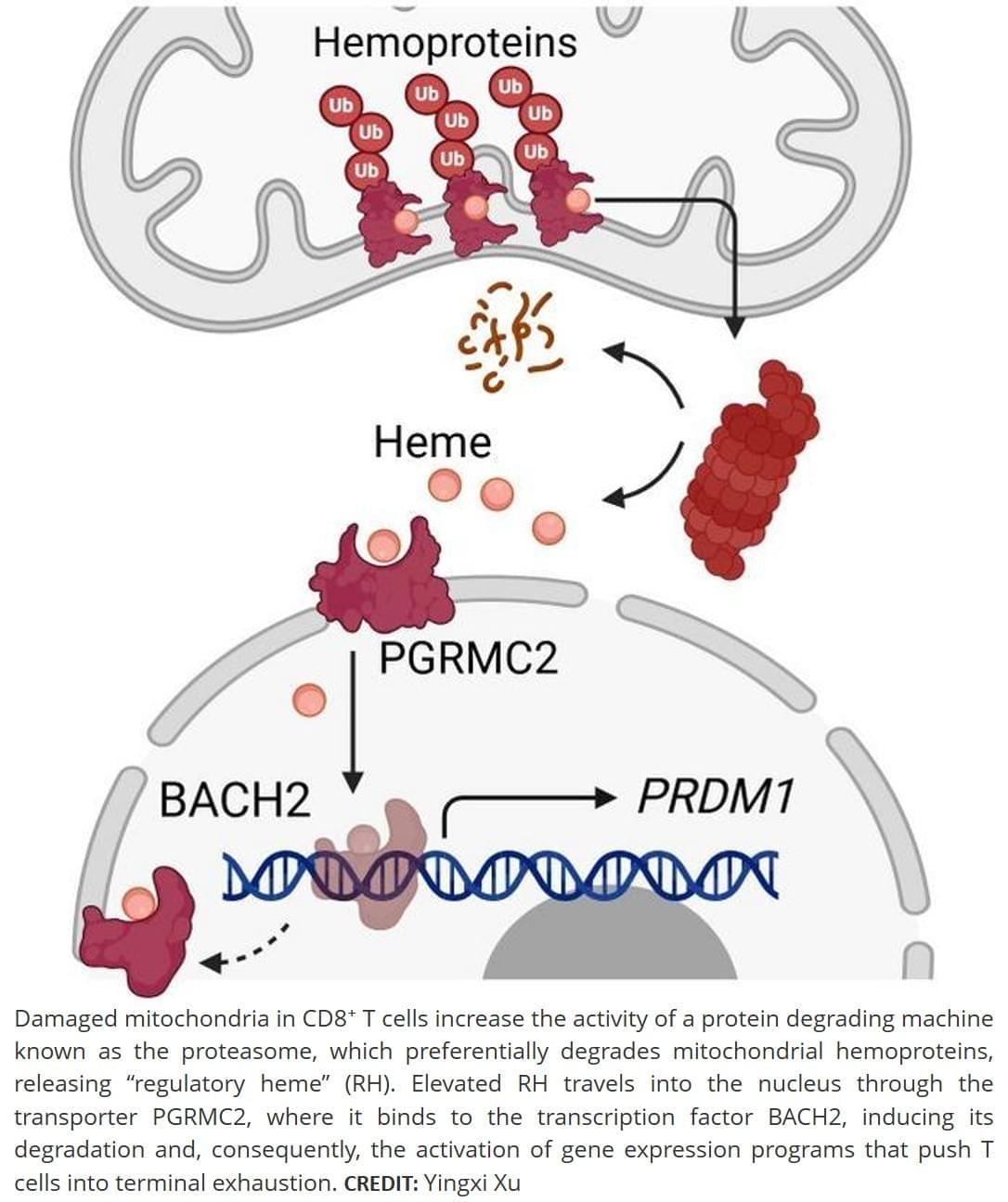
The researchers report in their paper that the glut of dysfunctional mitochondria enhances the activity of a cellular protein digesting machine, known as the proteasome, in T cells. The activated proteasome, they show, preferentially degrades mitochondrial heme-containing proteins.

As might be expected, this bias leads to quite the buildup of heme in the cells, resulting in the generation of a functionally distinct form of the molecule referred to as “regulatory heme,” which zips into the nucleus through a transporter named PGRMC2. There it binds to a transcription factor, a protein that regulates gene expression, causing its degradation. This kicks off a series of events that culminates in the activation of genetic programs known to induce terminal exhaustion.

The researchers show that genetic disruption of PGRMC2 abrogates this effect, keeping anti-tumor T cells in a functionally vibrant state, suggesting it is a potential drug target for the enhancement of T cell-activating cancer immunotherapies.

The researchers also examined how the pharmacological inhibition of the proteasome with an existing leukemia therapy, bortezomib, might affect CAR-T cells. Like bortezomib, CAR-T therapy is currently used to treat B cell acute lymphoblastic leukemia (B-ALL).

“We found that the transient and low-dose addition of bortezomib to CAR-T cell cultures during manufacturing reduces exhaustion-associated programs in the cells and induces durable reprogramming of their gene expression patterns to maintain them in a proliferative and functionally vibrant state,” said the author. ScienceMission sciencenewshighlights.
Mitochondria Delivery Method Rescues Parkinson’s in Mice

Scientists used red blood cells as membrane donors to encapsulate healthy mitochondria and send them into diseased cells, achieving improvements across multiple models and conditions [1].

The delivery problem

Mitochondrial diseases are a diverse group of disorders that arise when mitochondria malfunction. They are often caused by mutations in mitochondrial DNA (mtDNA) itself or in nuclear genes encoding mitochondria-related proteins.

Heat shock proteins as a promising breast cancer therapeutic

Heat shock proteins are emerging as potential targets in breast cancer research.

In Molecular & Cellular Proteomics, Tyelor Reynolds and colleagues determined that both NDNB1 and NDNB1182 display moderate selectivity for TNBC cells, and inhibition of Hsp90β using these inhibitors led to alterations in proteins associated with cell cycle functions, cell signaling pathways and DNA repair mechanisms.

➡️ Explore the findings:. ➡️ Read the paper: https://www.mcponline.org/article/S1535-9476(25)00142-2/fulltext MolCellProt BreastCancerResearch proteomics.


Researchers used a range of mass spectrometry-based techniques to identify how inhibition of select heat shock proteins impacts triple-negative breast cancer prognosis. This work unveiled isoform-specific targets on heat shock protein 90 which may be beneficial in therapeutic development.

Time Dilation Visualized

Check out Brilliant at https://brilliant.org/TheOverviewEffekt/. You can sign up for free and with that link and get a 20% discount on the annual premium subscription.

Relativsitic Calculator: https://www.overvieweffekt.com/tools/.

I do the relativistic math behind Project Hail Mary — time dilation, mass ratios, coast phases, and the relativsitic rocket equation with astrophage. How long would it take to reach Alpha Centauri, Tau Ceti, Betelgeuse, Andromeda, and the edge of the observable universe under constant 1.5G acceleration? We also look at Andy Weir’s mass ratio mistake, the astrophage infection range problem, and visualize the spread using the AT-HYG stellar catalog. Includes a interactive relativistic travel calculator on my website.

Software & Hardware I Use:
Blender https://www.blender.org/ (Free and Open Source)
Davinci Resolve https://www.blackmagicdesign.com/prod… (Free)
Nvidia RTX 4,070 https://amzn.to/4tfZNda.
AMD Ryzen 9 9950X https://amzn.to/4thtPNH

Mass Effect music from @MrHulthen Check it out and his channel here: https://youtu.be/8FT-oz9aZU4?si=7M-lEa0_7eXX_0Xo.

▀▀▀▀▀▀▀▀▀▀▀▀▀▀▀▀▀▀▀▀▀▀▀▀▀▀

The Aliens and Spaceships of Project Hail Mary (Explained)

With the movie project hail mary just out a few days back, we are here to discuss the alien species and the spaceships that appeared in the movie. If you have seen the trailer, you would know what Rocky is, but here we will discuss in detail about his species and two others that are key to the story.

Credits:
https://www.artstation.com/artwork/Ze • (old archive) Project Hail Mary ship — gra…

FAIR-USE COPYRIGHT DISCLAIMER Copyright Disclaimer under Section 107 of the Copyright Act 1976, allowance is made for “fair use” for purposes such as criticism, commenting, news reporting, teaching, scholarship, and research. Fair use is a use permitted by copyright statute that might otherwise be infringing. Non-profit, educational or personal use tips the balance in favour of fair use. Nutbug does not own the rights to these videos and pictures. They have, in accordance with fair use, been repurposed with the intent of educating and inspiring others. However, if any content owners would like their images removed, please contact us by email [email protected].
• (old archive) Project Hail Mary ship — gra…

Read more

Scientists observe atoms existing in two places at once for the first time

In a world-first, quantum physicists at ANU have observed atoms entangled in motion. Their experiment using helium atoms, represents a major advancement on similar experiments using photons, which are particles of light.

But unlike photons, helium atoms have mass and experience gravity.

Read the full article in Nature Communications:
https://www.nature.com/articles/s4146… development unlocks new ways to examine one of the biggest unanswered questions about the universe: how does the small-scale physics of quantum mechanics interact with gravity and general relativity at the universal scale? By observing quantum entanglement in atoms for the first time, are we one small step closer to finding out whether the “Theory of Everything” is not just hot air?

This development unlocks new ways to examine one of the biggest unanswered questions about the universe: how does the small-scale physics of quantum mechanics interact with gravity and general relativity at the universal scale?

By observing quantum entanglement in atoms for the first time, are we one small step closer to finding out whether the “Theory of Everything” is not just hot air?

For more visit https://science.anu.edu.au/

Black Holes May Not Be What We Thought

Brian Greene and physicist Samir Mathur explore one of the deepest puzzles in modern physics, the true nature of black holes and the fate of information in the universe.

Their conversation centers on the black hole information paradox, a problem that has challenged physicists for decades. If quantum mechanics says information can never be destroyed, how can black holes once thought to erase everything that falls into them be reconciled with that principle? Mathur introduces the fuzzball theory, a proposal from string theory suggesting that black holes are not empty regions but complex structures that preserve information.

Greene and Mathur also revisit key developments in black hole physics, from entropy and Hawking radiation to modern ideas like firewalls and wormholes. They reflect on why certain approaches may fall short and whether recent theoretical insights are bringing the paradox closer to resolution. This conversation offers an engaging look at how physicists are rethinking black holes, quantum gravity, and the fundamental structure of reality.

This program is part of the Rethinking Reality series, supported by the John Templeton Foundation.

Participant: Samir Mathur.
Moderator: Brian Greene.

#worldsciencefestival #briangreene #blackhole.

/* */