Toggle light / dark theme

Get the latest international news and world events from around the world.

Log in for authorized contributors

Hume on suicide

Anyone interested in the morality of suicide reads David Hume’s essay on the subject even today. There are numerous reasons for this, but the central one is that it sets up the starting point for contemporary debate about the morality of suicide, namely, the debate about whether some condition of life could present one with a morally acceptable reason for autonomously deciding to end one’s life. We shall only be able to have this debate if we think that at least some acts of suicide can be moral, and we shall only be able to think this if we give up the blanket condemnation of suicide that theology has put in place. I look at this strategy of argument in the context of the wider eighteenth-century attempt to develop a non-theologically based ethic. The result in Hume’s case is a very modern tract on suicide, with voluntariness and autonomy to the fore and with reflection on the condition of one’s life and one’s desire to carry on living a life in that condition the motivating circumstance.

JWST Just Found Something That Shocked Scientists

The release of the 2026 dark matter map marks a definitive shift in how we approach the cosmos. For decades, we were in the hunting phase, trying to prove that dark matter existed and attempting to catch a single particle in a laboratory. While we still haven’t touched a dark matter particle, we have moved into the surveying phase. We are no longer asking if it is there; we are busy measuring its dimensions, its density, and its influence on the growth of everything we can see. This map of the Sextans field is essentially the first page in a new atlas of the invisible universe.

▀▀▀▀▀▀
Timestamps:
0:00 Dark Matter.
1:05 The Cosmic Lens.
4:20 The COSMOS-Web Survey.
7:15 Mapping the Filaments.
10:22 Beyond the Standard Model.
13:15 The Architect of Life.

▀▀▀▀▀▀
Fexl Spanish: / @fexl_es.
Fexl Portuguese: / @fexlpt.
Fexl Ukraine: / @fexl_ua.

▀▀▀▀▀▀
References:
Nature Astronomy (January 2026): An ultra-high-resolution map of (dark) matter: https://www.nature.com/articles/s4155… Pre-print (Technical Breakdown): COSMOS-Web: The ultra-deep weak lensing survey: https://arxiv.org/abs/2601.17239 NASA Webb Mission Page: Webb Unveils the Dark Matter Scaffolding of the Universe: https://www.nasa.gov/missions/webb/na… COSMOS-Web Collaboration Official Site: https://cosmos.astro.caltech.edu/ NASA JPL Press Release: Seeing the Unseen: 800,000 Galaxies Mapped: https://www.jpl.nasa.gov/news/nasa-re… #fexl #space #jwst.

ArXiv Pre-print (Technical Breakdown): COSMOS-Web: The ultra-deep weak lensing survey: https://arxiv.org/abs/2601.

Bart D. Ehrman

In this episode of MythVision, we dive into one of the most intense debates in New Testament textual criticism.

If we have more manuscripts of the New Testament than any other ancient book — why do scholars estimate up to 500,000 textual variants?

Are we actually close to the original text?
Do the Gospels contradict each other?
Do these differences matter — or are they just minor copying mistakes?

In this discussion we explore:

The “embarrassment of riches” argument.

The variant reading “Today I have begotten you” (Luke 3:22)

Finally Released! The James Webb Telescope Has Found The Object That Holds Our Universe Together

#jameswebbspacetelescope #jwst.
Finally Released! The James Webb Telescope Has Found The Object That Holds Our Universe Together.

Containing nearly 800,000 galaxies, this image from NASA’s James Webb Space Telescope is overlaid with a map of dark matter, represented in blue. Researchers used Webb data to find the invisible substance via its gravitational influence on regular matter.

You see, Scientists using data from NASA’s James Webb Space Telescope have made one of the most detailed, high-resolution maps of dark matter ever produced. It shows how the invisible, ghostly material overlaps and intertwines with “regular” matter, the stuff that makes up stars, galaxies, and everything we can see.

Published Monday, Jan. 26, in Nature Astronomy, the map builds on previous research to provide additional confirmation and new details about how dark matter has shaped the universe on the largest scales — galaxy clusters millions of light-years across — that ultimately give rise to galaxies, stars, and planets like Earth.

💼 Business Inquiries and Contact.
• For business inquiries, copyright matters or other inquiries please contact us at: [email protected].

⚠️ Copyright Disclaimers.

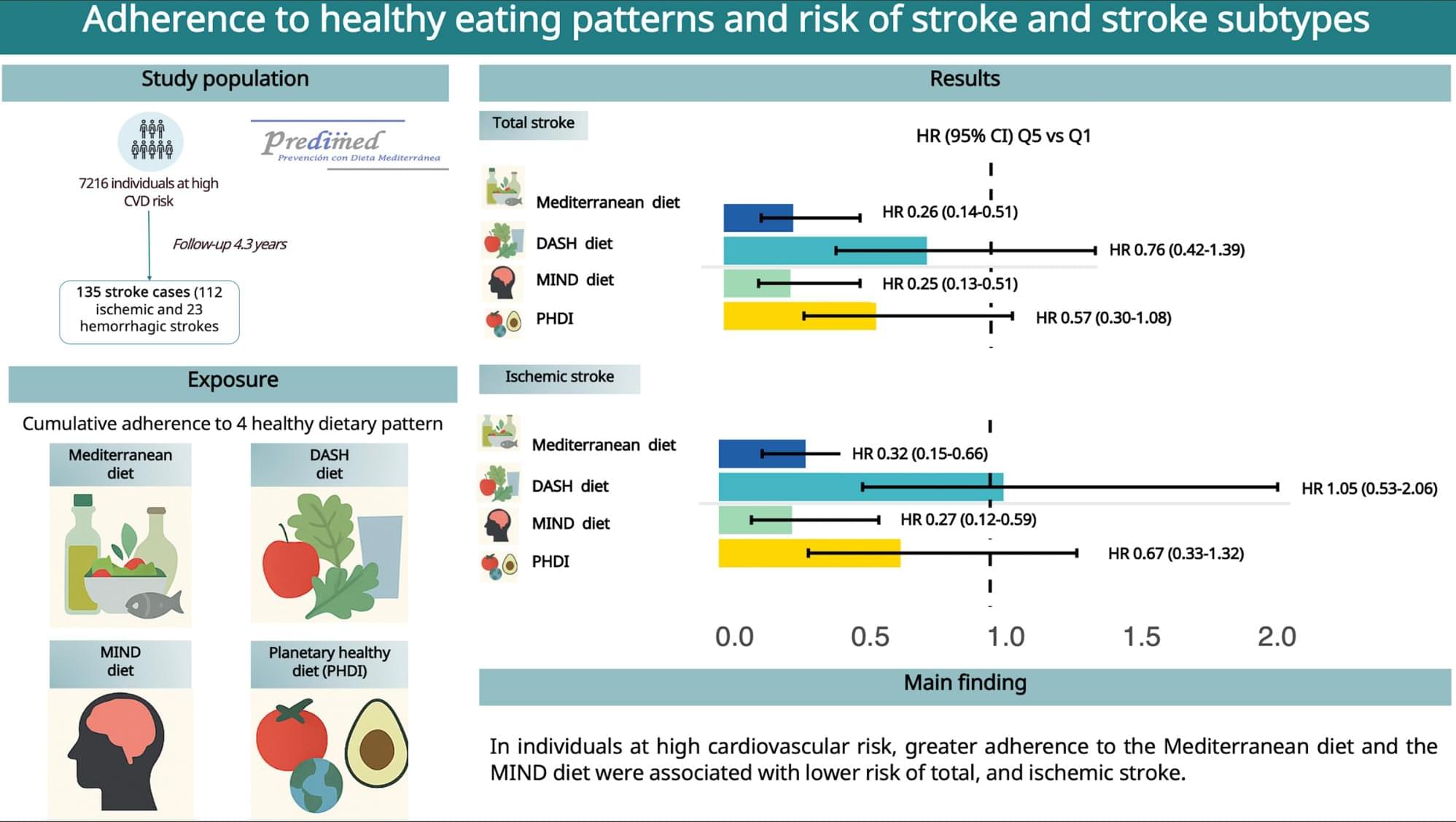
Adherence to Different Dietary Patterns and Subsequent Risk of Total, Ischemic, and Hemorrhagic Stroke

In people with elevated cardiovascular risk at baseline, adherence to the Mediterranean and Mediterranean-DASH Diet Intervention for Neurodegenerative Delay diets was associated with a lower risk of stroke.


BACKGROUND: Adherence to healthy dietary patterns has been related to lower cardiovascular disease risk. However, few studies have examined prospective associations between adherence to different healthy dietary scores and the incidence of stroke and its subtypes. The aim of this study was to prospectively examine the associations between adherence to 4 recognized healthy dietary patterns and the risk of total and ischemic stroke in an existing dietary-based randomized controlled trial. METHODS: This is a secondary observational cohort analysis of 7,447 participants at high cardiovascular disease risk enrolled in the PREDIMED trial (Prevención Con Dieta Mediterranea).

What Can 50-Year-Old Chatbots Teach Us About Clinical Applications of AI?

Can a large language model (LLM) provide insights on the history of chatbots and their clinical applications? 🤖

In this episode of JAMA+ AI Conversations, JAMA+ AI Editor in Chief Roy Perlis, MD, MSc, interviews OpenAI’s ChatGPT (GPT-4o, voice mode) about the development and legacy of the first clinical chatbots, ELIZA and PARRY.

The discussion explores differing perspectives of their creators, as well as how foundational debates about technology and ethics continue to inform the present landscape of AI in mental health care.

🎧 Listen now.


JAMA+ AI Editor in Chief Roy Perlis, MD, MSc, conducted an interview with ChatGPT about the history of chatbots and their clinical applications, for JAMA+ AI Conversations.

Living ‘Mini Brains’ Meet Next-Generation Bioelectronics

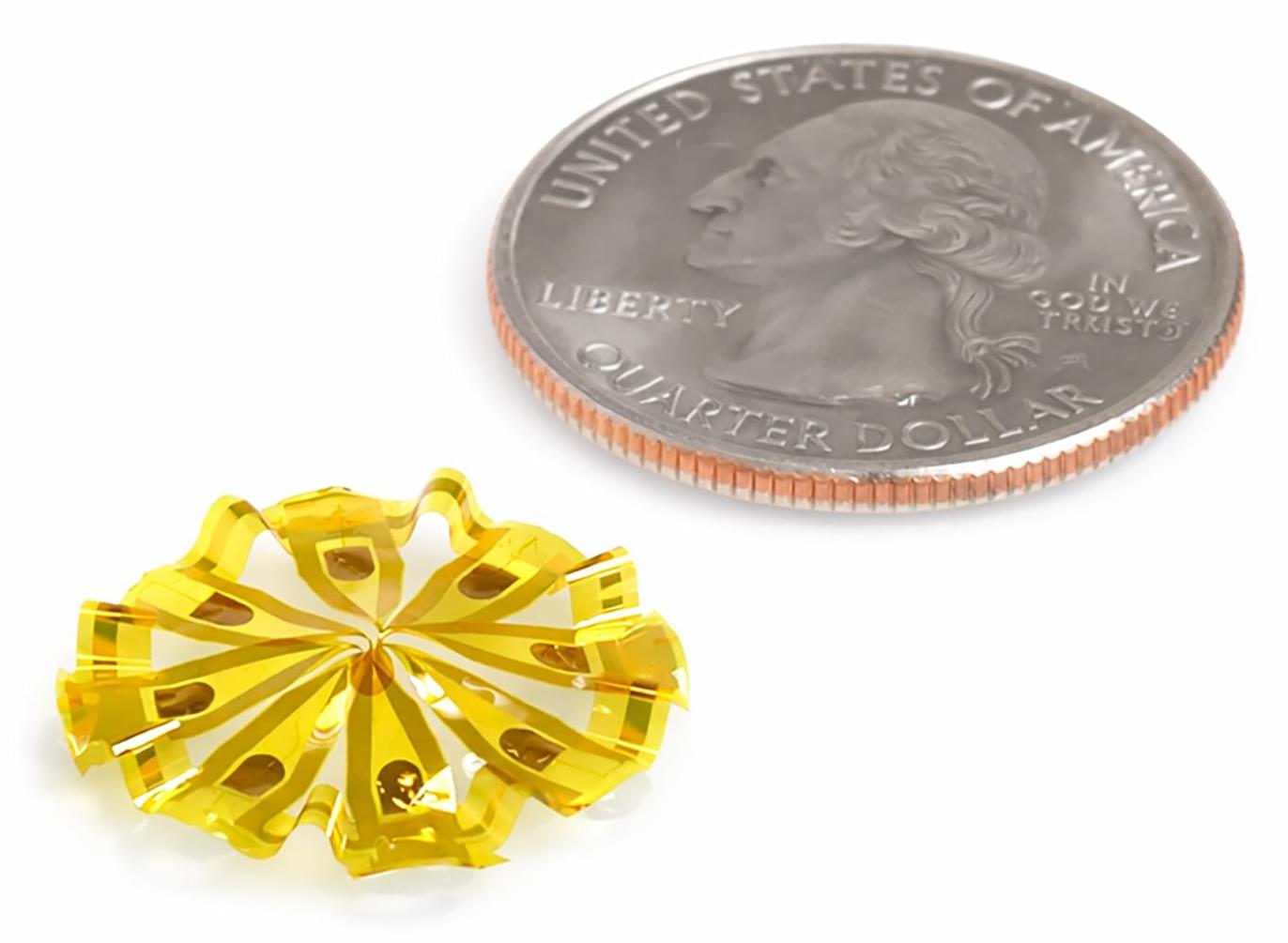
A team led by Northwestern University and Shirley Ryan AbilityLab scientists have developed a new technology that can eavesdrop on the hidden electrical dialogues unfolding inside miniature, lab-grown human brain-like tissues, according to a study published the journal Nature Biomedical Engineering.

Known as human neural organoids — and sometimes called “mini brains” — these millimeter-sized structures are powerful models of brain development and disease. But until now, scientists could only record and stimulate activity from a small fraction of their neurons — missing network-wide dynamics that give rise to coordinated rhythms, information processing and the complex patterns of activity that define brain function.

For the first time, the new technology overcomes that stubborn limitation. The soft, three-dimensional (3D) electronic framework wraps around an organoid like a breathable, high-tech mesh. Rather than sampling select regions, it delivers near-complete, shape-conforming coverage with hundreds of miniaturized electrodes. That dense, three-dimensional interfacing enables scientists to map and manipulate neural activity across almost the entire organoid.

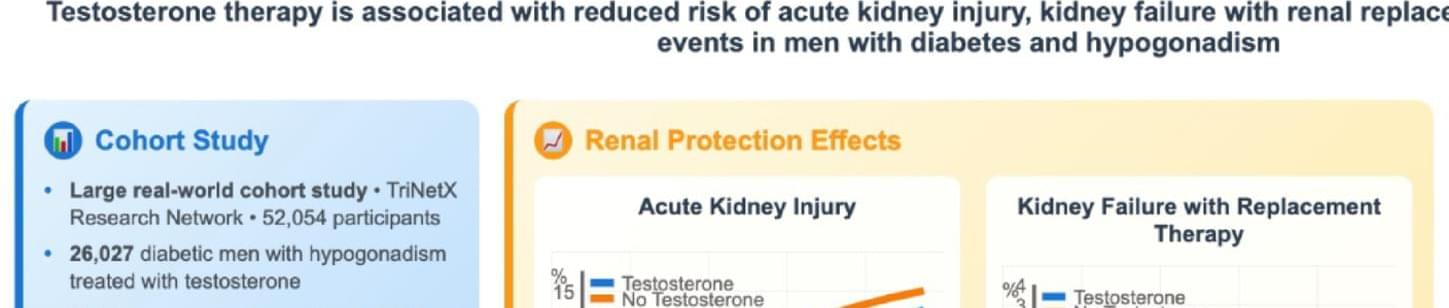
Testosterone therapy is associated with reduced risk of acute kidney injury, kidney failure with renal replacement therapy, and cardiovascular events in men with diabetes and hypogonadism

Testosterone deficiency is common in men with diabetes. Effects of testosterone therapy on kidney failure and cardiovascular outcomes in diabetic men remain poorly understood. Our aim was to assess whether testosterone therapy is associated with reduced risk of acute kidney injury and kidney failure requiring replacement therapy in men with diabetes and hypogonadism compared to matched untreated men with diabetes.

Participants were recruited from the TriNetX Research Collaborative network. We identified 26,027 diabetic men with hypogonadism treated with testosterone and matched them 1:1 using propensity score matching to 26,027 untreated diabetic men with hypogonadism. Primary outcomes were acute kidney injury and kidney failure requiring replacement therapy (dialysis or transplantation). Secondary outcomes included myocardial infarction, ischemic stroke, atrial fibrillation, and all-cause mortality. Cox proportional hazard models were used over a mean follow-up of 3.3 years.

Men had a mean age of 58 years (SD 12), with 71% being non-Hispanic White. Testosterone-treated men had significantly lower risk of acute kidney injury (HR: 0.93 [95% CI 0.87–0.98], p = 0.01) and kidney failure with replacement therapy (HR: 0.81 [95% CI 0.72–0.92], p = 0.001) compared to untreated men. Testosterone therapy was also associated with reduced risk of myocardial infarction (HR: 0.85 [95% CI 0.78–0.93], p 0.0001), ischemic stroke (HR: 0.88 [95% CI 0.80–0.97], p = 0.01), atrial fibrillation (HR: 0.91 [95% CI 0.85–0.98], p = 0.01), and all-cause mortality (HR: 0.85 [95% CI 0.79–0.91], p 0.0001).

/* */