Toggle light / dark theme

Get the latest international news and world events from around the world.

Log in for authorized contributors

How noise limits today’s quantum circuits

Imagine you’re trying to build a very long, complicated chain of dominoes. The aim is that each domino hits the next one perfectly, all the way down the line, producing an amazing result at the end. A quantum circuit is like a domino chain: a long chain of tiny steps (“operations”) that work together to process information together in a powerful way.

Now imagine that every domino is a little wobbly. In the quantum circuit, that wobble is called “noise.” It might not look like much—after all, all regular systems are subjected to some kind of “noise”—but noise in quantum circuits can accumulate and build up to a crescendo of problems.
Ytterbium atomic clock could open a new window on fundamental physics

For the first time, an international team of physicists has successfully harnessed a rare orbital transition in atoms of ytterbium to create a new type of atomic clock that is both highly precise and extremely sensitive to fundamental physical effects. Publishing their results in Nature Photonics, the researchers, led by Taiki Ishiyama at Kyoto University, say their approach could pave the way for some of the most stringent tests yet of predictions made by the Standard Model.

To measure the passing of time, an atomic clock excites an electron in confined atoms to a higher energy level, then interrogates the transition frequency of the atoms. Because these oscillations display such little variation, atomic clocks are the most accurate timekeepers ever developed.

To date, the most precise devices involve atoms trapped in an optical lattice: a periodic array of light and darkness created by interfering laser beams. These clocks operate at optical frequencies with hundreds of trillions of oscillations per second—far surpassing the microwave frequencies used in previous atomic clock designs. Already, this extraordinary precision has enabled sensitive tests of fundamental physics, as described by the Standard Model.

Gravity from positivity: Single massive spin-3/2 particle makes gravity logically inevitable, study claims

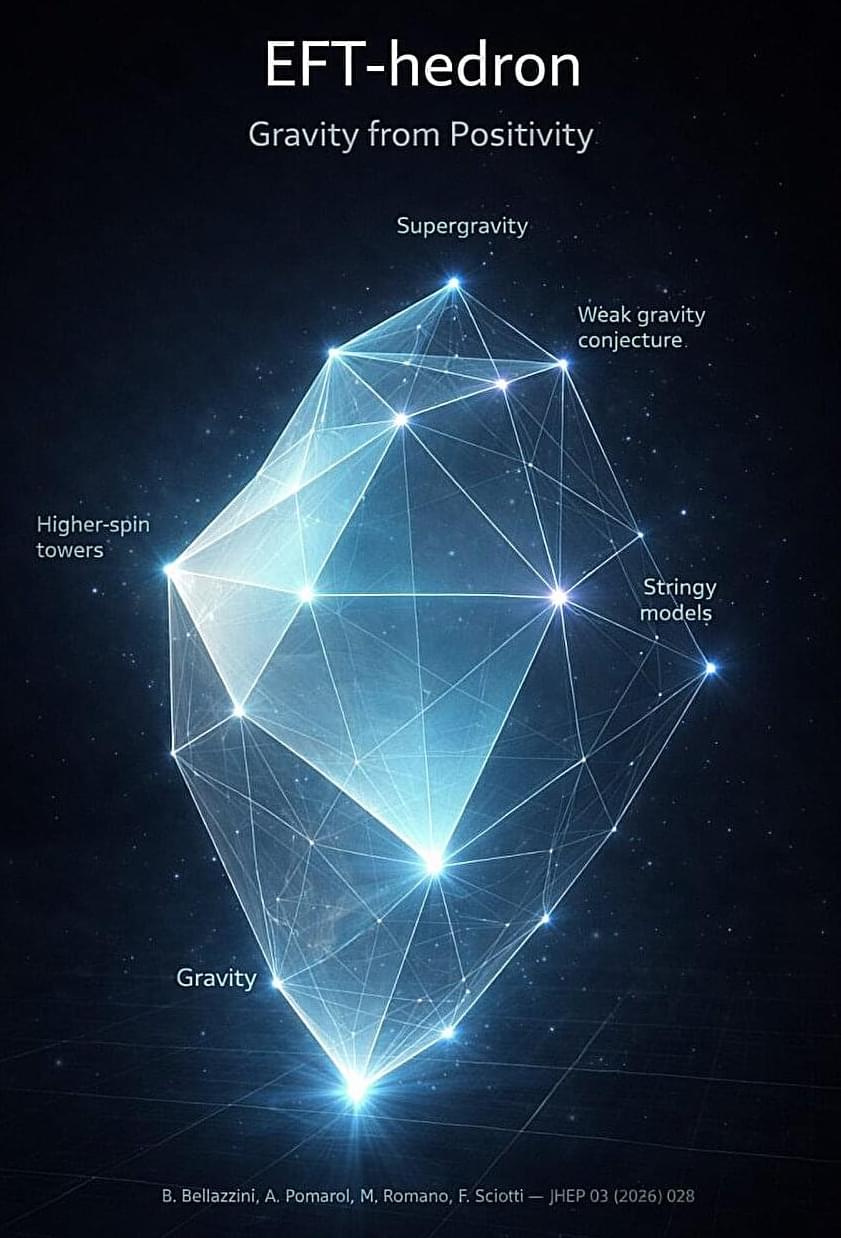
Researchers at IPhT (CEA, CNRS) and the Universitat Autònoma de Barcelona have shown that gravity—and with it, supersymmetry—emerge as logical necessities whenever a massive spin-3/2 particle exists in nature. Two principles are enough: causality, the fact that no signal can travel faster than light, and unitarity, the requirement that probabilities are conserved in quantum mechanics. The structure of supergravity is not assumed: it bootstraps itself.

In fundamental physics, gravity is usually thought of as an ingredient one adds to a theory. But could it instead be forced by the internal consistency of the quantum world? This is what a study published in the Journal of High Energy Physics demonstrates.

The starting point is disarmingly simple: a single massive spin-3/2 particle. The authors show that such a particle simply cannot exist in isolation within a consistent theory. Its scattering amplitudes grow too fast with energy, clashing with positivity inequalities—the mathematical encoding of causality (the speed of light as an absolute limit) and unitarity (the conservation of probabilities in every quantum process). The theory breaks down barely above the particle’s own mass.

Underground lab clears crucial hurdle for dark matter hunt

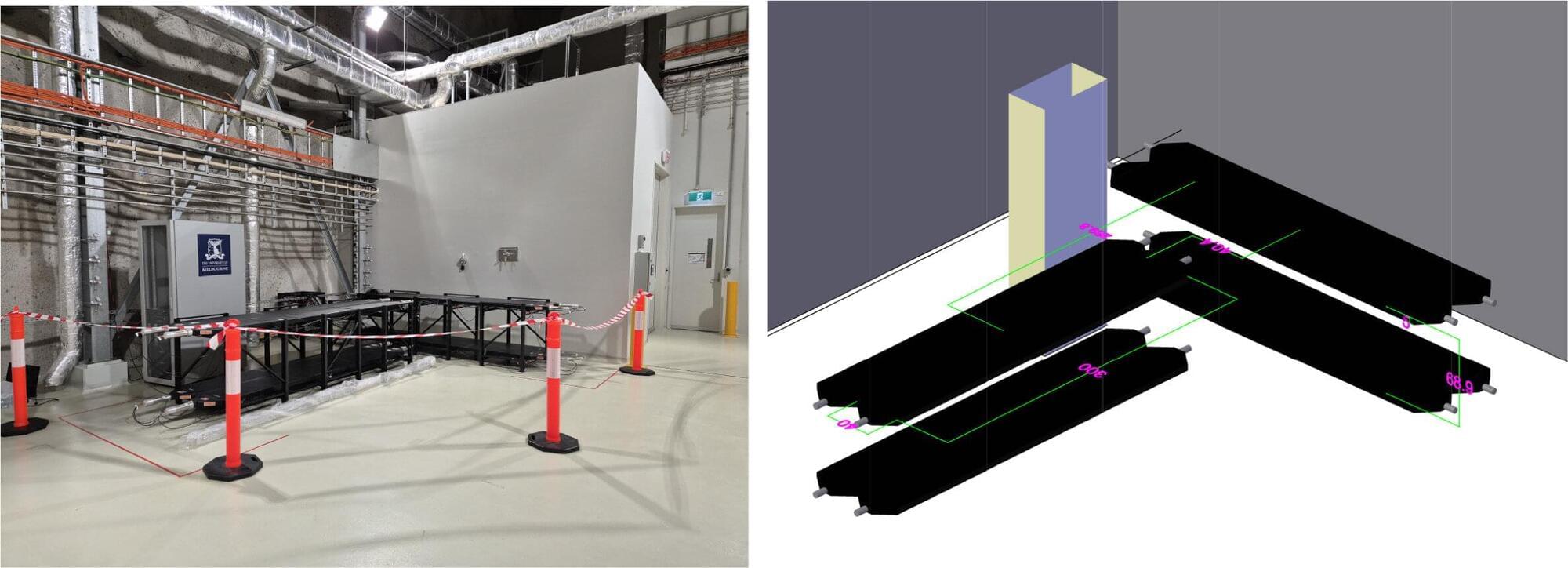
Australia’s bid to detect elusive dark matter has taken a major step forward, with new research confirming that cosmic radiation levels deep inside the Stawell Underground Physics Laboratory (SUPL) are low enough to support the world-class experiment that will commence later this year.

ARC Center of Excellence for Dark Matter Particle Physics researchers recorded muon —or cosmic radiation—levels inside and outside the laboratory for more than a year. They detected 30,000 muons inside the underground laboratory, while 8.4 billion muons would be expected to be detected on the surface of Earth.

The SABRE Collaboration paper, published in Astroparticle Physics, is the first to use data collected in SUPL, marking a major achievement for Australian and international scientists involved in the project.

Compact flat-lens system can generate nondiffracting bottle beams

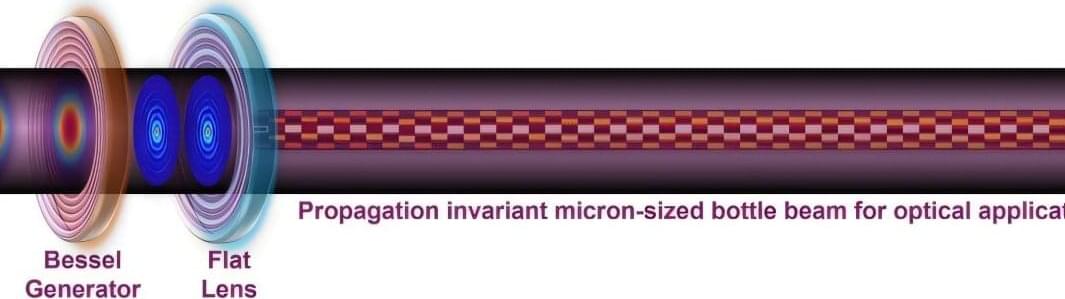
Most laser sources produce Gaussian beams that diverge as they propagate. This natural spreading limits their effectiveness in applications that require light to remain concentrated over long distances. To overcome this challenge, structured light beams have been developed, whose amplitude, phase, and polarization can be carefully controlled.

Among these are Bessel beams, which are generated by the self-interference of laser beams as they propagate through space. However, ideal Bessel beams possess complex ring structures that complicate their practical use. Additionally, existing methods for generating advanced beam shapes, such as optical bottle beams, often involve complex and expensive setups that necessitate precise alignment.

Now, researchers at Chiba University, Japan, have developed a simple and compact method to generate a laser chain beam that remains nondiffracting during free-space propagation.

Novel approach to quantum error correction portends a scalable future for quantum computing

A University of Sydney quantum physicist has developed a new approach to quantum error correction that could significantly reduce the number of physical qubits required to build large-scale, fault-tolerant quantum computers. The study, co-authored by Dr. Dominic Williamson from the School of Physics, is titled “Low-overhead fault-tolerant quantum computation by gauging logical operators” and published in Nature Physics.

The work was done while Dr. Williamson was on a sabbatical working at global technology firm IBM in California. Elements of the new design have been integrated into IBM’s plan to build large-scale quantum computing.

“We’re at a point where theory and experiment are beginning to align,” Dr. Williamson said. “The big question now is how to design quantum computers that can be scaled efficiently to solve useful problems. Our work provides a promising blueprint.”

Quantum coherence could be preserved at large scales in realistic environments

Quantum states are notoriously fragile, and can be destroyed simply through interactions, measurements, and exposure to their surrounding environments. In a new theoretical study published in Physical Review X, Rohan Mittal and colleagues at the University of Cologne have discovered a new way to protect quantum behavior on large scales within systems driven far from equilibrium. Their results could have promising implications for the design of more robust quantum devices.

When quantum many-body systems are driven out of equilibrium, they undergo decoherence, causing quantum correlations and superpositions to break down. Even when such a system is built from entirely quantum components, the effect can cause its behavior to become indistinguishable from that of a classical system on larger scales, making it unsuitable for technologies such as quantum computing or sensing.

So far, researchers have attempted to solve the decoherence problem by fine-tuning two independent parameters: one to push the system to the boundary between two distinct quantum phases, and another to ensure that quantum coherence is maintained at this boundary. In practice, however, the need to account for two parameters simultaneously has made this approach both fragile and experimentally daunting.

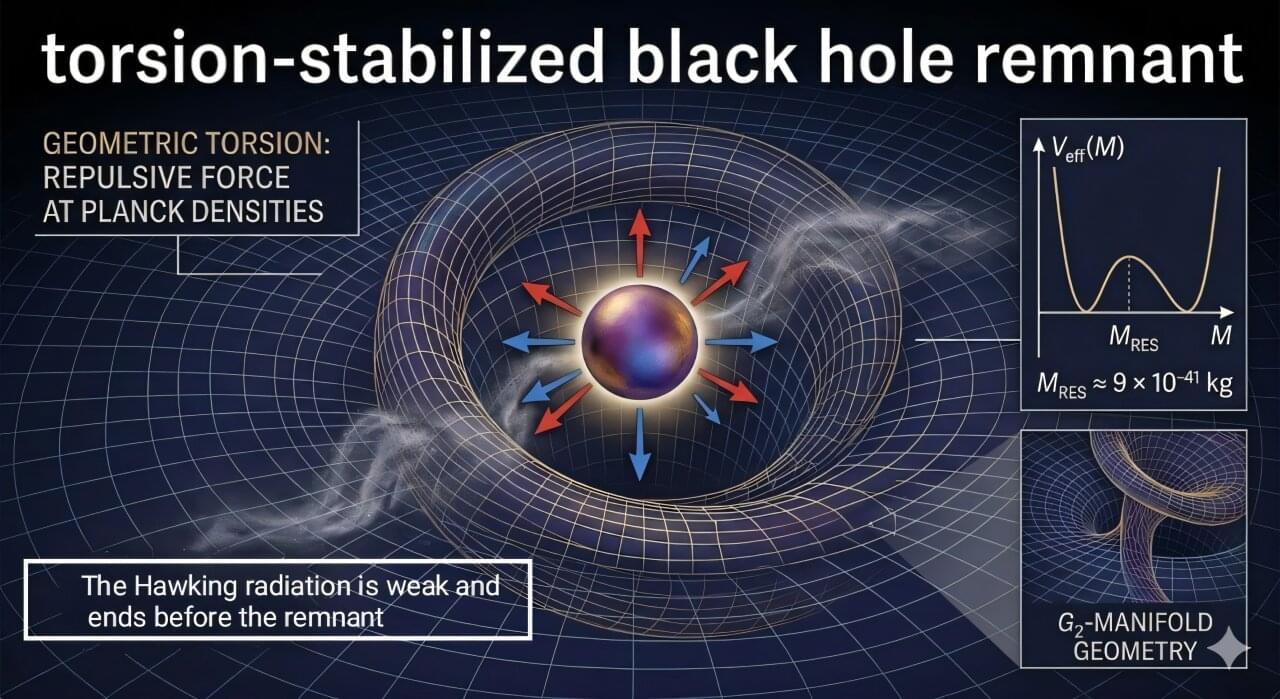
The secrets of black holes and the Higgs mass could be hidden in a 7-dimensional geometry

One of the greatest mysteries of modern physics, the “black hole information paradox,” might have finally found an elegant solution, and the answer could also reveal the origins of the mass of fundamental particles.

In the 1970s, Stephen Hawking demonstrated, through semi-classical calculations, that black holes are not truly black, but emit a weak radiation that causes them to gradually shrink until they disappear.

This process, however, brings with it a massive problem: it seems to cause an irreversible loss of information, violating the unitarity principle of quantum mechanics. In other words, the laws of quantum physics state that information cannot be destroyed, but the evaporation of a black hole suggests otherwise.

A tiny detector for microwave photons could advance quantum tech

Detecting a single particle of light is hard; detecting a single microwave photon is even harder. Microwave photons, the tiny packets of electromagnetic radiation used in current technologies like Wi-Fi and radar, carry far less energy than visible light. They are about 100,000 times weaker than optical photons.

Many existing quantum technologies depend on detecting individual photons with high reliability. For visible light, this is well established using devices that convert incoming light directly into electrical signals. But at microwave frequencies (0.3–30 GHz), this fails because each individual photon doesn’t carry enough energy to release an electric charge into a material. This means that detecting single microwave photons requires a completely different strategy.

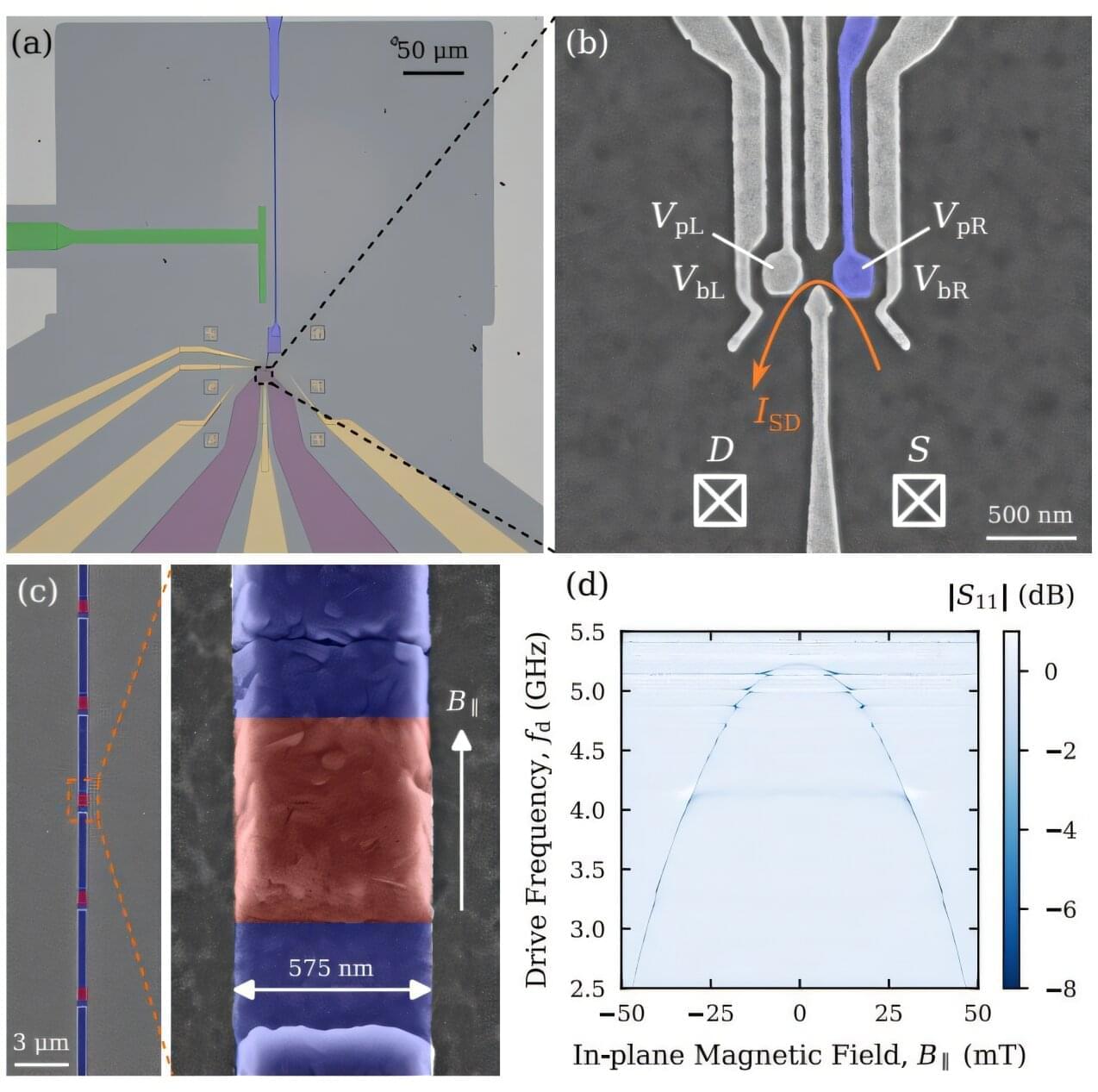
A long-standing goal has been to realize a simple device capable of continuously detecting microwave photons. Now, scientists at EPFL, led by Pasquale Scarlino, have developed a semiconductor-based detector that takes an important step in that direction.

The most pristine star yet found in the known universe

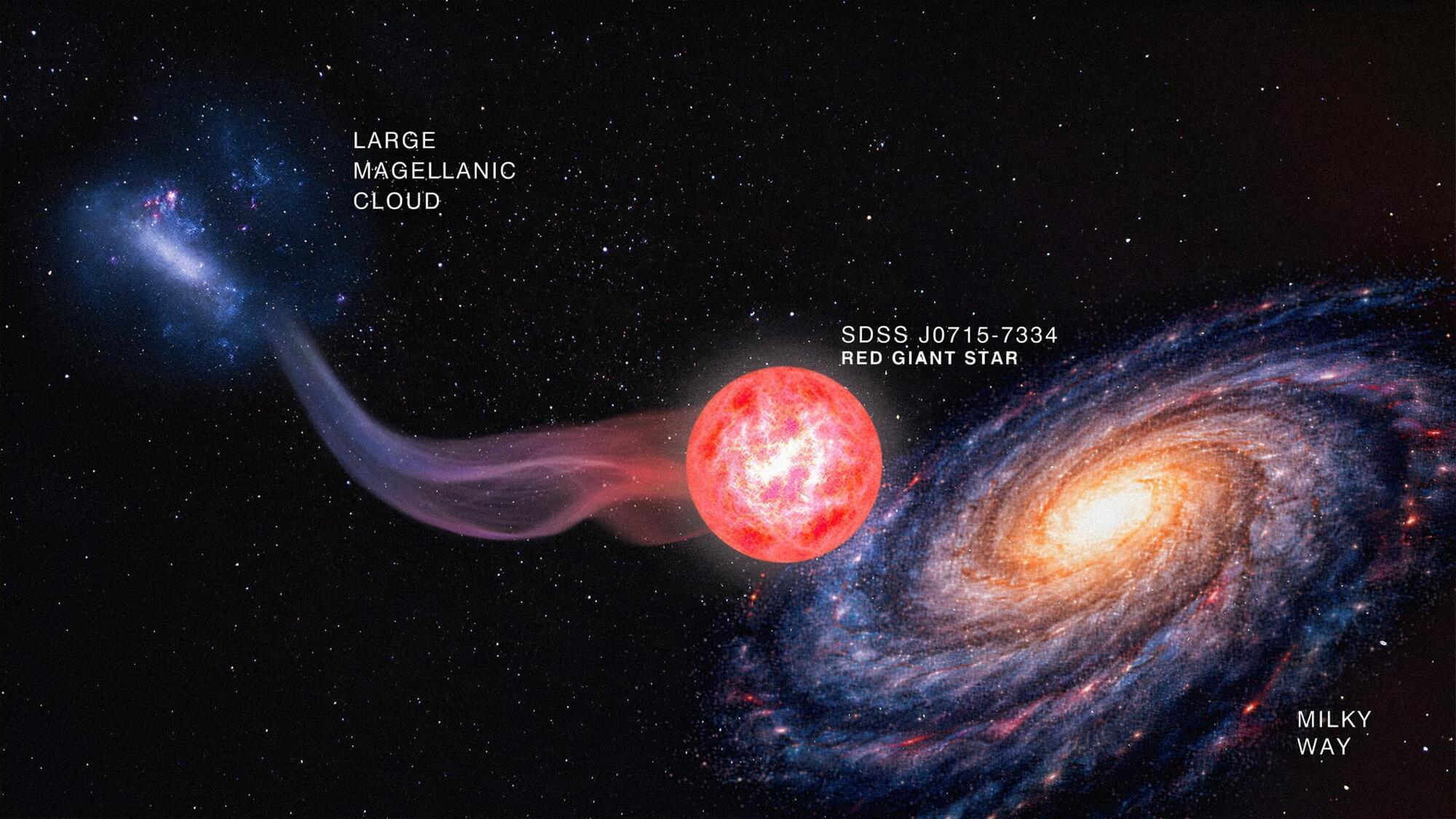
An unusual team of astronomers used Sloan Digital Sky Survey-V (SDSS-V) data and observations on the Magellan telescopes at Carnegie Science’s Las Campanas Observatory in Chile to discover the most pristine star in the known universe, called SDSS J0715-7334. Their work is published in Nature Astronomy.

Led by the University of Chicago’s Alexander Ji—a former Carnegie Observatories postdoctoral fellow—and including Carnegie astrophysicist Juna Kollmeier—who leads SDSS, now in its fifth generation—the research team identified a star from just the second generation of celestial objects in the cosmos, which formed just a few billion years after the universe began.

“These pristine stars are windows into the dawn of stars and galaxies in the universe,” Ji explained. Several of his and Kollmeier’s co-authors on the paper are undergraduate students from UChicago, whom Ji brought to Las Campanas on an observing trip for spring break last year. “My first visit to LCO is where I really fell in love with astronomy, and it was special to share such a formative experience with my students.”

/* */