Toggle light / dark theme

Get the latest international news and world events from around the world.

Log in for authorized contributors

A direct leap into terahertz: Dirac materials enable efficient signal conversion at room temperature

Highspeed Internet, autonomous driving, the Internet of Things: data streams are proliferating at enormous speed. But classic radio technology is reaching its limits: the higher the data rate, the faster the signals need to be transmitted.

Researchers at the Helmholtz-Zentrum Dresden-Rossendorf (HZDR) have now demonstrated that weak radio signals can be efficiently converted into significantly higher frequencies using this material that is just several tens of nanometers thick. And at room temperature, at that. The results open up prospects for future generations of mobile communications and high-resolution sensor technology. The paper is published in the journal Communications Physics.

The more data to be transmitted simultaneously, the higher the carrier frequency must be. As a result, research is now delving into the terahertz range. This frequency spectrum lies outside the microwave range currently used and, so far, has been difficult to access technologically.

Magnetism switching in antiferromagnets: Two distinct mechanisms successfully visualized

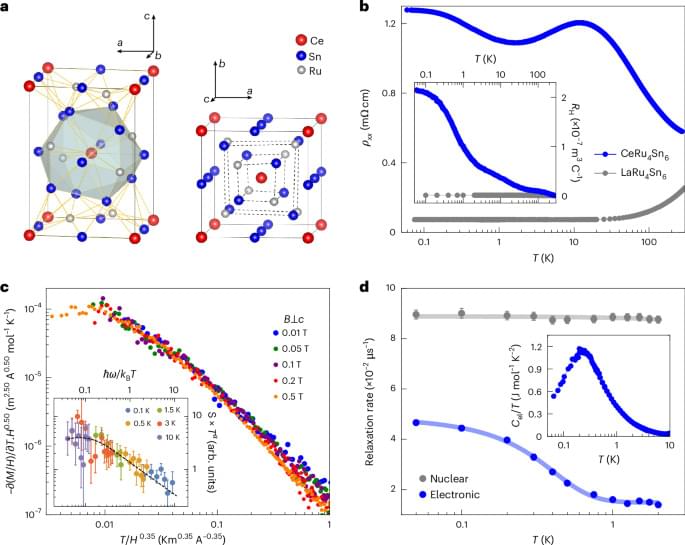
A research team led by Ryo Shimano of the University of Tokyo has successfully visualized two distinct mechanisms through which up and down spins, inherent properties of electrons, switch in an antiferromagnet, a material in which spin alignments cancel each other out. One of the visualized mechanisms provides a working principle for developing ultrafast, non-volatile magnetic memory and logic devices, which could be much faster than today’s technologies.

The findings are published in the journal Nature Materials.

Paper slips with holes, small metal rods, vacuum tubes, and transistors: These are technologies that have been used to encode 0s and 1s, the basis of classical computation. However, the world’s ever-growing computational needs demand yet more powerful tools. Antiferromagnets are a class of materials whose magnetic properties, or lack thereof, could be leveraged to encode 0s and 1s in a novel way.

Tiny Earthquakes Spark a Microbial Awakening Beneath Yellowstone

Researchers studying Yellowstone’s depths discovered that small earthquakes can recharge underground microbial life.

The quakes exposed new rock and fluids, creating bursts of chemical energy that microbes can use. Both the water chemistry and the microbial communities shifted dramatically in response. This dynamic may help explain how life survives in deep, dark environments.

A large portion of earth’s life lives underground.

Contractors with hacking records accused of wiping 96 govt databases

U.S. prosecutors have charged two Virginia brothers arrested on Wednesday with allegedly conspiring to steal sensitive information and destroy government databases after being fired from their jobs as federal contractors.

Twin brothers Muneeb and Sohaib Akhter, both 34, were also sentenced to several years in prison in June 2015, after pleading guilty to accessing U.S. State Department systems without authorization and stealing personal information belonging to dozens of co-workers and a federal law enforcement agent who was investigating their crimes.

Muneeb Akhter also hacked a private data aggregation company in November 2013 and the website of a cosmetics company in March 2014.

Critical React, Next.js flaw lets hackers execute code on servers

A maximum severity vulnerability, dubbed ‘React2Shell’, in the React Server Components (RSC) ‘Flight’ protocol allows remote code execution without authentication in React and Next.js applications.

The security issue stems from insecure deserialization. It received a severity score of 10/10 and has been assigned the identifiers CVE-2025–55182 for React and CVE-2025–66478 (CVE rejected in the National Vulnerability Database) for Next.js.

Security researcher Lachlan Davidson discovered the flaw and reported it to React on November 29. He found that an attacker could achieve remote code execution (RCE) by sending a specially crafted HTTP request to React Server Function endpoints.

Hackers are exploiting ArrayOS AG VPN flaw to plant webshells

Threat actors have been exploiting a command injection vulnerability in Array AG Series VPN devices to plant webshells and create rogue users.

Array Networks fixed the vulnerability in a May security update, but has not assigned an identifier, complicating efforts to track the flaw and patch management.

An advisory from Japan’s Computer Emergency and Response Team (CERT) warns that hackers have been exploiting the vulnerability since at least August in attacks targeting organizations in the country.

/* */