JUST PUBLISHED:
As humanity expands into space, we’ll need new ways to grow food. Explore how orbital farms could sustain billions—on Earth, Mars, and beyond.
Checkout Scav: https://go.nebula.tv/scav?ref=isaacar… Watch my exclusive video Autonomous Space Industry: https://nebula.tv/videos/isaacarthur–… Nebula using my link for 40% off an annual subscription: https://go.nebula.tv/isaacarthur Grab one of our new SFIA mugs and make your morning coffee a little more futuristic — available now on our Fourthwall store! https://isaac-arthur-shop.fourthwall… Visit our Website: http://www.isaacarthur.net Join Nebula: https://go.nebula.tv/isaacarthur Support us on Patreon: / isaacarthur Support us on Subscribestar: https://www.subscribestar.com/isaac-a… Facebook Group:
/ 1,583,992,725,237,264 Reddit:
/ isaacarthur Twitter:
/ isaac_a_arthur on Twitter and RT our future content. SFIA Discord Server:
/ discord Credits: Orbital Farms — Extended Edition Episode 471a; November 1, 2024 Produced, Narrated & Written: Isaac Arthur Graphics: Jarred Eagley Jeremy Jozwik Katie Byrne Ken York YD Visual Udo Schroeter Select imagery/video supplied by Getty Images Music Courtesy of Epidemic Sound http://epidemicsound.com/creator.
Watch my exclusive video Autonomous Space Industry: https://nebula.tv/videos/isaacarthur–…
Get Nebula using my link for 40% off an annual subscription: https://go.nebula.tv/isaacarthur.
Grab one of our new SFIA mugs and make your morning coffee a little more futuristic — available now on our Fourthwall store! https://isaac-arthur-shop.fourthwall…
Visit our Website: http://www.isaacarthur.net.
Join Nebula: https://go.nebula.tv/isaacarthur.
Support us on Patreon: / isaacarthur.
Support us on Subscribestar: https://www.subscribestar.com/isaac-a…
Facebook Group: / 1583992725237264
Reddit: / isaacarthur.
Twitter: / isaac_a_arthur on Twitter and RT our future content.
SFIA Discord Server: / discord.
Credits:
Orbital Farms — Extended Edition.
Episode 471a; November 1, 2024
Produced, Narrated & Written: Isaac Arthur.
Graphics:
Jarred Eagley.
Jeremy Jozwik.
Katie Byrne.
Ken York YD Visual.
Udo Schroeter.
Select imagery/video supplied by Getty Images.
Music Courtesy of Epidemic Sound http://epidemicsound.com/creator
Layoffs, consolidation, streaming losses, artificial intelligence and the rise of the creator economy are reshaping Hollywood, raising questions about whether the industry is just hitting a rough patch or in terminal decline.
#hollywood #film #tv ——– Like this video? Subscribe: https://www.youtube.com/Bloomberg?sub_confirmation=1
Get unlimited access to Bloomberg.com for just $1.99 your first month: https://www.bloomberg.com/subscriptions?in_source=YoutubeOriginals Bloomberg Originals offers bold takes for curious minds on today’s biggest topics. Hosted by experts covering stories you haven’t seen and viewpoints you haven’t heard, you’ll discover cinematic, data-led shows that investigate the intersection of business and culture. Exploring every angle of climate change, technology, finance, sports and beyond, Bloomberg Originals is business as you’ve never seen it.
Subscribe for business news, but not as you’ve known it: exclusive interviews, fascinating profiles, data-driven analysis, and the latest in tech innovation from around the world.
Visit our partner channel Bloomberg News for global news and insight in an instant.
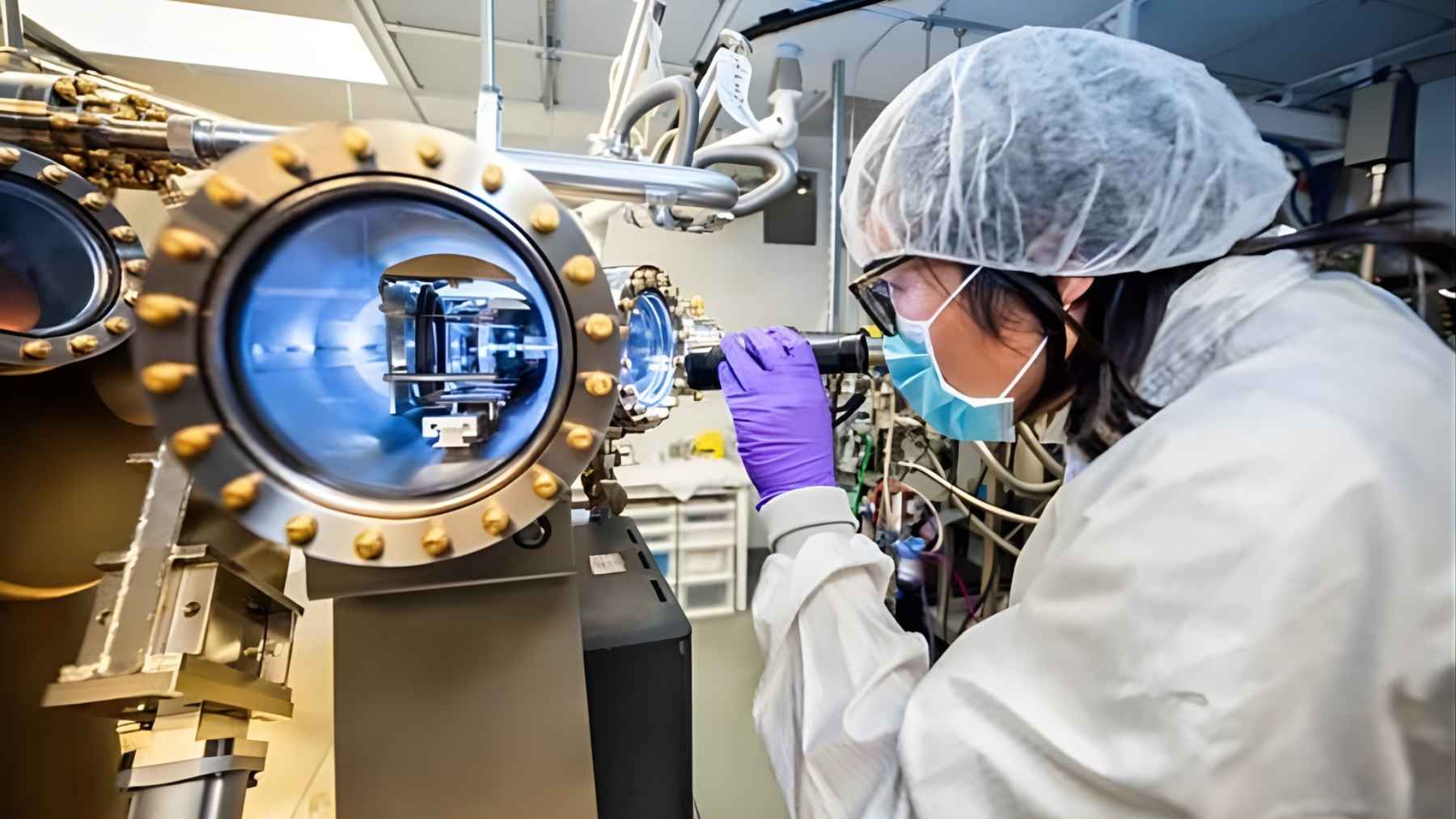
Could future gasoline come from thin air and sunlight instead of oil wells? A team of Chinese scientists has unveiled a lab system that imitates plant photosynthesis to turn carbon dioxide and water into gasoline building blocks using only sunlight. Their work hints at a way to recycle a major greenhouse gas while still using existing engines and fuel infrastructure.
In an artificial photosynthesis study, the researchers report a “charge reservoir” material that stores solar energy as electrical charge, then delivers it on demand to drive reactions. The system converts carbon dioxide into carbon monoxide, a key building block for synthetic fuels, and uses water as its only electron source instead of extra helper chemicals.
Although still a lab device, the setup works under natural sunlight and is meant to connect renewable energy to industry and transport.
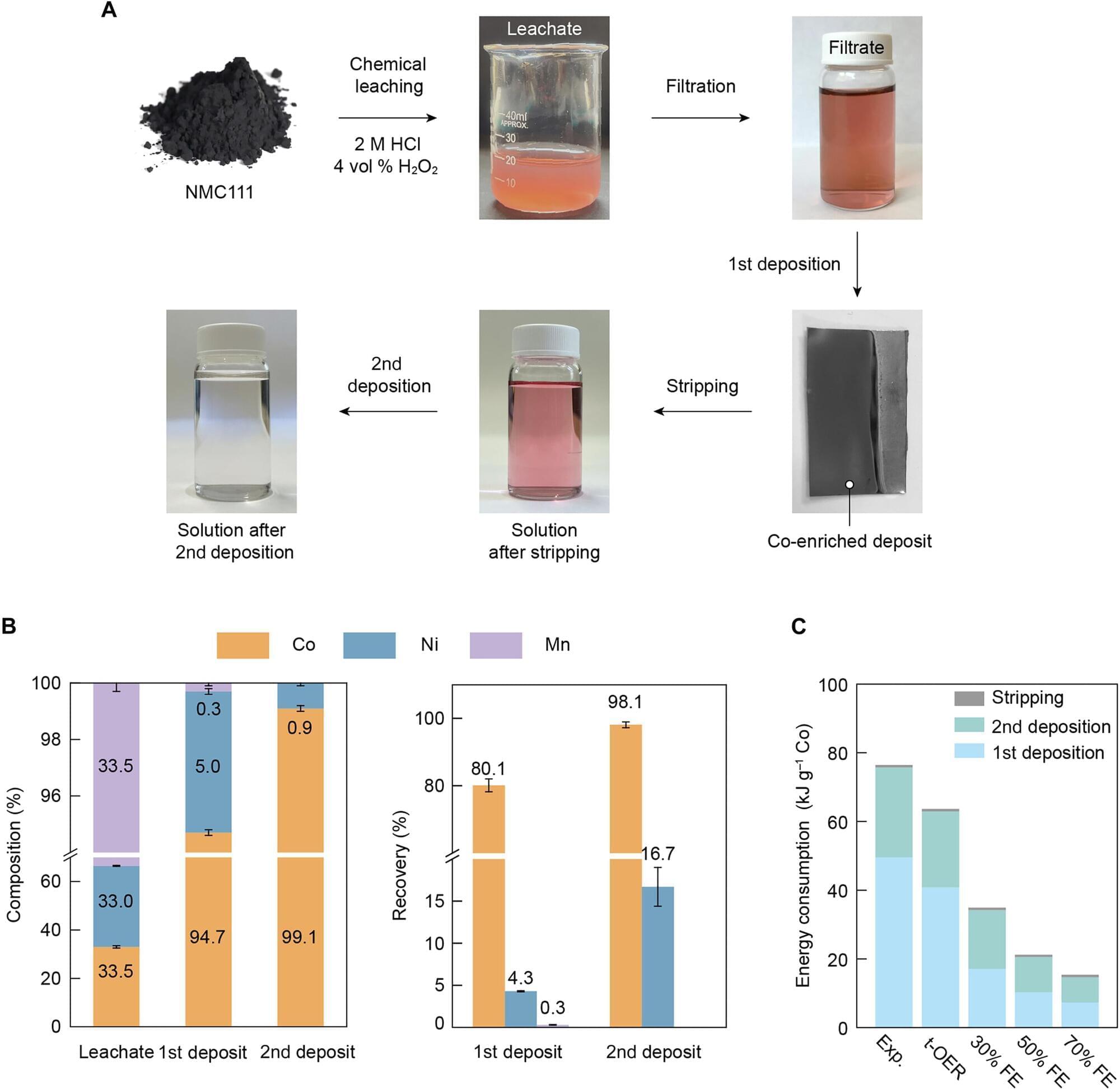
Cobalt and nickel are vital components for batteries, superalloys and catalysts, used in technologies ranging from smartphones to jet engines. But when it comes to recycling, they are notoriously difficult to separate because they are chemically nearly identical. To solve this, a team led by scientists at Johns Hopkins University in the United States has developed a cleaner and cheaper way to extract these elements. And it is thanks in part to grapes.
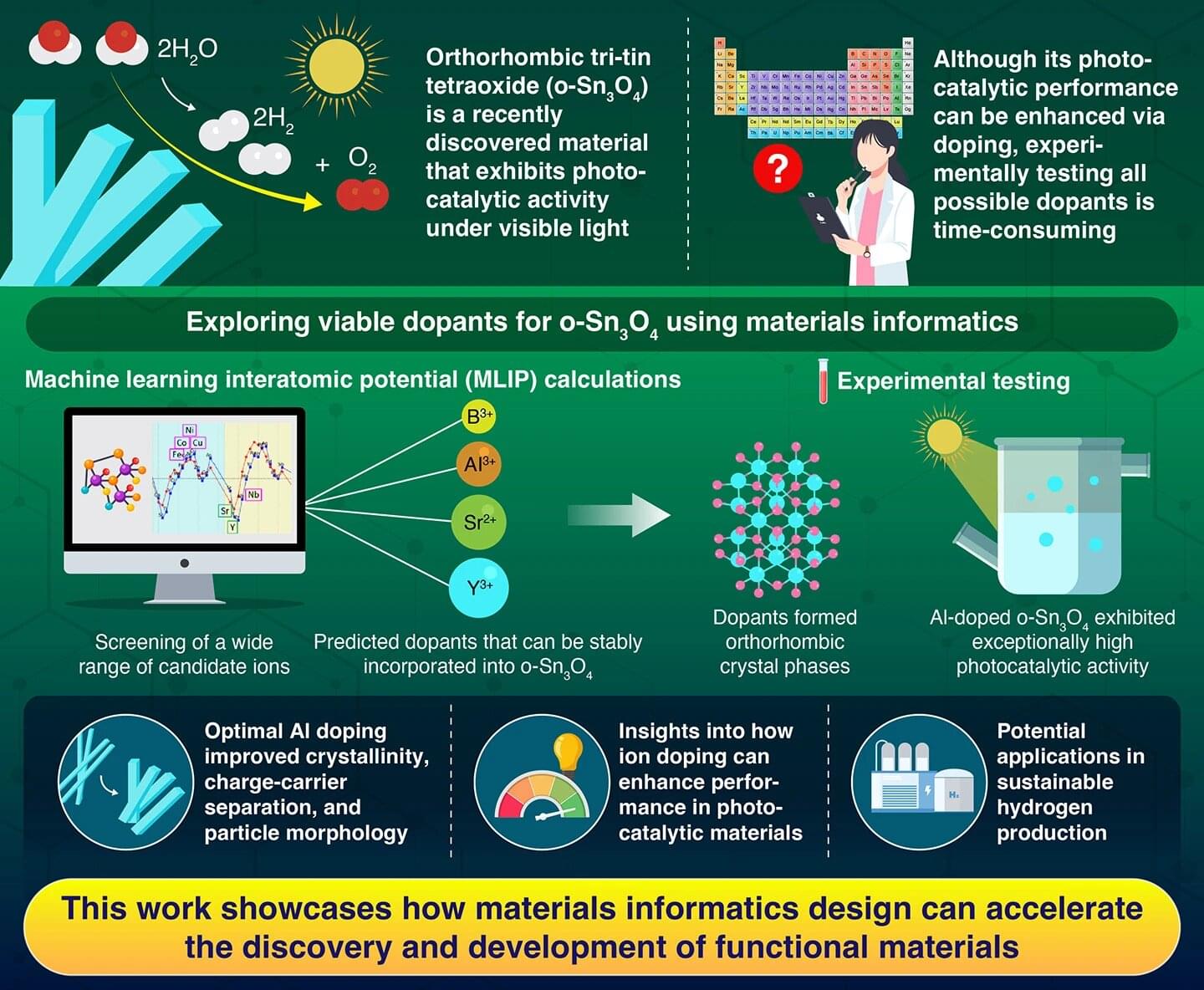
MLIP calculations successfully identify suitable dopants for a novel photocatalytic material, report researchers from the Institute of Science Tokyo. As demonstrated in their study, published in the Journal of the American Chemical Society, a materials informatics approach could predict which ions can be stably introduced into orthorhombic Sn3O4, a promising and recently discovered photocatalytic tin oxide.
Their experiments revealed that aluminum-doped samples achieved 16 times greater hydrogen production than the undoped material, paving the way for next-generation clean energy applications.
Building a sustainable hydrogen economy requires clean and efficient ways to produce hydrogen at scale. One particularly attractive approach is photocatalysis—using materials called photocatalysts to split water into hydrogen and oxygen utilizing sunlight.

Excellent review in which Solé et al. explore how physical/mathematical constraints may determine what subset of biological systems could theoretically evolve in the universe. Lots of fascinating ideas applying concepts like Turing machines, cellular automata, McCulloch-Pitts networks, energy minimization, and phase transitions to multiscale biological and evolutionary phenomena!
I found the description of how parasites almost inevitably emerge and drive increased biodiversity in computational models of evolution particularly fascinating. Interestingly, I recall this idea was featured in the Hyperion Cantos novels during an explanation of the history of artificial intelligence in their fictional universe!
Abstract. It has been argued that the historical nature of evolution makes it a highly path-dependent process. Under this view, the outcome of evolutionary dynamics could have resulted in organisms with different forms and functions. At the same time, there is ample evidence that convergence and constraints strongly limit the domain of the potential design principles that evolution can achieve. Are these limitations relevant in shaping the fabric of the possible? Here, we argue that fundamental constraints are associated with the logic of living matter. We illustrate this idea by considering the thermodynamic properties of living systems, the linear nature of molecular information, the cellular nature of the building blocks of life, multicellularity and development, the threshold nature of computations in cognitive systems and the discrete nature of the architecture of ecosystems. In all these examples, we present available evidence and suggest potential avenues towards a well-defined theoretical formulation.

New work from Chaorui Duan, William Fairbrother et al. (Brown University) reveals how intronic Alu repeats and RNA metabolism shape endogenous dsRNA levels and cell-intrinsic immunity.
InnateImmunity Inflammation
Defective intron recycling leads to the accumulation of intron-derived double-stranded RNA in the cytoplasm, which suppresses PKR and RNase L activation.
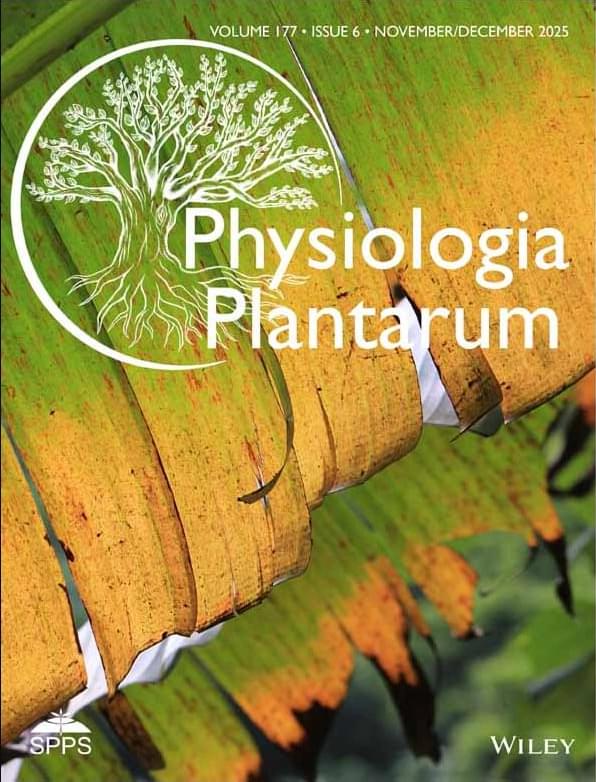
🚱Plants face various environmental stresses, to which they respond in different ways. Due to climate change, it is expected that plants will encounter increased phases of drought and changes in herbivory.
🐛This study thus aimed to evaluate the intra-individual variation in responses, that is phenotypic plasticity, to single and combined stresses, including drought and insect herbivory. Authors used plants of the aromatic species Tanacetum vulgare, which are characterized by distinct terpenoid chemotypes and metabolic fingerprints shaped by maternal origin. Clones were exposed to no stress, drought, herbivory, or a combination of both.
⚗️The impacts of these treatments were determined in terms of aboveground biomass as well as emission rates or concentrations, richness, and functional Hill diversity (FHD) of volatile organic compounds (VOCs), stored leaf and root terpenoids, and leaf metabolic fingerprints.
📊Drought resulted in lower plant aboveground biomass, VOC richness, and VOC FHD. Herbivory had no effect on biomass, but increased the VOC emission rates and richness, also in combination with drought. The treatment significantly affected the phenotypic plasticity of the aboveground biomass and VOC emission.
👉These findings highlight the importance of studying intra-individual variation in plant responses to different stresses and their combinations to fully comprehend the finely tuned chemodiversity.
Read more.
This website uses a security service to protect against malicious bots. This page is displayed while the website verifies you are not a bot.