See More
Category: space – Page 788
Commercialising space exploration and development
When Nanoracks was created a decade ago it became the first company in the world to own and market its own hardware on the International Space Station. In doing so it faced a number of philosophical challenges, in particular because the notion of a private company wanting to own research hardware, market the results and set its own prices was something of an alien concept for NASA at the time. Here, in an article based on his presentation at the Asgardia Space Science & Investment Conference (ASIC) in October, CEO Jeff Manber reflects on the company’s pioneering commercial journey and looks at challenges that lie in the future.
The business model of Nanoracks has essentially been to grow, not through increasing investment but by building increasingly more complex hardware. I like to think that we’re not actually in the hardware business but, in reality, we are — and it’s where we have found a niche in the market.
Ten years ago, when we started with Nanolabs, it was the first time that miniature (10 × 10 × 10 cm) space laboratories had been standardised. I made a decision right at the start not to patent the Nanolab and its power frame because I wanted to create an ecosystem. Today, we are competing with ICE Cubes (a public-private partnership between the European Space Agency (ESA) and Belgium-based Space Applications Services) and Space Tango (a Kentucky, USA-based company that builds research and manufacturing systems into compact smart containers, called CubeLabs, installed in hubs on the International Space Station (ISS). We want to see the market develop and so, as much as possible, we try not to patent. However, at the same time, we believe we’ll be better at getting the customers and building the market.
Episode 11 — Betelgeuse Dimming Mystery Might Be Solved, Says Edward Guinan
Great interview with Villanova University astronomer Ed Guinan, who explains today’s news of the latest paper on why Betelgeuse experienced such a deep dimming this past Fall and Winter. We cover a lot of territory from how Gene Roddenberry chose the name Guinan for the Whoopi Goldberg character on Star Trek’s Next Generation to the history behind the pole star’s mysterious brightening; to the Dog Star Sirius; to why life might still be possible around red dwarfs; to our Sun’s longterm future. Please listen!
In a stroke of serendipity during a wide-ranging podcast interview, Villanova University astronomer Edward Guinan explains the paper behind today’s news flap about the red supergiant star’s inexplicable dimming. The most recent explanation is that dust generated from cooling plasma spewed forth from the massive star’s interior caused Betelgeuse to appear more dim than usual. While Guinan acknowledges this scenario is a possibility, he remains skeptical. Please listen to this candid and entertaining episode!
Viewing Mars In 4K
This new 4k footage from Mars taken by the Curiosity Rover will leave you in complete awe of ‘The Red Planet’.
U.S. Air Force
Everybody has questions about space and what’s beyond the horizon. Our mission is to be the answer.
Welcome to the United States Air Force. Learn about great opportunities for enlisted airmen, officers and health care professionals.
Why James Webb will operate far from Earth?
The James Webb Space Telescope will not be in orbit around the Earth, like the Hubble is, rather it will actually orbit the Sun, 1.5 million kms away from the Earth at the second Lagrange point or L2.
Music: epic cinematic dramatic adventure trailer by romansenykmusic.
WATCH: MARS in 4K!!
A world first. New footage from Mars rendered in stunning 4K resolution.
Although the cameras are high quality, the rate at which the rovers can send data back to earth is the biggest challenge. Curiosity can only send data directly back to earth at 32 kilo-bits per second.
Instead, when the rover can connect to the Mars Reconnaissance Orbiter, we get more favourable speeds of 2 Megabytes per second.
However, this link is only available for about 8 minutes each Sol, or Martian day.
As you would expect, sending HD video at these speeds would take a long long time. As nothing really moves on Mars, it makes more sense to take and send back images.
Credits — NASA, ElderFoxDocumentaries.
#MARS #Marsin4K #MARSinHD #MARSVideo #OccupyMars #MarsSurface #NASA
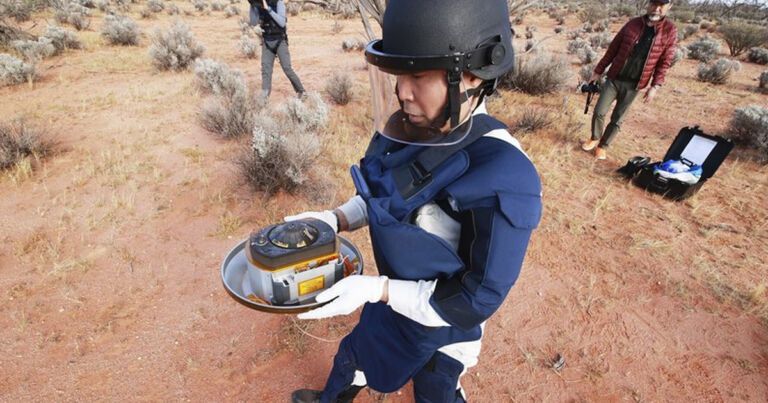
NASA: Next week, NASA’s OSIRIS-REx Asteroid Sample Return Mission will practice touching asteroid Bennu one last time before its big moment
Next week, NASA’s OSIRIS-REx Asteroid Sample Return Mission will practice touching asteroid Bennu one last time before its big moment. The 4-hour excursion will bring the spacecraft to just 131 ft (40 m) above Bennu.
Here’s a preview of the rehearsal: https://go.nasa.gov/30zVOgR
The James Webb Space Telescope will not be in orbit around the Earth
The James Webb Space Telescope will not be in orbit around the Earth, like the Hubble is, rather it will actually orbit the Sun, 1.5 million kms away from the Earth at the second Lagrange point or L2.
Music: epic cinematic dramatic adventure trailer by romansenykmusic.