Toggle light / dark theme

Galactic siblings fight in vivid NASA Hubble image

The image shows an elongated galaxy sandwiched, and stretched, between two galaxies. A long tail is visible in the galaxy on the right in this image: Called a “tidal tail,” this can occur when stars and gases are “stripped” from the outside arms of galaxies during a merger, according to Cosmos.

Tweet may have been deleted

The Hubble Space Telescope — the size of a large school bus — is over 30 years old. The solar-powered telescope takes detailed images of far-off cosmic objects, like Arp 195, yet the legendary instrument is wearing down with age, most recently exemplified by a computer problem that sent Hubble offline for weeks. Still, NASA expects “Hubble will last for many more years and will continue making groundbreaking observations, working in tandem with other space observatories including the James Webb Space Telescope to further our knowledge of the cosmos.”

This Miniature Particle Accelerator Powers a Tiny Laser With Huge Promise

Particle accelerators are hugely important in the study of the matter of the Universe, but the ones we think of tend to be gigantic instruments – surrounding cities in some cases. Now scientists have made a much smaller version to power an advanced laser, a setup that could be just as useful as its larger counterparts.

The particle accelerator in question is a plasma wakefield accelerator, which generates short and intense bursts of electrons, and the laser it’s powering is what’s known as a free-electron laser (FEL), which uses its light to analyze atoms, molecules, and condensed matter in incredibly high resolutions.

While this scenario has been tried before, the resulting laser light hasn’t been intense enough to be useful at smaller scales. Here, the researchers were able to keep the setup enclosed in few normal-sized rooms while amplifying the final electron beam produced by the laser, increasing the intensity by 100 times in the last step of the process.

Astronomers Show How “Tatooine” Planets Form in Binary Systems Without Getting Crushed

Astronomers have developed the most realistic model to date of planet formation in binary star systems.

The researchers, from the University of Cambridge and the Max Planck Institute for Extraterrestrial Physics, have shown how exoplanets in binary star systems – such as the ‘Tatooine’ planets spotted by NASA

Established in 1958, the National Aeronautics and Space Administration (NASA) is an independent agency of the United States Federal Government that succeeded the National Advisory Committee for Aeronautics (NACA). It is responsible for the civilian space program, as well as aeronautics and aerospace research. It’s vision is “To discover and expand knowledge for the benefit of humanity.”

Scientists find two huge red rocks in the asteroid belt that shouldn’t be there

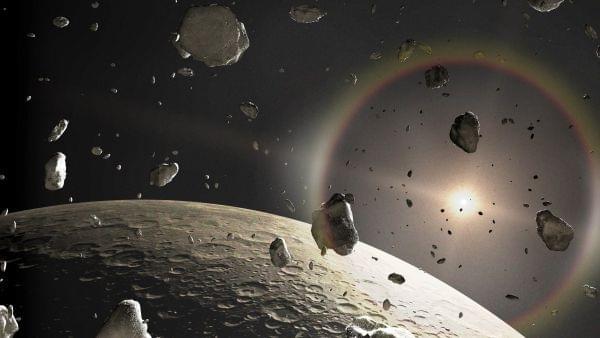
Scientists have found two huge, red objects in the asteroid belt that they believe are not supposed to be there – both of which have “complex organic matter” on their surfaces.

These two asteroids, called 203 Pompeja and 269 Justitia, were discovered by Jaxa, the Japan Aerospace Exploration Agency. Pompeja is approximately 110 kilometres wide, while the smaller Justitia has a diameter of only 55 kilometres.

Found in the cluster of rocks between Mars and Jupiter, these two objects are distinctly different from their neighbours. Both Pompeja and Justitia reflect more red light than other surrounding asteroids due to the increased presence of complex organic material on their surface – such as carbon or methane.

A ‘Very Exciting’ unique exoplanet has more water than earth

The CHEOPS satellite accidentally spotted a rare exoplanet with no known equivalent. The satellite detected this unique exoplanet while looking for two exoplanets in a bright nearby star system.

This planet called ‘Nu2 Lupi d’ is located 50 light-years away in the constellation Lupus (Latin for Wolf), around a star called Nu2 Lupi. It is about 2.5 times the size of Earth and almost 9 times its mass.

What’s more, scientists used measurements with archival data from other observatories and numerical models to characterize the density and composition of the planet and its neighbors. They found that the planet has a rocky interior. It has far more water than the Earth. However, the water is not liquid; instead of taking high-pressure ice or high-temperature steam, making the planets uninhabitable.

Scientists capture most-detailed radio image of Andromeda galaxy to date

Scientists have published a new, detailed radio image of the Andromeda galaxy—the Milky Way’s sister galaxy—which will allow them to identify and study the regions of Andromeda where new stars are born.

The study—which is the first to create a radio image of Andromeda at the of 6.6 GHz—was led by University of British Columbia physicist Sofia Fatigoni, with colleagues at Sapienza University of Rome and the Italian National Institute of Astrophysics. It was published online in Astronomy and Astrophysics.

“This image will allow us to study the structure of Andromeda and its content in more detail than has ever been possible,” said Fatigoni, a Ph.D. student in the department of physics and astronomy at UBC. “Understanding the nature of physical processes that take place inside Andromeda allows us to understand what happens in our own galaxy more clearly—as if we were looking at ourselves from the outside.”

/* */