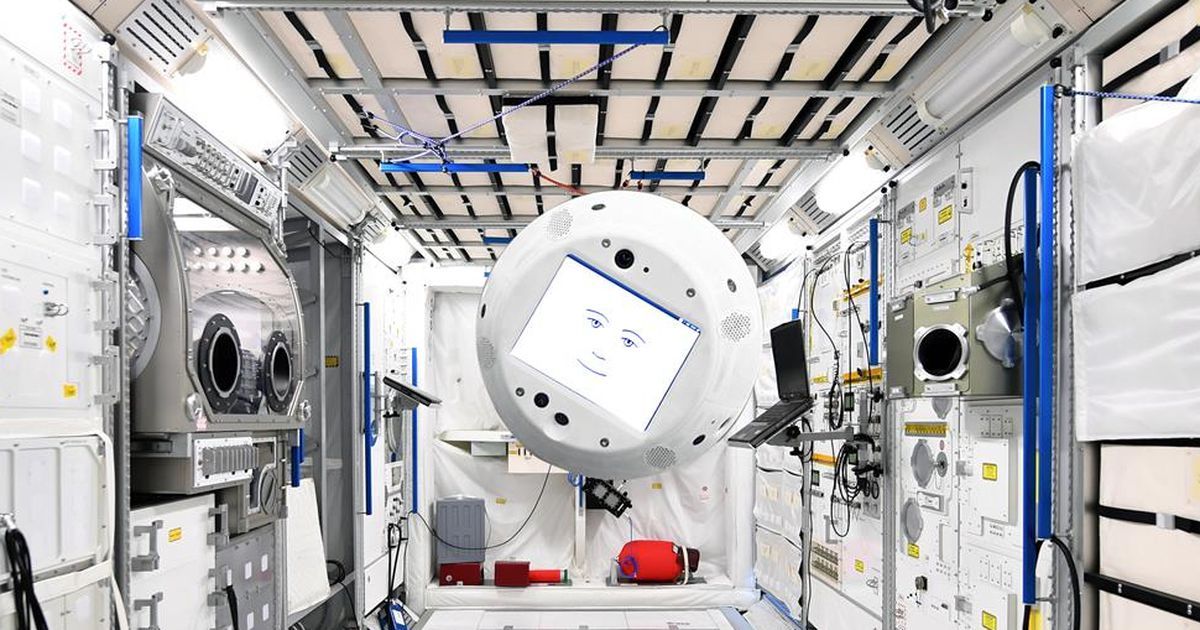
After two years in development, Project MELT (Manufacturing of Experimental Layer Technology) has resurfaced with a prototype microgravity 3D printer.
Made for the European Space Agency (ESA) the Additive Layer Manufacturing (ALM) breadboard machine is designed to 3D print high performance polymers aboard the International Space Station (ISS) and other off-world locations.
An asteroid the size of the Statue of Liberty is set to narrowly miss Earth on Tuesday evening. Luckily, it won’t actually smack into our planet or cause any da.
When it’s complete, the Giant Magellan Telescope will be as tall as the Statue of Liberty. On this podcast episode, an astronomy expert explains what the enormous telescope can teach us about the universe.
When Google DeepMind researchers trained a neural network to tackle a virtual maze, it spontaneously developed digital equivalents to the specialized neurons called grid cells that mammals use to navigate. Not only did the resulting AI system have superhuman navigation capabilities, the research could provide insight into how our brains work.
Grid cells were the subject of the 2014 Nobel Prize in Physiology or Medicine, alongside other navigation-related neurons. These cells are arranged in a lattice of hexagons, and the brain effectively overlays this pattern onto its environment. Whenever the animal crosses a point in space represented by one of the corners these hexagons, a neuron fires, allowing the animal to track its movement.
Mammalian brains actually have multiple arrays of these cells. These arrays create overlapping grids of different sizes and orientations that together act like an in-built GPS. The system even works in the dark and independently of the animal’s speed or direction.
Babak Hodjat, inventor of the technology that powers Apple’s virtual assistant, speaks to the uncertainties and opportunities in this innovative space.
Long before our Sun formed it was nothing more than a bunch of material floating listlessly in a large cloud of gas, dust, and debris. These space clouds, called nebulas, are where stars and planets are born, eventually coalescing into larger bodies which become slaves to gravity and form systems such as the one we currently reside in. But what factors affect star and planet formation, and what ultimately determines the type of stars that form? Using observations of one very special nebula, scientists now think have begun to understand.
One of the biggest hurdles in studying these molecular space clouds is that telescopes can only produce a 2D picture of them, making it impossible to model the interior structure and movements of the dust and gasses. Researchers focused on the cloud known as Musca, which lies hundreds of light years away from Earth, but is still close enough to study. The scientists discovered that this particular cloud is “singing.”
We’ve all dreamed of owning, or at the very least being a passenger of, a flying car. It’s the sci-fi dream that never transpired — until recently, that is. With a growing emphasis of developing flying taxis among several different companies, one wonders if the revolutionary Tesla Motors has plans to join in on this new venture.
Could Elon Musk’s random tweet from late last year be an indicator of Tesla’s interest in flying cars and their joining of this brand new “space race?”
Future wars could be much more fierce with weapons even more powerful than nukes:
The world is progressing in many ways, but tribalism isn’t going away, so new arms races in AI, drones, bio-weapons and space weapons are already under way. Forewarned is forearmed. What sort of weaponry should we expect? I’ve discussed AI and bio approaches before on other blogs, so this one looks just at kinetic weaponry using advanced materials, coupled to EM acceleration systems.