Toggle light / dark theme

Los Alamos Forms Quantum Computing-Focused Research Center

PRESS RELEASE — Los Alamos National Laboratory has formed the Center for Quantum Computing, which will bring together the Lab’s diverse quantum computing research capabilities. Headquartered in downtown Los Alamos, the Center for Quantum Computing will consolidate the Laboratory’s expertise in national security applications, quantum algorithms, quantum computer science and workforce development in a shared research space.

“This new center of excellence will bring together the Laboratory’s quantum computing research capabilities that support Department of Energy, Defense and New Mexico state initiatives to achieve a critical mass of expertise greater than the individual parts,” said Mark Chadwick, associate Laboratory director for Simulation, Computing and Theory. “This development highlights our commitment to supporting the next generation of U.S. scientific and technological innovation in quantum computing, especially as the technology can support key Los Alamos missions.”

The center will bring together as many as three dozen quantum researchers from across the Lab. The center’s formation occurs at a pivotal time for the development of quantum computing, as Lab researchers partner with private industry and on a number of state and federal quantum computing initiatives to bring this high-priority technology closer to fruition. Laboratory researchers may include those working with the DARPA Quantum Benchmarking Initiative, the DOE’s Quantum Science Center, the National Nuclear Security Administration Advanced Simulation and Computing program’s Beyond Moore’s Law project, and multiple Laboratory Directed Research and Development projects.


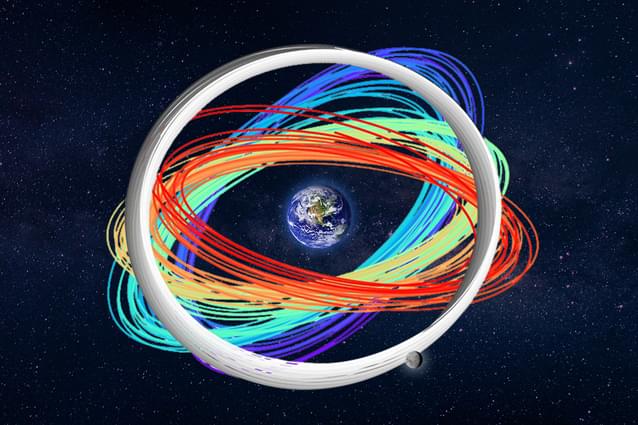
Simulations and supercomputing calculate one million orbits in cislunar space

Satellites and spacecraft in the vast region between the earth and moon and just beyond — called cislunar space — are crucial for space exploration, scientific advancement and national security. But figuring out where exactly to put them into a stable orbit can be a huge, computationally expensive challenge.

In an open-access database and with publicly available code, researchers at Lawrence Livermore National Laboratory (LLNL) have simulated and published one million orbits in cislunar space. The effort, enabled by supercomputing resources at the Laboratory, provides valuable data that can be used to plan missions, predict how small perturbations might change orbits and monitor space traffic.

To begin, the Space Situational Awareness Python package takes in a range of initial conditions for an orbit, like how elliptical and tilted the orbit is and how far it gets from the earth.

How AI & Quantum Are Reshaping Federal Innovation

By Chuck Brooks

#artificialintelligence #tech #government #quantum #innovation #federal #ai


By Chuck Brooks, president of Brooks Consulting International

In 2026, government technological innovation has reached a key turning point. After years of modernization plans, pilot projects and progressive acceptance, government leaders are increasingly incorporating artificial intelligence and quantum technologies directly into mission-critical capabilities. These technologies are becoming essential infrastructure for economic competitiveness, national security and scientific advancement rather than merely scholarly curiosity.

We are seeing a deliberate change in the federal landscape from isolated testing to the planned implementation of emerging technology across the whole government. This evolution represents not only technology momentum but also policy leadership, public-private collaboration and expanded industrial capability.

Eclipse Foundation Mandates Pre-Publish Security Checks for Open VSX Extensions

The Eclipse Foundation, which maintains the Open VSX Registry, has announced plans to enforce security checks before Microsoft Visual Studio Code (VS Code) extensions are published to the open-source repository to combat supply chain threats.

The move marks a shift from a reactive to a proactive approach to ensure that malicious extensions don’t end up getting published on the Open VSX Registry.

“Up to now, the Open VSX Registry has relied primarily on post-publication response and investigation. When a bad extension is reported, we investigate and remove it,” Christopher Guindon, director of software development at the Eclipse Foundation, said.

Researchers Find 341 Malicious ClawHub Skills Stealing Data from OpenClaw Users

A security audit of 2,857 skills on ClawHub has found 341 malicious skills across multiple campaigns, according to new findings from Koi Security, exposing users to new supply chain risks.

ClawHub is a marketplace designed to make it easy for OpenClaw users to find and install third-party skills. It’s an extension to the OpenClaw project, a self-hosted artificial intelligence (AI) assistant formerly known as both Clawdbot and Moltbot.

The analysis, which Koi conducted with the help of an OpenClaw bot named Alex, found that 335 skills use fake pre-requisites to install an Apple macOS stealer named Atomic Stealer (AMOS). This activity set has been codenamed ClawHavoc.

OpenClaw Bug Enables One-Click Remote Code Execution via Malicious Link

A high-severity security flaw has been disclosed in OpenClaw (formerly referred to as Clawdbot and Moltbot) that could allow remote code execution (RCE) through a crafted malicious link.

The issue, which is tracked as CVE-2026–25253 (CVSS score: 8.8), has been addressed in version 2026.1.29 released on January 30, 2026. It has been described as a token exfiltration vulnerability that leads to full gateway compromise.

“The Control UI trusts gatewayUrl from the query string without validation and auto-connects on load, sending the stored gateway token in the WebSocket connect payload,” OpenClaw’s creator and maintainer Peter Steinberger said in an advisory.

/* */