Alphabet’s AI subsidiary DeepMind has built a new AI language model named Gopher. It has 280 billion parameters, making it significantly larger than OpenAI’s GPT-3.
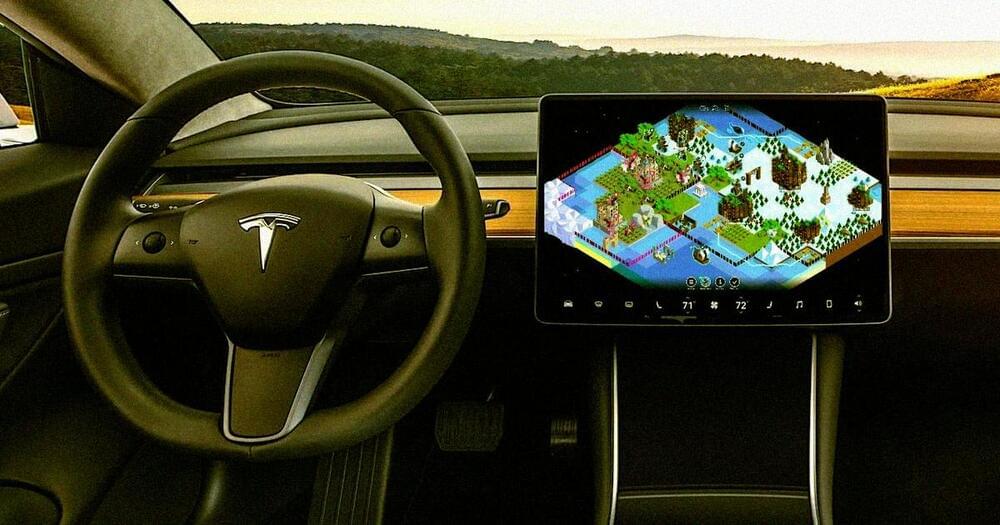
Tesla is allowing drivers — yes, the person behind the wheel who is ideally preoccupied with tasks such as “steering” — to play video games on its vehicles’ massive console touchscreens while driving.
“I only did it for like five seconds and then turned it off,” Tesla owner Vince Patton told The New York Times. “I’m astonished. To me, it just seems inherently dangerous.”
The feature has reportedly been available for some time. Given that the company is already facing fierce scrutiny for rolling out its still unfinished Full Self-Driving beta to customers, it’s not exactly a good look.

AI artist Botto has just made over a million dollars for NFTs of its work.
Botto, which works in collaboration with a human community, hit the million dollar mark within five weeks of putting a batch of NFT-backed artwork up for auction, Euronews reported.
The haul elevates the AI artist into a small-but-growing cohort of synthetic creators, and the designer behind Botto, German artist Mario Klingemann, told Euronews that he believes Botto’s practice could eventually extend to books and music.
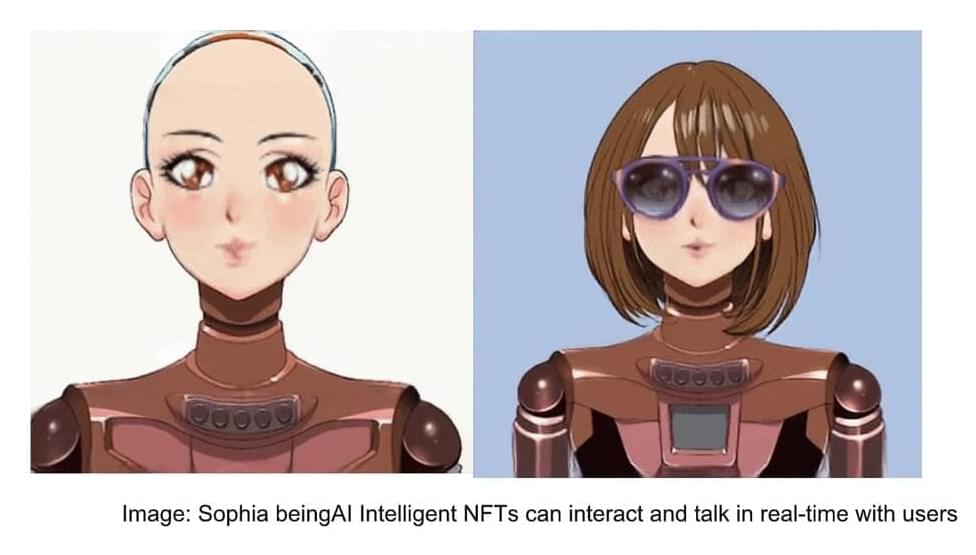
Alethea AI and BeingAI are collaborating with the Binance NFT marketplace to introduce the AI game characters that are based on nonfungible tokens (NFTs).
Alethea AI creates smart avatars who use AI to hold conversations with people, and it has launched its own NFT collectible AI characters. NFTs use the transparency and security of the digital ledger of blockchain to authenticate unique digital items. The companies see this as the underlying AI infrastructure for iNTFs, or intelligent nonfungible tokens, on the path to the metaverse, the universe of virtual worlds that are all interconnected, like in novels such as Snow Crash and Ready Player One.
Being AI, meanwhile, is on a quest to create AI characters who can interact and talk in real time with users. Both companies are working with the NFT marketplace of Binance to launch intelligent IGO (Initial Game Offering), featuring a hundred intelligent NFTs characters.
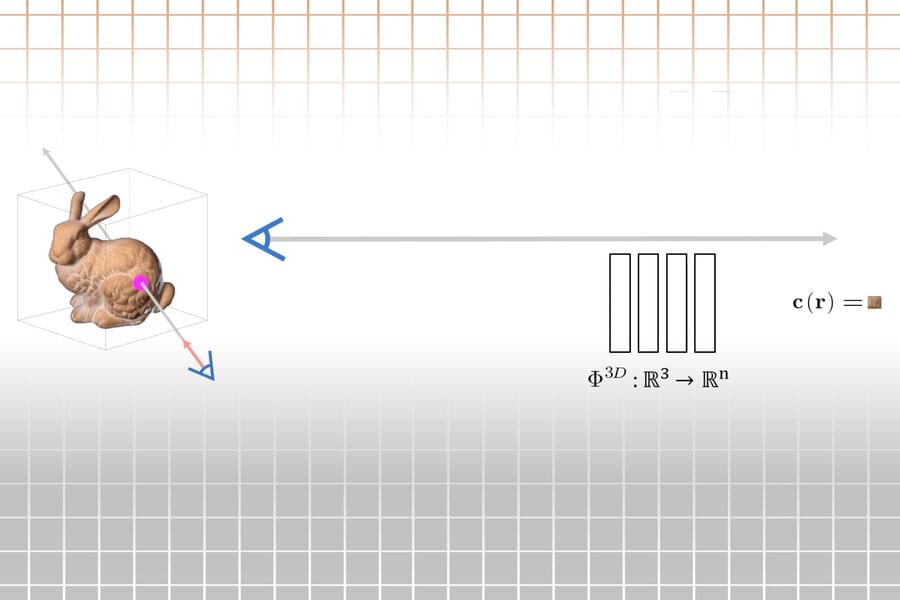
Humans are pretty good at looking at a single two-dimensional image and understanding the full three-dimensional scene that it captures. Artificial intelligence agents are not.
Yet a machine that needs to interact with objects in the world—like a robot designed to harvest crops or assist with surgery—must be able to infer properties about a 3D scene from observations of the 2D images it’s trained on.
While scientists have had success using neural networks to infer representations of 3D scenes from images, these machine learning methods aren’t fast enough to make them feasible for many real-world applications.

Games have a long history of serving as a benchmark for progress in artificial intelligence. Recently, approaches using search and learning have shown strong performance across a set of perfect information games, and approaches using game-theoretic reasoning and learning have shown strong performance for specific imperfect information poker variants. We introduce, a general-purpose algorithm that unifies previous approaches, combining guided search, self-play… See more.
Games have a long history of serving as a benchmark for progress in.
Artificial intelligence. Recently, approaches using search and learning have.
Shown strong performance across a set of perfect information games, and.
approaches using game-theoretic reasoning and learning have shown strong.
performance for specific imperfect information poker variants. We introduce.
Player of Games, a general-purpose algorithm that unifies previous approaches.
Combining guided search, self-play learning, and game-theoretic reasoning.
Player of Games is the first algorithm to achieve strong empirical performance.
In large perfect and imperfect information games — an important step towards.
The idiom “actions speak louder than words” first appeared in print almost 300 years ago. A new study echoes this view, arguing that combining self-supervised and offline reinforcement learning (RL) could lead to a new class of algorithms that understand the world through actions and enable scalable representation learning.
Machine learning (ML) systems have achieved outstanding performance in domains ranging from computer vision to speech recognition and natural language processing, yet still struggle to match the flexibility and generality of human reasoning. This has led ML researchers to search for the “missing ingredient” that might boost these systems’ ability to understand, reason and generalize.
In the paper Understanding the World Through Action, UC Berkeley assistant professor in the department of electrical engineering and computer sciences Sergey Levine suggests that a general, principled, and powerful framework for utilizing unlabelled data could be derived from RL to enable ML systems leveraging large datasets to better understand the real world.
To set some benchmarks for their simulator, the researchers tried out three different design algorithms working in conjunction with a deep reinforcement learning algorithm that learned to control the robots through many rounds of trial and error.
The co-designed bots performed well on the simpler tasks, like walking or carrying things, but struggled with tougher challenges, like catching and lifting, suggesting there’s plenty of scope for advances in co-design algorithms. Nonetheless, the AI-designed bots outperformed ones design by humans on almost every task.
Intriguingly, many of the co-design bots took on similar shapes to real animals. One evolved to resemble a galloping horse, while another, set the task of climbing up a chimney, evolved arms and legs and clambered up somewhat like a monkey.
None.
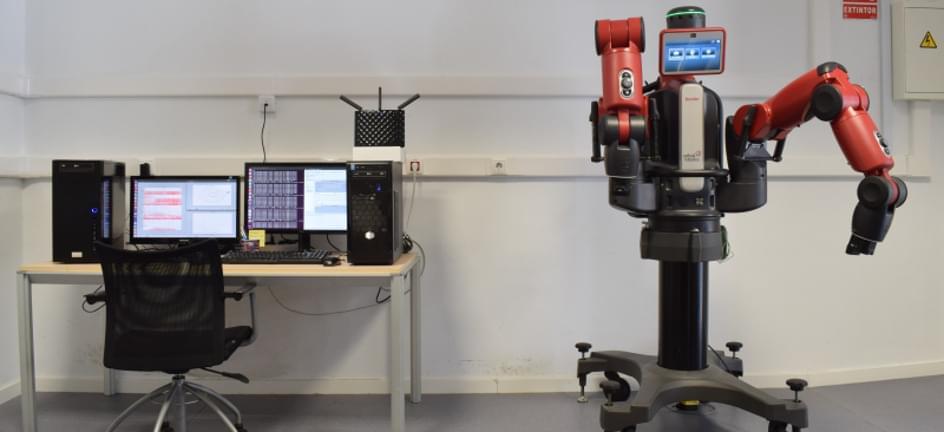
Researchers at Human Brain Project partner University of Granada in Spain have designed a new artificial neural network that mimics the structure of the cerebellum, one of the evolutionarily older parts of the brain, which plays an important role in motor coordination. When linked to a robotic arm, their system learned to perform precise movements and interact with humans in different circumstances, surpassing performance of previous AI-based robotic steering systems. The results have been published in the journal Science Robotics.