An art collective is trying to get an AI-supported candidate into Danish Parliament in 2023. Could we have a fully virtual candidate one day?
With all the political rancor that has become a part of our everyday reality, maybe it’s time to admit that humans may not be the best at forging agreements. Our egos are always in play, and emotions often rule our political choices more than reason. Maybe artificial intelligence (AI) could do a better job, or at least that’s what the creators of The Synthetic Party, the world’s first AI-based political party, think. The party hopes to run an AI candidate in Denmark’s general election in 2023.
Full Story:
Imaginima/iStock.
The party would also like to see the UN adding an 18th sustainable development goal which would let humans coexist directly with algorithms.
This is Episode 7 in a series of videos discussing the General Theory of General Intelligence as overviewed in the paper. Goertzel, Ben. “The General Theory of General Intelligence: A Pragmatic Patternist Perspective.“ https://arxiv.org/pdf/2103.15100 This episode overviews ideas regarding how the particular nature and requirements of *human-like-ness* can be used guide the design and education of AGI systems. This is where cognitive science and computer science richly intersect. Core architectural ideas of OpenCog along with numerous other AGI systems (MicroPsi, LIDA, Aaron Sloman’s work,…) are reviewed in this context. Some additional references relevant to this episode are: Goertzel, Ben. “The Embodied Communication Prior: A characterization of general intelligence in the context of Embodied social interaction.” In 2009 8th IEEE International Conference on Cognitive Informatics, pp. 38–43. IEEE, 2009. http://citeseerx.ist.psu.edu/viewdoc/download?doi=10.1.1.352…1&type=pdf. Bengio, Yoshua. “The consciousness prior.” 2017 https://arxiv.org/pdf/1709.08568 Goertzel, Ben, Matt Iklé, and Jared Wigmore. “The architecture of human-like general intelligence.” In Theoretical foundations of artificial general intelligence, pp. 123–144. Atlantis Press, Paris, 2012. http://citeseerx.ist.psu.edu/viewdoc/summary?doi=10.1.1.352.1548 Ben Goertzel, Cassio Pennachin, and Nil Geisweiller. Engineering. General Intelligence, Part 1: A Path to Advanced AGI via Embodied Learning and Cognitive Synergy. Springer: Atlantis Thinking Machines, 2013. https://1lib.us/book/2333263/7af06e?id=2333263&secret=7af06e. Ben Goertzel, Cassio Pennachin, and Nil Geisweiller. Engineering. General Intelligence, Part 2: The CogPrime Architecture for Integrative, Embodied AGI. Springer: Atlantis Thinking Machines, 2013. https://1lib.us/book/2333264/207a57?id=2333264&secret=207a57 – SingularityNET is a decentralized marketplace for artificial intelligence. We aim to create the world’s global brain with a full-stack AI solution powered by a decentralized protocol. We gathered the leading minds in machine learning and blockchain to democratize access to AI technology. Now anyone can take advantage of a global network of AI algorithms, services, and agents. Website: https://singularitynet.io. Forum: https://community.singularitynet.io. Telegram: https://t.me/singularitynet. Twitter: https://twitter.com/singularity_net. Facebook: https://facebook.com/singularitynet.io. Instagram: https://instagram.com/singularitynet.io. Github: https://github.com/singnet
Artificial General Intelligence — Short for AGI is a trending and recent topic of debate among AI researchers and computer scientists. A pressing issue for AI or artificial Intelligence is the AI alignment problem. The AI control problem could be the most important task for humanity to solve. There have been many suggestions from AI researchers to avoid the dangers of artificial general intelligence or a digital super-intellgience. It seems among the best solutions to this problem has been a merging scenario with AGI. Elon Musk has suggested we regulate artificial intelligence and we should proceed very carefully if humanity collectively decides that creating a digital super-intelligence is the right move. Elon Musk is the founder of many high tech companies, including Neuralink. Which develops implantable brain–machine interfaces. Elon Musk warns that AI is probably the biggest existential threat for humanity. AGI is probably even more dangerous than nuclear warheads and nobody would suggest we allow anyone to build nuclear weapons if they want. The pressing issue for a potential AGI development and eventually the creation of a digital super-intelligence is going to be increasingly relevant in the coming years. Dr. Ben Goertzel, CEO & Founder, of SingularityNET Foundation, is one of the world’s foremost experts in Artificial General Intelligence. According to him these reactions are probably going to look very silly to people a few decades from now, as they go about their lives which have been made tremendously easy and happy and fascinating compared to 2020 reality, via the wide rollout of advanced AGI systems to handle manufacturing service, and all the other practical jobs that humans now spend their time doing. Elon musk suggested, the merge scenario with A.I. is the one that seems like probably the best,” or as he put it on the Joe Rogan Experience. “If you can’t beat it, join it.
A Sydney Harbor Tunnel explosion showcases the work of UNSW researchers using wireless signals and artificial intelligence to more accurately identify dangerous fire situations.
Engineers from UNSW Sydney have developed a new fire detection system that could help save lives by monitoring the changes in Wi-Fi signals.
And a controlled test detonation of a car, planned by the Sydney Harbor Tunnel Company, recently provided further data to demonstrate the effectiveness of the technology.
Hyperparameter tuning is important for algorithms. It improves their overall performance of a machine learning model and is set before the learning process and happens outside of the model. If hyperparameter tuning does not occur, the model will produce errors and inaccurate results as the loss function is not minimized.
Hyperparameter tuning is about finding a set of optimal hyperparameter values which maximizes the model’s performance, minimizes loss and produces better outputs.
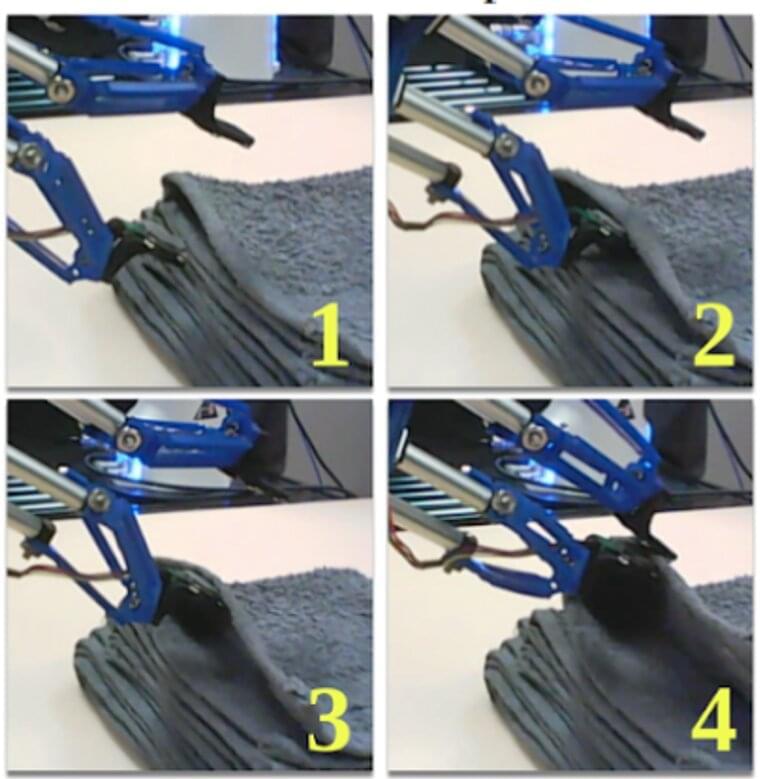
In recent years, roboticists have been trying to improve how robots interact with different objects found in real-world settings. While some of their efforts yielded promising results, the manipulation skills of most existing robotic systems still lag behinds those of humans.
Fabrics are among the types of objects that have proved to be most challenging for robot to interact with. The main reasons for this are that pieces of cloth and other fabrics can be stretched, moved and folded in different ways, which can result in complex material dynamics and self-occlusions.
Researchers at Carnegie Mellon University’s Robotics Institute have recently proposed a new computational technique that could allow robots to better understand and handle fabrics. This technique, introduced in a paper set to be presented at the International Conference on Intelligent Robots and Systems and pre-published on arXiv, is based on the use of a tactile sensor and a simple machine-learning algorithm, known as a classifier.
The early-stage development of many age-targeting compounds often involves studies of their effects on the lifespan of the transparent nematode (worm) model Caenorhabditis elegans. A highly manual process, this exercise is time-consuming and only produces data on one endpoint – lifespan.
Durham University associate professors David Weinkove and Chris Saunter invented a technology that automates measurements of movement in many large populations of worms simultaneously. Crucially, this technology goes beyond measuring lifespan, also capturing information about how worms’ health declines as they age – their healthspan.
Longevity. Technology: Together, Weinkove and Saunter have co-founded a spinout company called Magnitude Biosciences, leveraging their innovative platform to test drugs and other interventions for their capacity to prolong healthspan. We caught up with Weinkove to learn more about the background to the company and where it goes from here.
GUEST BIO: John Carmack is a legendary programmer, co-founder of id Software, and lead programmer of many revolutionary video games including Wolfenstein 3D, Doom, Quake, and the Commander Keen series. He is also the founder of Armadillo Aerospace, and for many years the CTO of Oculus VR.
Headlines such as “MACHINE COMES TO LIFE” and “GOOGLE ENGINEER URGENT WARNING” have led many to believe that science fiction has become reality, with artificial intelligence reaching the level of human consciousness. What are the religious implications? And what are the facts? What do we know about how artificial intelligence really operates?