Toggle light / dark theme

Physicists Create Mind-Bending New Phase of Matter That Acts Like It Has Two Time Dimensions

Physicists demonstrated a way of storing quantum information that is less prone to errors by subjecting a quantum computer’s qubits to quasi-rhythmic laser pulses based on the Fibonacci sequence.

Physicists have created a remarkable, never-before-seen phase of matter by shining a laser pulse sequence inspired by the Fibonacci sequence at atoms inside a quantum computer. Despite there still being only one singular flow of time, the phase has the benefits of two time dimensions, the physicists reported on July 20 in the journal Nature.

This mind-bending property offers a highly desirable benefit: Information stored in the phase is far more protected against errors than with alternative setups currently used in quantum computers. As a result, the information can exist for far longer without getting garbled, an important milestone for making quantum computing.


Reality doesn’t exist until you measure it, quantum parlor trick confirms

😳!!!


The Moon isn’t necessarily there if you don’t look at it. So says quantum mechanics, which states that what exists depends on what you measure. Proving reality is like that usually involves the comparison of arcane probabilities, but physicists in China have made the point in a clearer way. They performed a matching game in which two players leverage quantum effects to win every time—which they can’t if measurements merely reveal reality as it already exists.

“To my knowledge this is the simplest [scenario] in which this happens,” says Adan Cabello, a theoretical physicist at the University of Seville who spelled out the game in 2001. Such quantum pseudotelepathy depends on correlations among particles that only exist in the quantum realm, says Anne Broadbent, a quantum information scientist at the University of Ottawa. “We’re observing something that has no classical equivalent.”

A quantum particle can exist in two mutually exclusive conditions at once. For example, a photon can be polarized so that the electric field in it wriggles vertically, horizontally, or both ways at the same time—at least until it’s measured. The two-way state then collapses randomly to either vertical or horizontal. Crucially, no matter how the two-way state collapses, an observer can’t assume the measurement merely reveals how the photon was already polarized. The polarization emerges only with the measurement.

Physicists harness quantum “time reversal” to measure vibrating atoms

MIT physicists have significantly amplified quantum changes in atomic vibrations, allowing them to exclude noise from the classical world. This advance may allow them to measure these atomic oscillations, and how they evolve over time, and ultimately hone the precision of atomic clocks and of quantum sensors for detecting dark matter or gravitational waves.

How quantum batteries could lead to million-mile EVs

The automotive industry has a ‘million-mile’ dream for electric vehicles, but it’s a boring one. They want to build a battery capable of being recharged over and over as many times as it takes to reach a million miles without losing its ability to retain a charge. Yawn.

We’re more interested in the cutting-edge quantum physics version of a million-mile battery: one that can last a million miles between charges.

This would effectively eliminate the need for the bulk of vehicle operators to ever charge their batteries. Even heavy-use owners could just pop into the shop for routine maintenance every couple of years to top their batteries off.

Breaking the Warp Barrier for Faster-Than-Light Travel: New Theoretical Hyper-Fast Solitons Discovered

Circa 2021


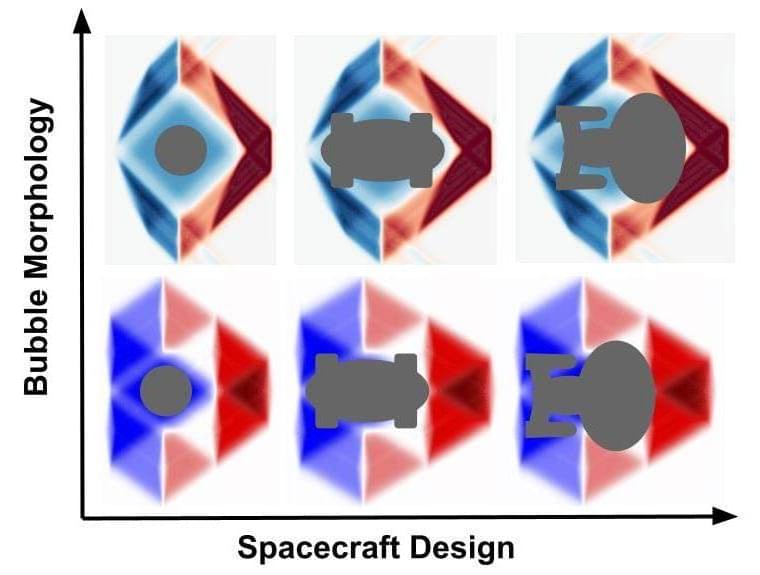
Astrophysicist at Göttingen University discovers new theoretical hyper-fast soliton solutions.

If travel to distant stars within an individual’s lifetime is going to be possible, a means of faster-than-light propulsion will have to be found. To date, even recent research about superluminal (faster-than-light) transport based on Einstein’s theory of general relativity would require vast amounts of hypothetical particles and states of matter that have “exotic” physical properties such as negative energy density. This type of matter either cannot currently be found or cannot be manufactured in viable quantities. In contrast, new research carried out at the University of Göttingen gets around this problem by constructing a new class of hyper-fast ‘solitons’ using sources with only positive energies that can enable travel at any speed. This reignites debate about the possibility of faster-than-light travel based on conventional physics. The research is published in the journal Classical and Quantum Gravity.

The author of the paper, Dr. Erik Lentz, analyzed existing research and discovered gaps in previous ‘warp drive’ studies. Lentz noticed that there existed yet-to-be explored configurations of space-time curvature organized into ‘solitons’ that have the potential to solve the puzzle while being physically viable. A soliton – in this context also informally referred to as a ‘warp bubble’ – is a compact wave that maintains its shape and moves at constant velocity. Lentz derived the Einstein equations for unexplored soliton configurations (where the space-time metric’s shift vector components obey a hyperbolic relation), finding that the altered space-time geometries could be formed in a way that worked even with conventional energy sources. In essence, the new method uses the very structure of space and time arranged in a soliton to provide a solution to faster-than-light travel, which – unlike other research – would only need sources with positive energy densities.

The observation of Chern mosaic and Berry-curvature magnetism in magic angle graphene

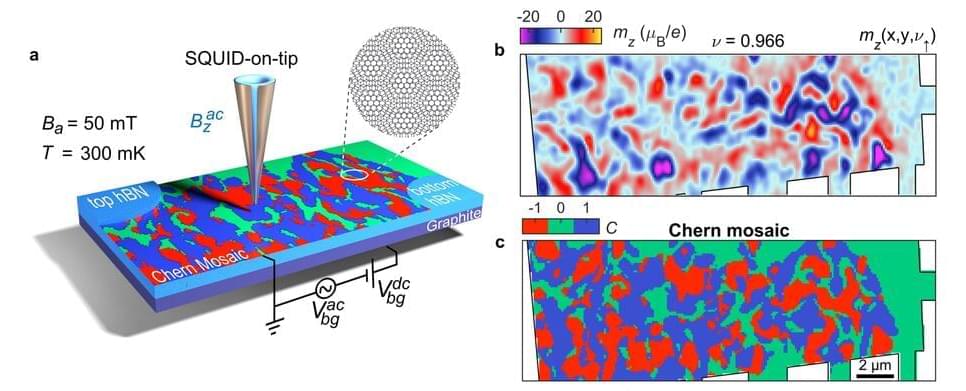
Researchers at the Weizmann Institute of Science, the Barcelona Institute of Science and Technology and the National Institute for Material Science in Tsukuba (Japan) have recently probed a Chern mosaic topology and Berry-curvature magnetism in magic-angle graphene. Their paper, published in Nature Physics, offers new insight about topological disorder that can occur in condensed matter physical systems.

“Magic angle twisted (MATBG) has drawn a huge amount of interest over the past few years due to its experimentally accessible flat bands, creating a playground of highly correlated physics,” Matan Bocarsly, one of the researchers who carried out the study, told Phys.org, “One such correlated phase observed in transport measurements is the quantum anomalous Hall effect, where topological edge currents are present even in the absence of an applied .”

The quantum anomalous Hall effect is a charge transport-related phenomenon, in which a material’s Hall resistance is quantized to the so-called von Klitzing constant. It resembles the so-called integer quantum Hall effect, which Bocarsly and his colleagued had studied extensively in their previous works, particularly in graphene and MATBG.

When Light and Electrons Spin Together: Advancing Toward Petahertz Electronics Based on Quantum Materials

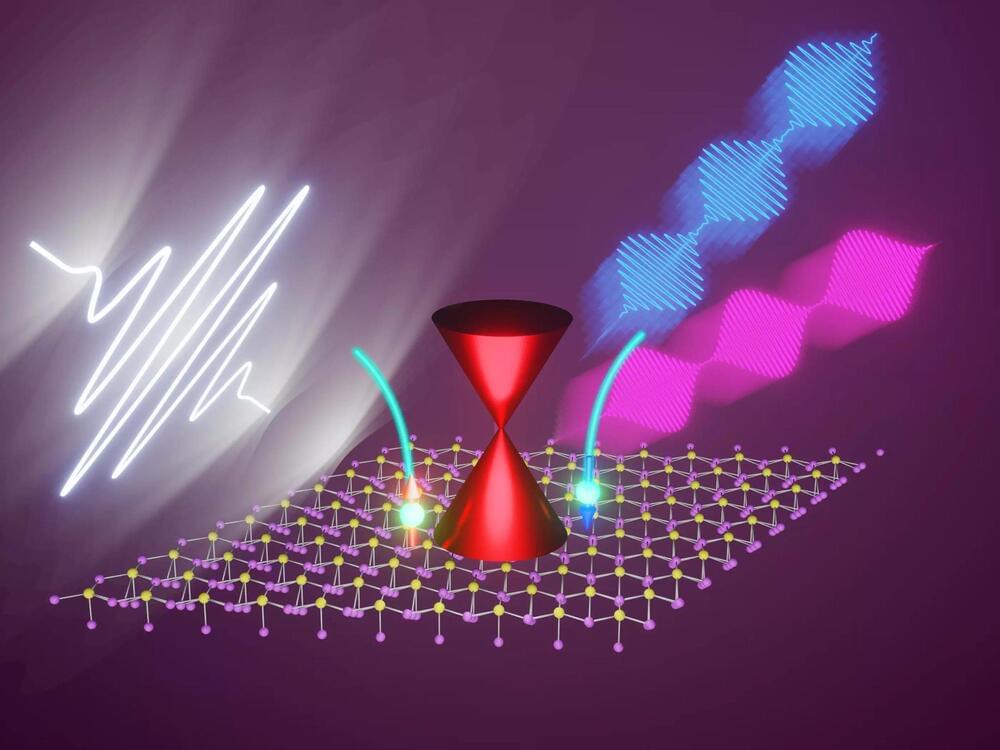
Theoretical physicists at the Max Planck Institute for the Structure and Dynamics of Matter (MPSD) have demonstrated how the coupling between intense lasers, the motion of electrons, and their spin influences the emission of light on the ultrafast timescale.

Electrons, which are present in all kinds of matter, are charged particles and therefore react to the application of light. When an intense light field hits a solid, electrons experience a force, called the Lorentz force, that drives them and induces some exquisite dynamics reflecting the properties of the material. This, in turn, results in the emission of light by the electrons at various wavelengths, a well-known phenomenon called high-harmonic generation.

Exactly how the electrons move under the influence of the light field depends on a complex mixture of properties of the solid, including its symmetries, topology, and band structure, as well as the nature of the light pulse. Additionally, electrons are like spinning tops. They have a propensity to rotate either clockwise or counter-clockwise, a property called the “spin” of the electrons in quantum mechanics.

/* */