@IBM Senior Vice President Darío Gil shows Richard Quest “the world’s most advanced quantum computer.”
Category: quantum physics – Page 336
US achieves superconductor breakthrough, can benefit quantum computing
A team of scientists in the United States has achieved a notable milestone in the domain of superconductors. This progress may have considerable consequences for the future of quantum computing.
The research details the development of a novel superconductor material that has the potential to transform quantum computing and potentially function as a “topological superconductor.”
A topological superconductor is a special kind of material that exhibits superconductivity (zero electrical resistance) and also has unique properties related to its shape or topology.

Dark electrons discovered in solids in superconductor breakthrough
Dark energy is not limited to outer space, many solid materials around us also contain electrons hidden in dark states.
Until now scientists believed that dark electrons, electrons associated with the quantum state of matter, simply don’t exist in solid materials.
However, a new study from…
A new study from researchers at South Korea’s Yonsei University reveals that solid materials do contain dark electrons. The finding will also allow scientists to develop novel superconductor materials.
The Universe May Be Inside A Quantum Object — What Just Happened
Seeing the universe as one quantum object changes how we think about reality. It suggests that the separations we see are just an illusion—a useful one for everyday life, but an illusion nonetheless. At the deepest level, there’s no true division, no separate objects or events. Everything is part of one continuous, interconnected whole.

Test of a prototype quantum internet runs under New York City for half a month
To introduce quantum networks into the marketplace, engineers must overcome the fragility of entangled states in a fiber cable and ensure the efficiency of signal delivery. Now, scientists at Qunnect Inc. in Brooklyn, New York, have taken a large step forward by operating just such a network under the streets of New York City.

Researcher explores how you can stretch your mind to grasp quantum entanglement
My new article, “Quantum Entanglement of Optical Photons: The First Experiment, 1964–67,” is intended to convey the spirit of a small research project that reaches into uncharted territory. The article breaks with tradition, as it offers a first-person account of the strategy and challenges of the experiment, as well as an interpretation of the final result and its significance. In this guest editorial, I will introduce the subject and also attempt to illuminate the question “What is a paradox?”
Could we ever harness quantum vacuum energy?
The fabric of spacetime is roiling with vibrating quantum fields, known as vacuum energy. It’s right there, everywhere we look. But could we ever get anything out of it?
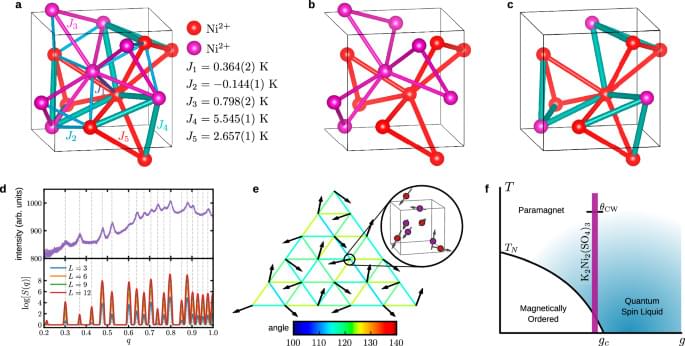
Dynamics of K2Ni2(SO4)3 governed by proximity to a 3D spin liquid model
Recently, quantum spin liquid signatures have been found in 3D systems. Here, using a combination of inelastic neutron scattering and calculations, the authors study the dynamic magnetic properties of a 3D quantum spin liquid candidate K2Ni2(SO4)3, identifying a spin liquid region in the theoretical phase diagram.

IBM Wants to Combine Quantum and Classical for the Best of Both Worlds
Some of these problems are as simple as factoring a large number into primes. Others are among the most important facing Earth today, like quickly modeling complex molecules for drugs to treat emerging diseases, and developing more efficient materials for carbon capture or batteries.
However, in the next decade, we expect a new form of supercomputing to emerge unlike anything prior. Not only could it potentially tackle these problems, but we hope it’ll do so with a fraction of the cost, footprint, time, and energy. This new supercomputing paradigm will incorporate an entirely new computing architecture, one that mirrors the strange behavior of matter at the atomic level—quantum computing.
For decades, quantum computers have struggled to reach commercial viability. The quantum behaviors that power these computers are extremely sensitive to environmental noise, and difficult to scale to large enough machines to do useful calculations. But several key advances have been made in the last decade, with improvements in hardware as well as theoretical advances in how to handle noise. These advances have allowed quantum computers to finally reach a performance level where their classical counterparts are struggling to keep up, at least for some specific calculations.
What is IBM doing in the race towards quantum computing?
Quantum computing is in all likelihood the 21st century’s great computer revolution. What is IBM doing to make the quantum dream a reality?