Toggle light / dark theme

Space: Time

Matter. What is reality? And if it’s so fundamental, why do we all experience it so differently? Join us for a marathon through the discoveries and paradoxes that suggest modern physics is pointing to a deeply uncomfortable truth: that our picture of the universe is far from complete, and what we think about reality may be completely wrong.

Love New Scientist? For a specially discounted New Scientist digital subscription, go to https://www.newscientist.com/youtube

Subscribe ➤ https://bit.ly/NSYTSUBS

00:00 Reality Is Already Broken
00:57 Scientists Build a Window into the Fourth Dimension
23:16 The Physicist Who Says Reality Is Not What It Seems
1:28:45 The Black Hole Paradox That Keeps Physicists Awake at Night
1:50:40 Sean Carroll: The Many Worlds of Quantum Mechanics
2:46:40 What are the foundations of reality?

Get more from New Scientist:
Official website: https://bit.ly/NSYTHP
Facebook: https://bit.ly/NSYTFB
Twitter: https://bit.ly/NSYTTW
Instagram: https://bit.ly/NSYTINSTA
LinkedIn: https://bit.ly/NSYTLIN

About New Scientist:
New Scientist was founded in 1956 for “all those interested in scientific discovery and its social consequences”. Today our website, videos, newsletters, app, podcast and print magazine cover the world’s most important, exciting and entertaining science news as well as asking the big-picture questions about life, the universe, and what it means to be human.

New Scientist
https://www.newscientist.com/

#reality #physics #paradox #space #time #science #universe

New photonic device efficiently beams light into free space

If a lot of light could be rapidly and precisely beamed off the chip, free from the confines of the wiring, it could open the door to higher-resolution displays, smaller Lidar systems, more precise 3D printers, or larger-scale quantum computers.

Now, researchers from MIT and elsewhere have developed a new class of photonic devices that enable the precise broadcasting of light from the chip into free space in a scalable way.

We Might Be Completely Wrong About Reality

Space. Time. Matter. What is reality? And if it’s so fundamental, why do we all experience it so differently? Join us for a marathon through the discoveries and paradoxes that suggest modern physics is pointing to a deeply uncomfortable truth: that our picture of the universe is far from complete, and what we think about reality may be completely wrong.

Love New Scientist? For a specially discounted New Scientist digital subscription, go to https://www.newscientist.com/youtube

Subscribe ➤ https://bit.ly/NSYTSUBS

00:00 Reality Is Already Broken
00:57 Scientists Build a Window into the Fourth Dimension
23:16 The Physicist Who Says Reality Is Not What It Seems
1:28:45 The Black Hole Paradox That Keeps Physicists Awake at Night
1:50:40 Sean Carroll: The Many Worlds of Quantum Mechanics
2:46:40 What are the foundations of reality?

Get more from New Scientist:
Official website: https://bit.ly/NSYTHP
Facebook: https://bit.ly/NSYTFB
Twitter: https://bit.ly/NSYTTW
Instagram: https://bit.ly/NSYTINSTA
LinkedIn: https://bit.ly/NSYTLIN

About New Scientist:

The Singularity Needs a Navigator

In 2013, physicist Alex Wissner-Gross published a single equation for intelligence in [ITALIC] Physical Review Letters [/ITALIC]: # F = T∇Sτ

The force of an intelligent system equals its temperature — computational capacity, raw horsepower — multiplied by the gradient of its future option-space. Intelligence is not a mysterious property of carbon-based brains.

It is a physical force: the tendency of any sufficiently energetic system to maximize the number of future states accessible to it.

The equation was elegant. Correct. And incomplete.

It describes the force. It does not describe the geometry of the space through which that force navigates.

A gradient without a metric is a direction without distance — it tells the system where to push but not what distortion it will encounter on the way there.

We spent three years building the geometry. We tested it across 69 billion simulations. What we found changes everything. ## The Missing Geometry — From Force to Navigation.

These Physicists Say They Found The Origin Of Reality

Take back your personal data with Incogni! Use code Sabine at the link below and get 60% off annual plans: https://incogni.com/sabine.

One of the most perplexing questions in the foundations of physics is how our shared sense of reality emerges out of quantum mechanics. This is because in quantum mechanics, it seems, different observers can arrive at different conclusions about what is real and what not. A group of physicists now used an approach called “Quantum Darwinism” to solve this tricky problem. At least they say they solved it. I am not so sure. Let’s have a look.

Paper: https://journals.aps.org/pra/abstract… mugs, posters and more: ➜ https://sabines-store.dashery.com/ 💌 Support me on Donorbox ➜ https://donorbox.org/swtg 👉 Transcript with links to references on Patreon ➜ / sabine 📝 Transcripts and written news on Substack ➜ https://sciencewtg.substack.com/ 📩 Free weekly science newsletter ➜ https://sabinehossenfelder.com/newsle… 👂 Audio only podcast ➜ https://open.spotify.com/show/0MkNfXl… 🔗 Join this channel to get access to perks ➜ / @sabinehossenfelder 📚 Buy my book ➜ https://amzn.to/3HSAWJW #science #sciencenews #quantum #physics This video discusses the concept of “reality” in quantum physics, touching on how different observers can reach different conclusions. It features a presentation of a scientific paper on the “Metrological approach to the emergence of classical objectivity,” suggesting a potential solution to a long-standing problem in quantum mechanics. We explore how the “observer effect” and individual “consciousness” play a crucial role in shaping our understanding of “reality does not exist” within the realm of “quantum physics explained.” This deep dive connects the fundamental principles of “quantum mechanics” with profound questions in “philosophy.”

👕T-shirts, mugs, posters and more: ➜ https://sabines-store.dashery.com/
💌 Support me on Donorbox ➜ https://donorbox.org/swtg.
👉 Transcript with links to references on Patreon ➜ / sabine.
📝 Transcripts and written news on Substack ➜ https://sciencewtg.substack.com/
📩 Free weekly science newsletter ➜ https://sabinehossenfelder.com/newsle
👂 Audio only podcast ➜ https://open.spotify.com/show/0MkNfXl
🔗 Join this channel to get access to perks ➜
/ @sabinehossenfelder.
📚 Buy my book ➜ https://amzn.to/3HSAWJW

#science #sciencenews #quantum #physics.

This video discusses the concept of \.

3 Questions: On the future of AI and the mathematical and physical sciences

Curiosity-driven research has long sparked technological transformations. A century ago, curiosity about atoms led to quantum mechanics, and eventually the transistor at the heart of modern computing. Conversely, the steam engine was a practical breakthrough, but it took fundamental research in thermodynamics to fully harness its power.

Today, artificial intelligence and science find themselves at a similar inflection point. The current AI revolution has been fueled by decades of research in the mathematical and physical sciences (MPS), which provided the challenging problems, datasets, and insights that made modern AI possible. The 2024 Nobel Prizes in physics and chemistry, recognizing foundational AI methods rooted in physics and AI applications for protein design, made this connection impossible to miss.

In 2025, MIT hosted a Workshop on the Future of AI+MPS, funded by the National Science Foundation with support from the MIT School of Science and the MIT departments of Physics, Chemistry, and Mathematics. The workshop brought together leading AI and science researchers to chart how the MPS domains can best capitalize on — and contribute to — the future of AI. Now a white paper, with recommendations for funding agencies, institutions, and researchers, has been published in Machine Learning: Science and Technology. In this interview, Jesse Thaler, MIT professor of physics and chair of the workshop, describes key themes and how MIT is positioning itself to lead in AI and science.

Quantum dots generate entangled photon pairs on demand

For the first time, researchers in China have demonstrated how quantum dots can be engineered to consistently generate pairs of entangled photons. By carefully tailoring the photonic environment surrounding a single quantum dot, the team showed that it is possible to produce highly correlated photon pairs with remarkable efficiency, potentially opening new opportunities for emerging quantum technologies. The work, led by Zhiliang Yuan at the Beijing Academy of Quantum Information Sciences, is reported in Nature Materials.

In recent years, technologies capable of generating single photons on demand have advanced at an impressive pace. Already, these sources have led to substantial progress in fields ranging from quantum computing and secure communications, to advanced sensing and biomedical imaging.

A natural next step will be the ability to produce pairs of photons that are identical and strongly entangled. Even when separated by large distances, the properties of entangled photons remain linked: an effect that lies at the heart of many quantum technologies.

Quantum computers must overcome major technical hurdles before tackling quantum chemistry problems

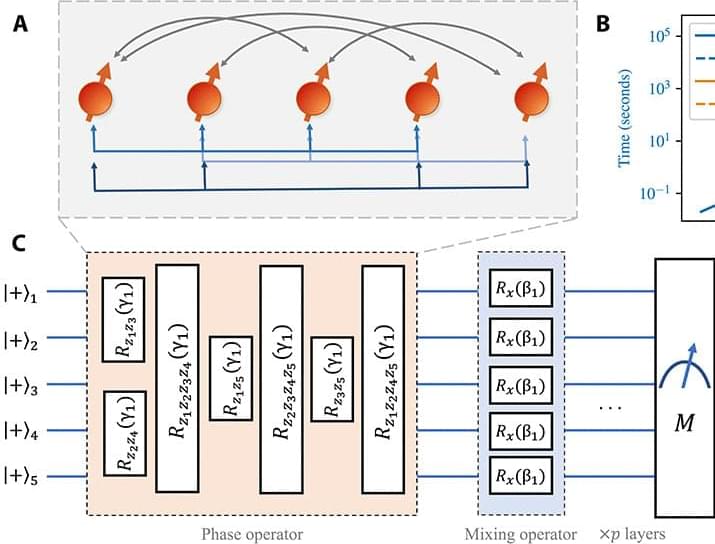
Although the potential applications of quantum computing are widespread, a new feasibility study suggests quantum computers still face major hurdles in solving quantum chemistry problems. The study, published in Physical Review B, evaluates what criteria are needed for a quantum advantage in searching for the ground state energy of molecules. The researchers attempt this feat using two different algorithms with differing strengths and weaknesses.

The team first determined the criteria for the variational quantum eigensolver (VQE) algorithm, which is used for noisy, near-term devices and sets an upper bound to the level of imprecision or decoherence in quantum hardware. The researchers derived quantitative criteria for VQE and QPE based on error rates, energy scales, and overlap with the ground state.

Results showed that VQE is extremely sensitive to hardware errors and decoherence. The team says that achieving chemical accuracy would require error rates far below current hardware capabilities. Available error mitigation techniques offer only limited improvement and scale poorly with system size.

/* */