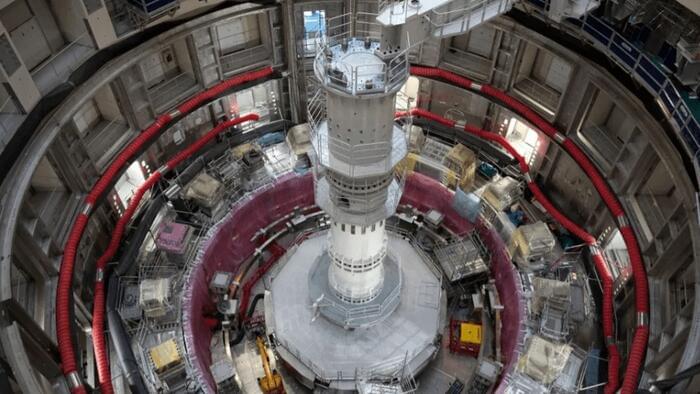
Scientists at Argonne National Laboratory have developed a new material that could replace expensive nickel alloys in nuclear reactors.
Category: nuclear energy – Page 47

Creating loops of liquid lithium for fusion temperature control
Fusion vessels have a Goldilocks problem: The plasma within needs to be hot enough to generate net power, but if it’s too hot, it can damage the vessel’s interior. Researchers at the Princeton Plasma Physics Laboratory (PPPL) are exploring ways to draw away excess heat, including several methods that use liquid metal.
One possibility, say researchers at the U.S. Department of Energy Lab, involves flowing liquid lithium up and down a series of slats in tiles lining the bottom of the vessel. The liquid metal could also help to protect the components that face the plasma against a bombardment of particles known as neutrons.
“The prevailing option for an economical commercial fusion reactor is a compact design,” said PPPL’s Egemen Kolemen, co-author of a 2022 paper on the research and an associate professor of mechanical and aerospace engineering and the Andlinger Center for Energy and the Environment. However, compactness makes handling the heat flux and neutron bombardment a bigger challenge.
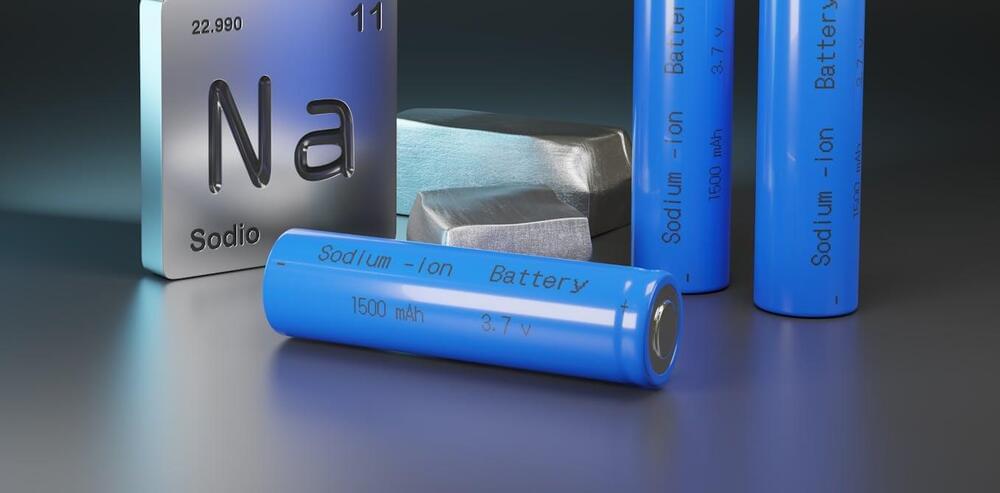
Sodium-ion batteries are set to spark a renewable energy revolution — and Australia must be ready
The challenges posed by solar and wind generators are real. They are inherently variable, producing electricity only when the sun is shining and the wind is blowing. To ensure reliable energy supplies, grids dominated by renewables need “firming” capacity: back-up technology that can supply electricity on demand.
Some, including the Albanese government, argue gas-fired generators are needed to fill the gap. Others, such as the Coalition, say renewables can’t “keep the lights on” at all and Australia should pursue nuclear energy instead.
But a new way to firm up the world’s electricity grids is fast developing: sodium-ion batteries. This emerging energy storage technology could be a game-changer – enabling our grids to run on 100% renewables.

Sodium-ion batteries set to spark renewable energy revolution — and Australia must be ready
The challenges posed by solar and wind generators are real. They are inherently variable, producing electricity only when the sun is shining and the wind is blowing. To ensure reliable energy supplies, grids dominated by renewables need “firming” capacity: back-up technology that can supply electricity on demand.
Some, including the Albanese government, argue gas-fired generators are needed to fill the gap. Others, such as the Coalition, say renewables can’t “keep the lights on” at all and Australia should pursue nuclear energy instead.
But a new way to firm up the world’s electricity grids is fast developing: sodium-ion batteries. This emerging energy storage technology could be a game-changer – enabling our grids to run on 100% renewables.

Breaking Barriers in Nuclear Fusion: How Neutron Migration Could Change Everything
Low-energy nuclear fusion reactions are influenced by the migration of neutrons and protons between fusing nuclei and their isospin compositions. Research conducted using high-performance computational models has shown the importance of isospin dynamics and nuclear shapes, particularly in asymmetric, neutron-rich systems, revealing significant implications for nuclear physics and potential energy applications.
Low-Energy Nuclear Fusion
Low-energy nuclear fusion reactions can potentially provide clean energy. In stars, low-energy fusion reactions during the stages of carbon and oxygen burning are critical to stellar evolution. These reactions also offer valuable insights into the exotic processes occurring in the inner crust of neutron stars as they accumulate matter. However, scientists do not fully understand the underlying dynamics governing these reactions.
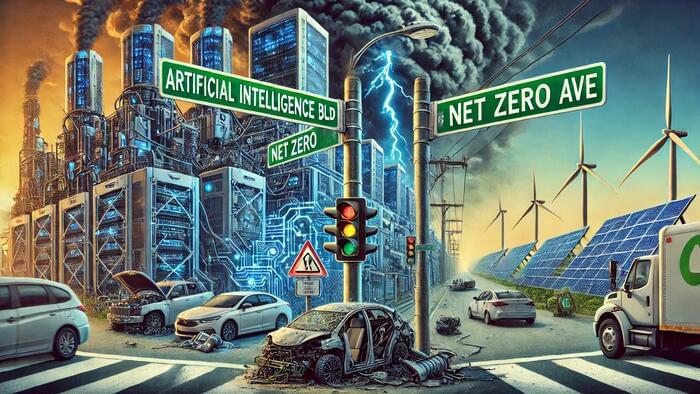
A Big Wreck Is About To Happen At The Intersection Of Artificial Intelligence Boulevard And Net Zero Avenue
To put the forecasted demand into context, consider this: A recent MIT study found that a single data center consumes electricity equivalent to 50,000 homes. Estimates indicate that Microsoft, Amazon, and Google operate about 600 data centers in the U.S. today…
Arguments exist that by 2030, 80% of renewable power sources will fulfill electricity demand. For reference, the U.S. generated roughly 240 billion kilowatt hours of solar and 425 billion kilowatt hours of wind, totaling 665 billion kilowatt hours in 2023. Assuming a 50/50 split between wind and solar, that scenario implies that, to satisfy the U.S. electricity demand that adequately facilitates AI competitiveness, wind and solar will have to generate approximately 3.4 trillion kilowatt hours of electricity each. That is more than a ten-fold increase over the next five years. The EIA highlights that the U.S. planned utility-scale electric-generating capacity addition in 2023 included 29 million kilowatts of solar (54% of the total) and 6 million kilowatts of wind (11% of the total), which pales in comparison to the estimated amount required.
It just doesn’t get much more clear; renewables cannot begin to supply the energy needed for AI data centers. Only fossil fuels and nuclear can get the job done. It’s that simple. AI is not something global elites are going to let slide by. They’ve had a good run with the Big Green Grift but those days are going to gradually (maybe not so gradually) come to an end, as the demand for energy to power AI forces a reconsideration.
How Can Warp Drive Travel Faster Than Light? Alcubierre Warp Drive Explained
The concept of traveling beyond the speed of light has been given theoretical grounding through the Alcubierre warp drive. Proposed by physicist Miguel Alcubierre in the 1990s, this warp drive involves creating a space-time bubble around a spacecraft. By contracting space in front of the spacecraft and expanding it behind, the ship can ride a wave of space-time, seemingly achieving faster-than-light travel without breaking the cosmic speed limit. In essence, it’s the space around the ship that moves, not the ship itself, allowing for rapid traversal of vast distances.
The theoretical feasibility of the Alcubierre warp drive hinges on generating an immense amount of energy, currently beyond our technological capabilities. The ship’s warp core, similar to a nuclear reactor, would utilize matter and antimatter collisions to produce the necessary energy for warping space. While this concept was initially fictional, Alcubierre proposed a solution to Einstein’s Field Equation that aligned with the principles of the Star Trek Warp Drive.
NASA has recently developed a model of Alcubierre Warp Drive. Ongoing developments and models inspired by the Alcubierre Drive suggest that interstellar travel might not be confined to science fiction in the distant future.
The Alcubierre Warp Drive presents an intriguing approach to faster-than-light travel by manipulating spacetime. Unlike traditional propulsion, this theoretical model involves compressing spacetime in front of a spacecraft and expanding it behind, creating a \.

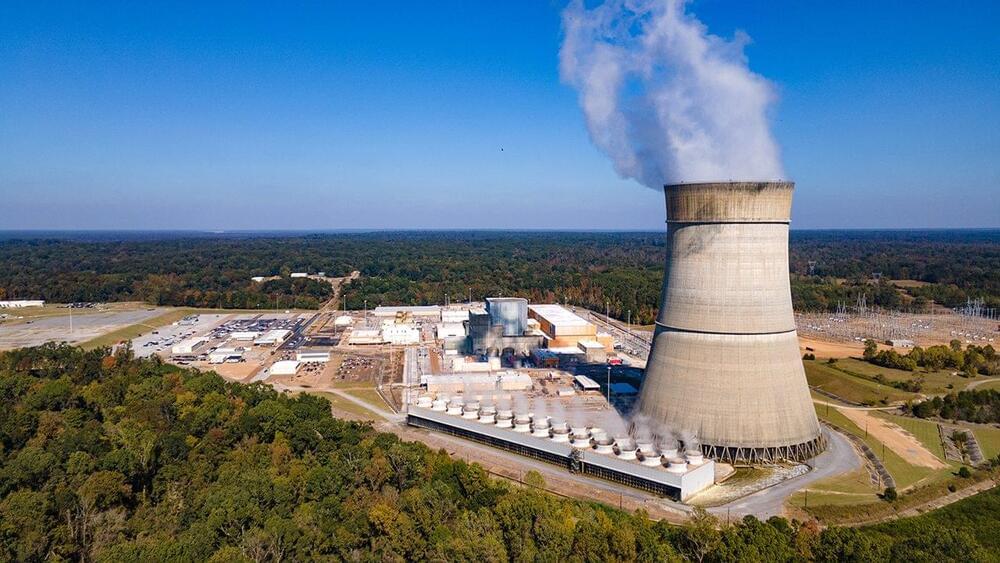
Inside The Secret Deals Between Tech Companies And Nuclear Power Plants
Tech companies, including Amazon Web Services, are striking deals with U.S. nuclear power plants to secure electricity for their data centers, driven by the skyrocketing demands of artificial intelligence. This move promises 24/7 carbon-free power but stirs controversy, as it could divert existing energy supplies, raise prices, and increase reliance on natural gas. These nuclear-powered data centers might accelerate the AI race, but they also spark debates over economic development, grid reliability, and climate goals. Could this be the future of tech or a risky gamble with unforeseen consequences?
As reported by WSJ, tech businesses searching the country for electrical supplies have focused on one important target: America’s nuclear power facilities.
The owners of about one-third of the United States’ nuclear power reactors are in negotiations with technology companies about providing electricity to new data centers needed to satisfy the needs of an artificial intelligence boom.