Toggle light / dark theme

Light-activated tissue adhesive patch offers rapid, watertight neurosurgical sealing

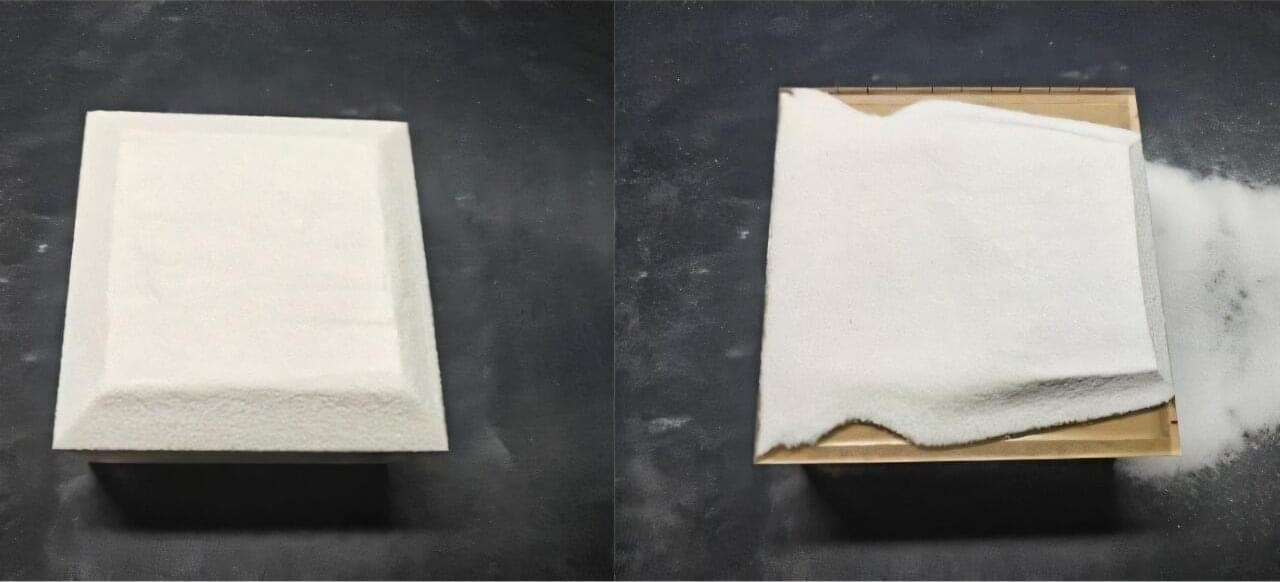
Durotomy is a common neurosurgical complication involving a tear in the dura mater, the protective membrane surrounding the brain and spinal cord. Damage can cause cerebrospinal fluid (CSF) leakage, leading to delayed healing, headaches, and infection, making a reliable watertight dural closure essential.

Tissue adhesives are increasingly being explored as alternatives to suturing for dural closure because they offer simpler and faster application. However, many existing glue-based sealants suffer from excessive swelling, leading to mass effect and unwanted tissue adhesion, which can lead to postoperative complications.

To address these limitations, researchers have investigated Janus tissue patches, which feature two distinct surfaces—one that adheres strongly to tissue and another that prevents unwanted adhesion. Unfortunately, most existing Janus patches rely on multiple materials and complex, multi-step fabrication processes, limiting their practical use.

Modern Calculations Finally Solve 50-Year-Old Magnetic Mystery in Steel

Researchers at the Department of Materials Science and Engineering within The Grainger College of Engineering have identified the first detailed physical mechanism explaining how magnetic fields slow the movement of carbon atoms inside iron. The study, published in Physical Review Letters, sheds new light on the role carbon plays in shaping the internal grain structure of steel.

Steel, which is made from iron and carbon, is among the most widely used construction materials worldwide. Producing steel with specific internal structures typically requires extreme heat, making the process highly energy intensive.

Decades ago, researchers observed that exposing certain steels to magnetic fields during heat treatment led to improved performance, but the explanations offered at the time remained largely theoretical. Pinpointing the underlying cause of this effect could give engineers more precise control over heat treatment, leading to more efficient processing and lower energy demands.

Tuning spin waves—using commercially available devices at room temperature

Physicist Davide Bossini from the University of Konstanz has recently demonstrated how to change the frequency of the collective magnetic oscillations of a material by up to 40%—using commercially available devices at room temperature.

“We now have a full picture,” Bossini says. For years, the physicist from the University of Konstanz has studied how to use light to control the collective magnetic oscillations of a material—known as magnons. In the summer of 2025, he was finally able to show how to change the “magnetic DNA” of a material via the interaction between light and magnons.

He now demonstrates how the frequency of oscillations can be controlled quasi instantly and on demand by means of a weak magnetic field and intense laser pulses. In this way, he can increase or decrease frequencies by up to 40%. The effect is due to the interaction of the optical excitation, magnetic anisotropy (directional dependence) and the external magnetic field.

Stanford Researchers Develop New Material That Changes Color and Texture Like an Octopus

Inspired by the remarkable camouflage abilities of octopus and cuttlefish, Stanford researchers have developed a soft material that can rapidly shift its surface texture and color at extremely fine scales. Octopus and cuttlefish are masters of disguise. Many species can quickly shift both the col

Scientists demonstrate low-cost, high-quality lenses for super-resolution microscopy

Researchers have shown that consumer-grade 3D printers and low-cost materials can be used to produce multi-element optical components that enable super-resolution imaging, with each lens costing less than $1 to produce. The new fabrication approach is poised to broaden access to fully customizable optical parts and could enable completely new types of imaging tools.

“We created optical parts that enable imaging of life’s smallest building blocks at a remarkable level of detail,” said lead author Jay Christopher from the University of Strathclyde in the UK. “This approach opens the possibility for customized imaging systems and unlocks imaging scenarios that are traditionally either impossible or need costly glass manufacturing services.”

In the journal Biomedical Optics Express, the researchers describe their lens design and manufacturing processes, which combine 3D printing, silicone molding and a UV curable clear resin. They used lenslets fabricated with their technique to create a multifocal structured illumination microscope that imaged microtubules in a cell’s cytoskeleton with a resolution of around 150 nm.

Ultra-small, high-performance electronics grown directly on 2D semiconductors

In recent years, electronics engineers have been trying to identify semiconducting materials that could substitute for silicon and enable the further advancement of electronic devices. Two-dimensional (2D) semiconductors, such as molybdenum disulfide (MoS₂), have proved to be among the most promising solutions, as their thinness and resistance to short-channel effects could yield highly performing and smaller electronics.

To create transistors and other electronic components based on 2D materials, however, engineers need to be able to attach electrical connections to them and reliably form ohmic contacts, which allow electrical current to flow freely through the resulting devices. As devices get smaller, however, they also require smaller contacts that have proved to be very difficult to attach to 2D semiconductors.

Researchers at Nanjing University and other institutes in China recently introduced a new strategy to reliably grow ultra-short and low-resistance semimetallic antimony crystal contacts directly on MoS₂

New calibration module offers improved measurement of thermoelectric device performance

A standard reference thermoelectric module (SRTEM) for objectively measuring thermoelectric module performance has been developed in Korea for the first time. A research team led by Dr. Sang Hyun Park at the Korea Institute of Energy Research developed the world’s second standard reference thermoelectric module, following Japan, and improved its performance by more than 20% compared with existing modules, demonstrating the excellence of Korea’s homegrown technology. The findings are published in the journal ACS Applied Materials & Interfaces.

A thermoelectric module is a device that generates electricity by creating a flow of electrons driven by a temperature difference, with one side becoming cold and the other becoming hot. Conversely, when an electric current is applied to a thermoelectric module, one side cools down while the other side heats up.

Thanks to these characteristics, thermoelectric modules are widely used in applications such as compact camping refrigerators and electronic equipment including computers. In addition, because they are environmentally friendly and well suited to miniaturization, they can be broadly applied to emerging fields such as carbon-free power generation and the space industry, which have recently drawn significant attention.

Ultra-strong, lightweight metal composite can withstand extreme heat

University of Toronto researchers have designed a new composite material that is both very light and extremely strong—even at temperatures up to 500 Celsius.

The material, which is described in a paper published in Nature Communications, is made of various metallic alloys and nanoscale precipitates, and has a structure that mimics that of reinforced concrete—but on a microscopic scale.

These properties could make it extremely useful in aerospace and other high-performance industries.

Calculating the spreading of fluids in porous materials to understand saltwater in soil

A solution to a tricky groundwater riddle from Australia: Researchers at TU Wien have developed numerical models to simulate the movement of fluids in porous materials.

Things are complicated along the Murray–Darling River in southern Australia. Agricultural irrigation washes salt out of the upper soil layers, and this salt eventually ends up in the river. To prevent the river’s salt concentration from rising too much, part of the is diverted into special basins.

Some of these basins are designed to let the salty water evaporate, others to slowly release it in a controlled manner in the underground. That keeps salt temporarily out of the river and allows better management of the river’s water—but it increases the salinity in the ground. How can we calculate how this saltwater spreads underground and what its will be?

/* */