With Raymond Kurzweil’s co-author Dr. Terry Grossman M.D and Dr. The panel will also awnser Longevity questions live. This is your opportunity to get powerful health insights from the World’s leading thinkers in Life Extension.
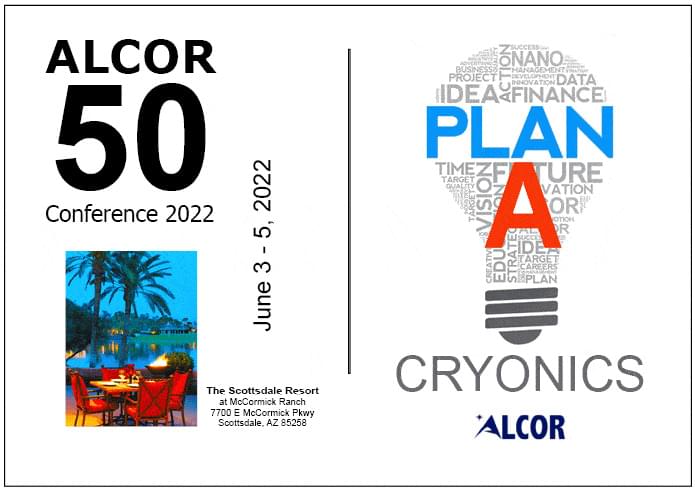
This year, the Alcor Life Extension Foundation is celebrating its 50th year. To mark the occasion, we are holding a conference on June 3–5, 2022, at the Scottsdale Resort in Scottsdale, Arizona.
The conference itself will be Alcor’s first major in-person gathering in seven years, so we’re going to “go big.” We expect members, prospective members, and others interested in life extension and the far future to turn out enthusiastically. We hope not only that our attendees will enjoy hearing from and interacting with you, but also that you may find the experience enjoyable. There is no organization quite like Alcor, after all, and very few opportunities to explore cryonics and its implications for society now and in the far future.
Reimagining A Healthier Future for All — Dr. Pat Verduin PhD, Chief Technology Officer, Colgate, discussing the microbiome, skin and oral care, and healthy aging from a CPG perspective.
Dr. Patricia Verduin, PhD, (https://www.colgatepalmolive.com/en-us/snippet/2021/circle-c…ia-verduin) is Chief Technology Officer for the Colgate-Palmolive Company where she provides leadership for product innovation, clinical science and long-term research and development across their Global Technology Centers’ Research & Development pipeline.
Dr. Verduin joined Colgate Palmolive in 2007 as Vice President, Global R&D. Previously she served as Vice President, Scientific Affairs, for the Grocery Manufacturers Association, and from 2000 to 2006, she held the position of Vice President, Research & Development, at ConAgra Foods.
Dr. Verduin started her career with 17 years at Nabisco, serving in multiple roles, including plant manager and scientist. She earned her undergraduate degree from the University of Delaware, holds an MBA from Fairleigh Dickinson University and a PhD in Food Science from Rutgers University.
Colgate-Palmolive Company (https://www.colgatepalmolive.com/) is an American multinational consumer products company specializing in the production, distribution and provision of household, health care, personal care and veterinary products, with a mission of re-imagining a healthier future for all people, their pets and our planet.
Estimates put this industry’s worth at a staggering $610 billion by 2025. 😳
The Renaissance philosopher Montaigne quipped that “death has us by the scruff of the neck at every moment.” He could have added: until, finally, it strangles us. But what if we knew how to escape death’s chokehold? What if we could avoid death and live forever?
Immortality might seem like the stuff of science fiction, yet it’s increasingly becoming the focus of real science. In 2013, Google launched Calico, a biotech firm whose objective is to “solve” death. PayPal co-founder Peter Thiel, meanwhile, has pledged to “fight” death. And last year, it was reported Amazon chairman Jeff Bezos had invested in Altos Labs, a company that plans to “rejuvenate” cells in order to “reverse disease.” (Bezos owns The Washington Post.)
Not an amazing update. All female rats are not getting the results the previous group of males got. To my knowledge human trials are still actively being set up for late this year.
In this video we report on the May 2022 update from Dr. Katcher’s experiment with E5, where he is testing to see how long the rats will stay alive if they are given an E5 injection every 90 days.
Papers referenced in the video: Life-Span Extension in Mice by Preweaning Food Restriction and by Methionine Restriction in Middle Age. https://pubmed.ncbi.nlm.nih.gov/19414512/
Earlier this month, we brought you the news that epigenetic reprogramming startup YouthBio Therapeutics had emerged from stealth. The company shed some light on its plans to develop epigenetic reprogramming therapies for age-related diseases by rejuvenating certain cells in our bodies. YouthBio aims to achieve this rejuvenation by developing gene therapies that enable partial cellular reprogramming – an area of longevity science that is now attracting significant commercial interest.
Longevity. Technology: Cellular reprogramming refers to the process of returning adult cells to a “pluripotent” state: blank, embryonic-like cells that can become any cell in the body. This reprogramming can be achieved using techniques based on the discovery of Yamanaka factors.
Scientists led by Dr. Manuel Serrano have observed symptoms of rejuvenation in the pancreas, liver, spleen, and blood of mice after applying one cycle of cell reprogramming.
To achieve this, the researchers have characterized rejuvenation by studying molecular marks in the DNA, gene expression, and cell metabolism. The study has been published in the journal Aging Cell.
Many diseases, including cancer, are associated with ageing and they are becoming more prevalent as life expectancy increases. Therefore, studying and understanding these processes is crucial if we are to deal with these conditions and also promote healthier aging.