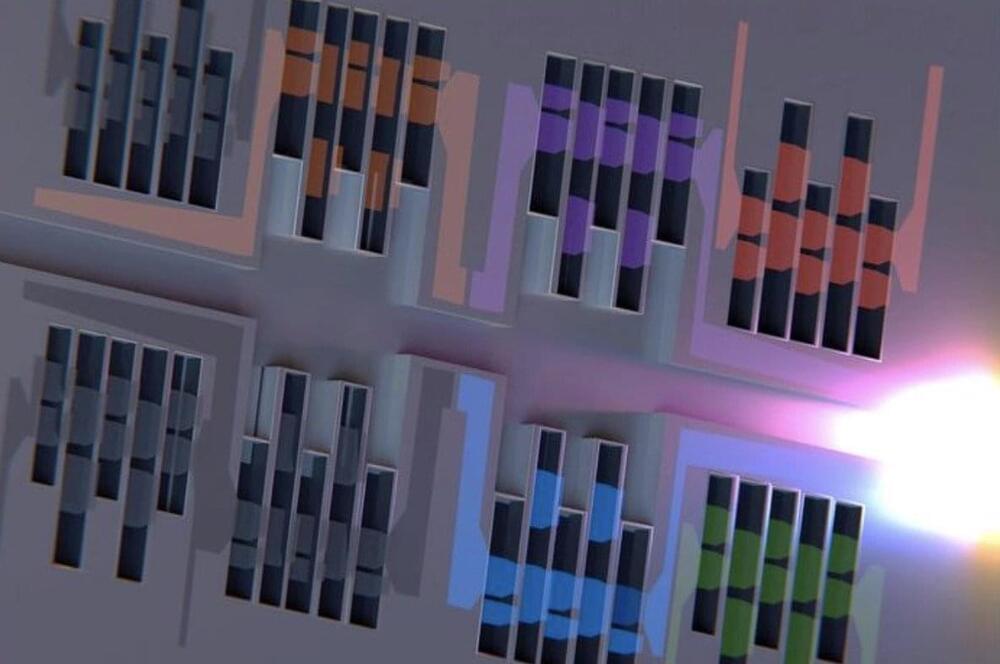
Scientists at the University of Florida have pioneered a method for using semiconductor technology to manufacture processors that significantly enhance the efficiency of transmitting vast amounts of data across the globe. The innovation, featured on the current cover of the journal Nature Electronics, is poised to transform the landscape of wireless communication at a time when advances in AI are dramatically increasing demand.
Traditionally, wireless communication has relied on planar processors, which, while effective, are limited by their two-dimensional structure to operate within a limited portion of electromagnetic spectrum. The UF-designed approach leverages the power of semiconductor technology to propel wireless communication into a new dimension—quite literally.
Researchers have successfully transitioned from planar to three-dimensional processors, ushering in a new era of compactness and efficiency in data transmission.
Join us for an extraordinary livestream webinar, ‘Paving the Way for the Future: Learning from 4 Biostasis Cases and the Challenges and Advancements at Tomorrow Bio’ featuring esteemed speakers Dr. Emil Kendziorra and Dr. Irishikesh Santhosh from Tomorrow Biostasis GmbH. This pivotal session, scheduled for March 18th, 2024, at 7:00 PM, will delve into the latest advancements and real-world applications of biostasis, focusing on the detailed processes and outcomes associated with four distinct patient cases from 2023.
In this webinar, we will explore the intricate procedures and challenges encountered during the biostasis process, including stabilization in the face of cardiopulmonary arrest, the nuances of surgical and perfusion procedures, and the critical cooldown process for long-term storage. Our experts will unpack the innovative techniques employed, the utilization of cryoprotectant solutions, cooling techniques, and the diligent monitoring through CT scans, alongside the resolution of unforeseen technical challenges.
Each case report offers a unique glimpse into the complexities of biostasis, presenting the issues faced, such as equipment malfunctions and procedural hurdles, and the subsequent strategies for resolution or planned mitigations. Through graphical presentations on temperature, pressure, and refractive index, and detailed analyses of CT scans, attendees will gain comprehensive insights into the cutting-edge methods and equipment pivotal to biostasis.
This webinar is not just a learning opportunity but a platform for interactive discussion. We encourage all attendees to engage with our speakers through live questions, share their insights, and participate in real-time polls. Whether you’re a seasoned medical professional, an avid student of science, or simply fascinated by the potential of biostasis to preserve life, this session promises to be both enlightening and engaging.
Mark your calendars for March 18th, 2024, at 7:00 PM, and prepare to be part of a groundbreaking exploration into the future of biostasis. Your participation and questions will enrich our collective understanding and foster a deeper discussion on the possibilities that lie ahead.
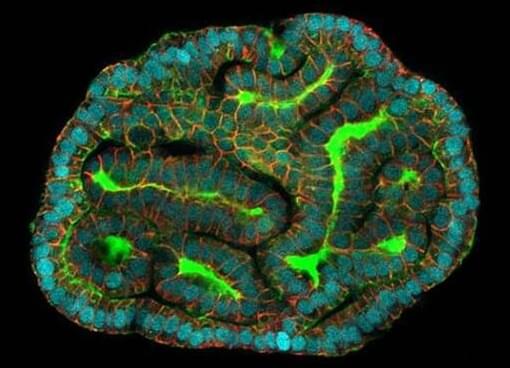
Scientists have grown small but complex models of human organs from live fetus cells for the first time, giving experts new insight into our development and potential treatments for malformations while in the womb.
These organoids aren’t full replicas of organs, but they’re close enough to the real deal that they can be used to study disease and other aspects of human biology that are difficult to investigate in living people.
In a new study carried out by an international team of researchers, lung, kidney, and intestine organoids were grown from living stem cells in amniotic fluid. This fluid helps to protect the growing baby and feed it with nutrients, and is taken from the mother without harming her baby as part of regular pregnancy tests.
Gartner predicts, too, that by 2027 15% of EV companies founded since the last decade will be acquired or bankrupt. “This does not mean the EV sector is crumbling,” said Pedro Pacheco, vice president of research at Gartner. “It is simply entering a new phase where companies with the best products and services will win over the remaining.” Of course, at least 18 EV and battery startups that went public in recent years and attracted huge investments are now struggling for cash, with plenty going belly up, including Lordstown Motors and Proterra.
Still, new innovations will push BEV price down, Gartner states. “New OEM incumbents want to heavily redefine the status quo in automotive,” he added. “They brought new innovations that simplify production costs such as centralized vehicle architecture or the introduction of gigacastings that help reduce manufacturing cost and assembly time, which legacy automakers had no choice to adopt to survive.”
By 2027, next-gen BEVs will be cheaper to make than comparable ICE vehicles, with production costs dropping faster than battery costs. But there’s a rub: Repair costs will be more expensive, Gartner says. By 2027, it predicts that the average cost of an EV body and battery “serious accident repair” will increase by 30%.
AI isn’t nearly as popular with the global populace as its boosters would have you believe.
As Axios reports based on a new poll of 32,000 global respondents from the consultancy firm Edelman, public trust is already eroding less than 18 months into the so-called “AI revolution” that popped off with OpenAI’s release of ChatGPT in November 2022.
“Trust is the currency of the AI era, yet, as it stands, our innovation account is dangerously overdrawn,” Justin Westcott, the global technology chair for the firm, told Axios. “Companies must move beyond the mere mechanics of AI to address its true cost and value — the ‘why’ and ‘for whom.’”
The increasing demand for ever-faster information processing has ushered in a new era of research focused on high-speed electronics operating at frequencies nearing terahertz and petahertz regimes. While existing electronic devices predominantly function in the gigahertz range, the forefront of electronics is pushing towards millimeter waves, and the first prototypes of high-speed transistors, hybrid photonic platforms, and terahertz metadevices are starting to bridge the electronic and optical domains.
However, characterizing and diagnosing such devices pose a significant challenge due to the limitations of available diagnostic tools, particularly in terms of speed and spatial resolution. How shall one measure a breakthrough device if it’s the fastest and smallest of its kind?
In response to this challenge, a team of researchers from the University of Konstanz now proposes an innovative solution: They create femtosecond electron pulses in a transmission electron microscope, compress them with infrared laser light to merely 80 femtosecond duration, and synchronize them to the inner fields of a laser-triggered electronic transmission line with the help of a photoconductive switch. Then, using a pump-probe approach, the researchers directly sense the local electromagnetic fields in their electronic devices as a function of space and time.
Researchers at the University of Rochester’s Laboratory for Laser Energetics (LLE) have led experiments showcasing an efficient “spark plug” for direct-drive approaches to inertial confinement fusion (ICF). In a pair of studies featured in Nature Physics, the team shares their findings and details the potential for scaling up these methods, aiming for successful fusion in a future facility.
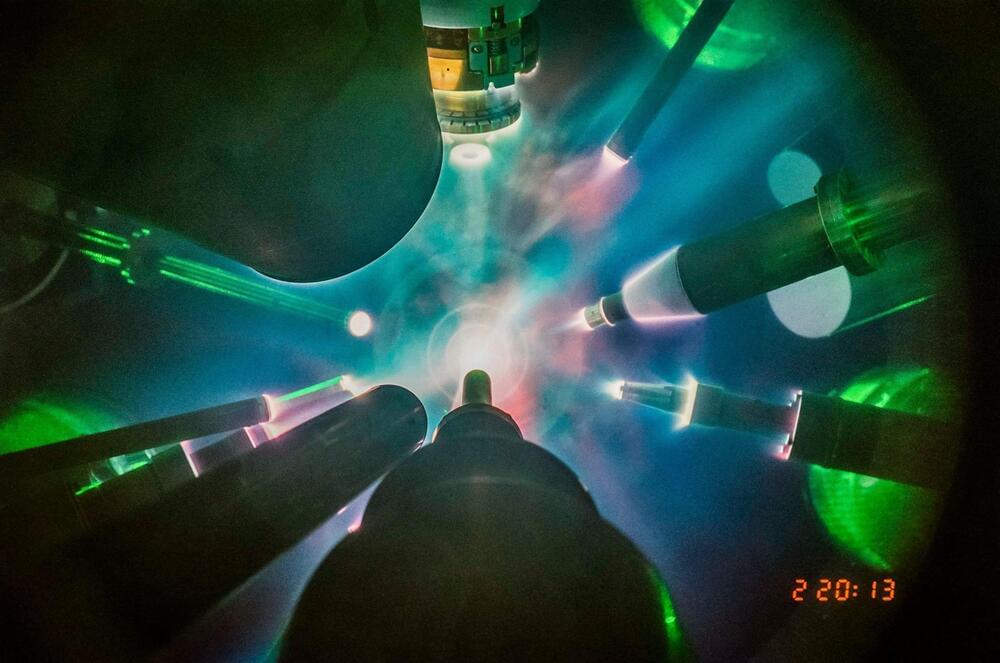
LLE is the largest university-based U.S. Department of Energy program and hosts the OMEGA laser system, which is the largest academic laser in the world but still almost one hundredth the energy of the National Ignition Facility (NIF) at the Lawrence Livermore National Laboratory in California. With OMEGA, Rochester scientists completed several successful attempts to fire 28 kilojoules of laser energy at small capsules filled with deuterium and tritium fuel, causing the capsules to implode and produce a plasma hot enough to initiate fusion reactions between the fuel nuclei. The experiments caused fusion reactions that produced more energy than the amount of energy in the central hot plasma.
The OMEGA experiments use direct laser illumination of the capsule and differ from the indirect drive approach used on the NIF. When using the indirect drive approach, the laser light is converted into X-rays that in turn drive the capsule implosion. The NIF used indirect drive to irradiate a capsule with X-rays using about 2,000 kilojoules of laser energy. This led to a 2022 breakthrough at NIF in achieving fusion ignition —a fusion reaction that creates a net gain of energy from the target.
The team behind the breakthrough used the Atacama Large Millimeter/ submillimeter Array (ALMA) to zoom in on water vapor locked up in gas and dust within a protoplanetary disk surrounding the sun-like star HL Tauri, located 450 light-years away from Earth in the constellation Taurus.
“I had never imagined that we could capture an image of oceans of water vapor in the same region where a planet is likely forming,” Stefano Facchiniresearch leader and an astronomer at the University of Milan, said in a statement. “Our results show how the presence of water may influence the development of a planetary system, just like it did some 4.5 billion years ago in our own solar system.”