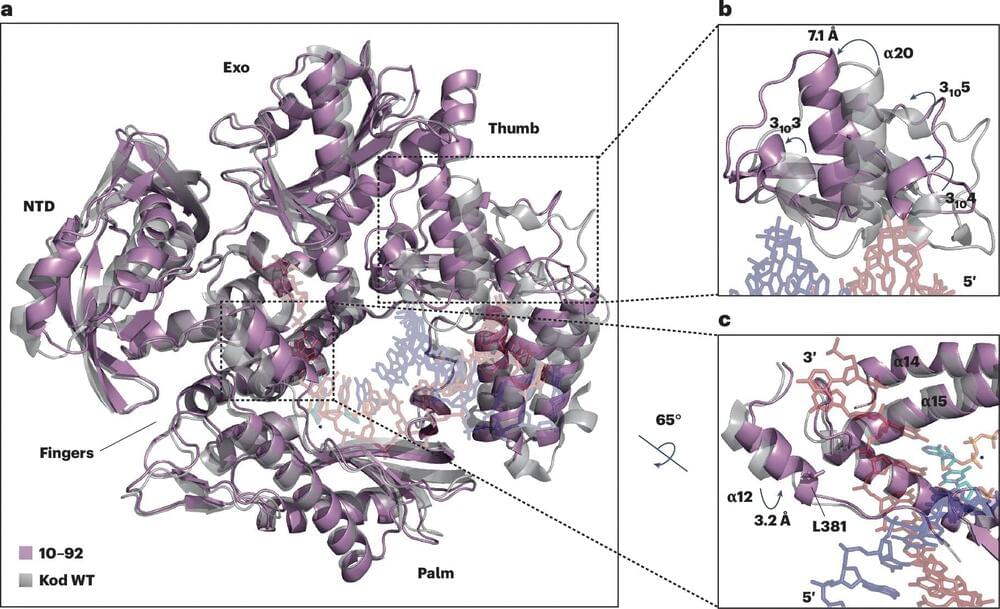
A research team led by the University of California, Irvine has engineered an efficient new enzyme that can produce a synthetic genetic material called threose nucleic acid. The ability to synthesize artificial chains of TNA, which is inherently more stable than DNA, advances the discovery of potentially more powerful, precise therapeutic options to treat cancer and autoimmune, metabolic and infectious diseases.
“It’s exciting to see the high efficiency and versatility of eePASSIGE, which could enable a new category of genomic medicines,” added Gao. “We also hope that it will be a tool that scientists from across the research community can use to study basic biological questions.”
Prime improvements
Many scientists have used prime editing to efficiently install changes to DNA that are up to dozens of base pairs in length, sufficient to correct the vast majority of known pathogenic mutations. But introducing entire healthy genes, often thousands of base pairs long, in their native location in the genome has been a long-standing goal of the gene-editing field. Not only could this potentially treat many patients regardless of which mutation they have in a disease-causing gene, but it would also preserve the surrounding DNA sequences, which would increase the likelihood that the newly installed gene is properly regulated, rather than expressed too much, too little, or at the wrong time.
Researchers have identified a plausible geological setting in which nucleic acids, the fundamental building blocks of genetic material, could have replicated on their own, potentially giving rise to life on Earth.
The study, published as a reviewed preprint in the journal eLife, shows how a simple interaction between gas flow and water in a narrow rock channel could create the physical conditions necessary for nucleic acid replication.
The work offers insights that may interest scientists exploring the origins of life as well as applications in nucleic acid research and diagnostics.
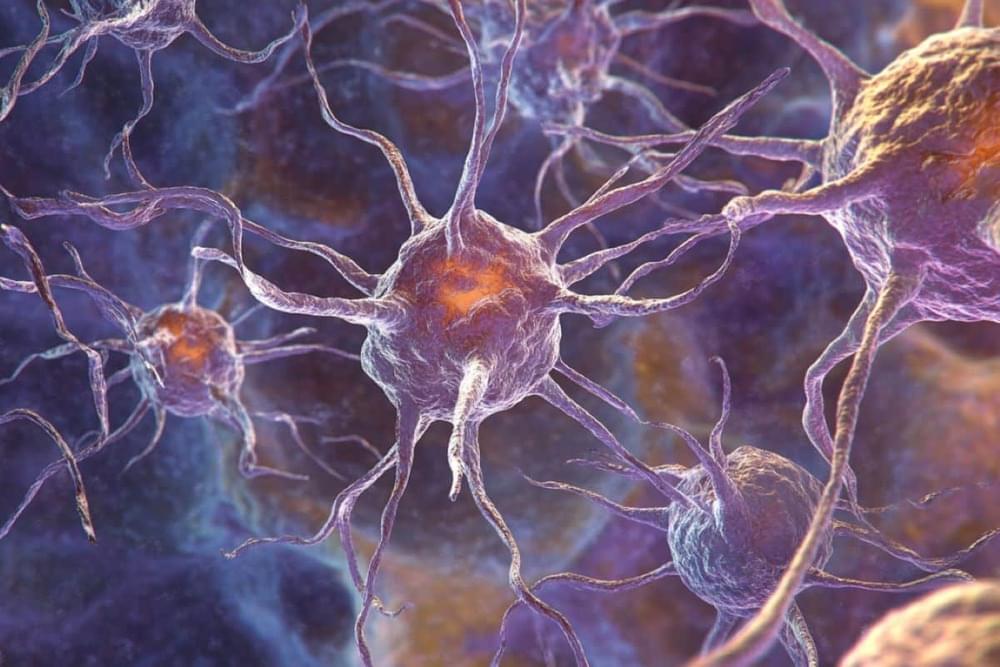
Summary: Scientists have identified how genetic variants influence the risk of neurological and psychiatric disorders, including schizophrenia and autism. Using live neural cells and DNA sequencing, researchers discovered thousands of “non-coding” genetic variants with context-dependent functions, activated during brain development.
These variants act like switches, turning genes on or off depending on cellular pathways. This research offers new insights into the biological mechanisms behind psychiatric disorders and could lead to personalized treatments based on genetic profiles.
Summary: Neural stem cells, which create new neurons in the brain, become less active with age due to elevated glucose levels. Researchers found that by knocking out the glucose transporter gene GLUT4 in older mice, they could significantly increase the production of new neurons.
This discovery opens up potential pathways for both genetic and behavioral interventions to stimulate brain repair, including the possibility of a low-carbohydrate diet. The findings could help treat neurodegenerative diseases and aid in brain recovery after injury.
Diseases that affect the retina, the light-sensitive layer at the back of the eye, are a significant cause of visual impairment and blindness. Gene therapy holds promise for treating some of these conditions, and current research advances may soon shift the therapeutic landscape for eye health. However, many obstacles remain in place, as this Special Feature discusses.
Gene therapy uses genetic material, either DNA or RNA, to treat or prevent the progression of a disease. It often involves the introduction of genetic material into a person’s cells to replace a defective or missing gene.
Although early attempts at gene therapy have been effective in achieving the expression of the therapeutic gene in the target tissue, they have also been accompanied by severe adverse effects.
UPTON, N.Y. — Efforts to achieve net-zero carbon emissions from transportation fuels are increasing demand for oil produced by nonfood crops. These plants use sunlight to power the conversion of atmospheric carbon dioxide into oil, which accumulates in seeds. Crop breeders interested in selecting plants that produce a lot of oil look for yellow seeds. In oilseed crops like canola, yellow-seeded varieties generally produce more oil than their brown-seeded counterparts. The reason: The protein responsible for brown seed color — which yellow-seeded plants lack — also plays a key role in oil production.
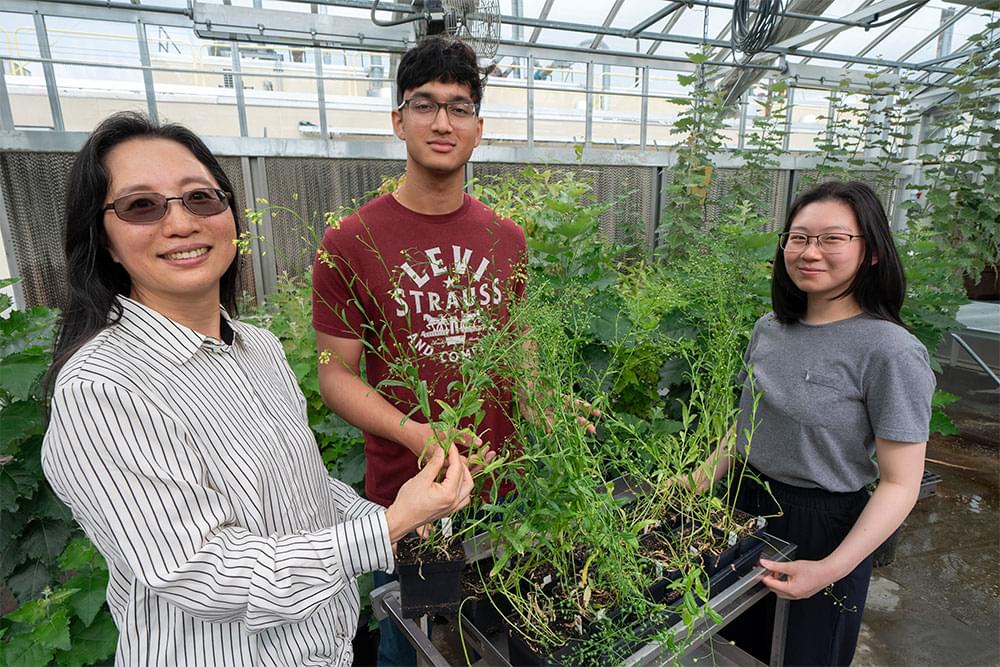
Now, plant biochemists at the U.S. Department of Energy’s (DOE) Brookhaven National Laboratory — who are interested in increasing plant oil synthesis for the sustainable production of biofuels and other bioproducts — have harnessed this knowledge to create a new high-yielding oilseed crop variety. In a paper just published in The Plant Biotechnology Journal,they describe how they used tools of modern genetics to produce a yellow-seeded variety of Camelina sativa, a close relative of canola, that accumulates 21.4% more oil than ordinary camelina.
“If breeders can get a few percent increase in oil production, they regard it as significant, because even small increases in yield can lead to large increases in oil production when you’re planting millions of acres,” said Brookhaven Lab biochemist John Shanklin, chair of the Lab’s Biology Department and leader of its plant oil research program. “Our nearly 22% increase was unexpected and could potentially result in a dramatic increase in production,” he said.
People genetically adapted to diving, 13 min. is a record, not average for them, they are exceptional anyway.
Picture yourself holding your breath. How long can you last underwater? A minute? Two? You probably imagined yourself sitting a foot or so beneath the surface of a pool during this exercise, but consider how long you can hold your breath actively swimming as deep below the surface of the ocean as you can go. This would probably look like maybe 30 seconds of swimming down followed by a rush to the surface. The Bajau people of the Philippines, though, according to reports, could quite confidently imagine swimming 200 feet below the ocean surface for up to 13 minutes.
These abilities aren’t merely the result of dedicated training. The Bajau people have lived their lives at sea for generations, so much so that they’ve developed special adaptations to their oceanic lifestyle.
We’re joined by Dr. Denis Noble, Professor Emeritus of Cardiovascular Physiology at the University of Oxford, and the father of ‘systems biology’. He is known for his groundbreaking creation of the first mathematical model of the heart’s electrical activity in the 1960s which radically transformed our understanding of the heart.
Dr. Noble’s contributions have revolutionized our understanding of cardiac function and the broader field of biology. His work continues to challenge long-standing biological concepts, including gene-centric views like Neo-Darwinism.
In this episode, Dr. Noble discusses his critiques of fundamental biological theories that have shaped science for over 80 years, such as the gene self-replication model and the Weissmann barrier. He advocates for a more holistic, systems-based approach to biology, where genes, cells, and their environments interact in complex networks rather than a one-way deterministic process.
We dive deep into Dr. Noble’s argument that biology needs to move beyond reductionist views, emphasizing that life is more than just the sum of its genetic code. He explains how AI struggles to replicate even simple biological systems, and how biology’s complexity suggests that life’s logic lies not in DNA alone but in the entire organism.
The conversation covers his thoughts on the flaws of Neo-Darwinism, the influence of environmental factors on evolution, and the future of biology as a field that recognizes the interaction between nature and nurture. We also explore the implications of his work for health and longevity, and how common perspectives on genetics might need rethinking.