Built for performance-critical indie games, where heap allocations and GC spikes can break smooth gameplay.


Consider teaching a computer how to read by giving it billions of books. You don’t teach it grammar rules or logic; you simply ask it to play a game: “Look at these words, and guess what word comes next.” To win this game at a world-class level, the computer can’t just memorize phrases. It has to start figuring out how the world works. If it’s reading a mystery novel, it needs to deduce who the killer is to guess the final sentence. If it’s reading a math textbook, it has to understand addition to predict the answer to a problem. This is the core idea explored in a recent scientific paper titled “Algorithmic Compression via Pretrained Neural Networks.”*The researchers look under the hood of today’s Large Language Models (LLMs)—like the AI assistants we use every day—to explain a fascinating mystery: Why does a machine trained merely to predict the next word end up looking like it can think, reason, and solve complex problems? Think about how a ZIP file works on your computer. If you have a massive text file filled with the word “apple” repeated a million times, a compression program won’t save all million words. It will compress it into a short rule: “Repeat ‘apple’ 1,000,000 times.” It turns a massive mountain of data into a tiny, elegant recipe. (learning how to learn). Because the AI is fed a massive, diverse diet of information, it can’t just memorize everything. Instead, it is forced to find the underlying “recipes” or rules behind the data it sees. When you type a prompt into an AI, it doesn’t just look up an answer in a database. It looks at your text, infers the “generative algorithm” (the underlying pattern or logic of what you are asking), and uses that pattern to compress the problem and generate the correct response. In essence, it deduces the hidden rules of the game on the fly. * Discover Complex Logic: When given a sequence of chess moves, the AI doesn’t just guess random moves; it actually reconstructs the abstract rules and evaluations of a chessboard in its digital “mind.” While this framework helps explain why AI is getting so smart, it also opens up big new questions. We know these models are compressing data and finding rules, but we still don’t fully understand the absolute limits of this approach. How close can a practical AI get to that theoretical “perfect” intelligence? What happens when the AI runs out of human data to learn from?
Vitányi was appointed professor of computer science at the University of Amsterdam, and researcher at the National Research Institute for Mathematics and Computer Science in the Netherlands (CWI, initially Mathematical Centre [MC]) where he is currently a CWI Fellow. He was guest professor at the University of Copenhagen in 1978; research associate at the Massachusetts Institute of Technology in 1985/1986; Gaikoku-Jin Kenkyuin (councilor professor) at INCOCSAT at the Tokyo Institute of Technology in 1998; visiting professor at Boston University in 2004, at Monash University in 1996 and at the National ICT of Australia NICTA at University of New South Wales in 2004/2005; visiting professor at and adjunct professor of computer science at the University of Waterloo from 2005.
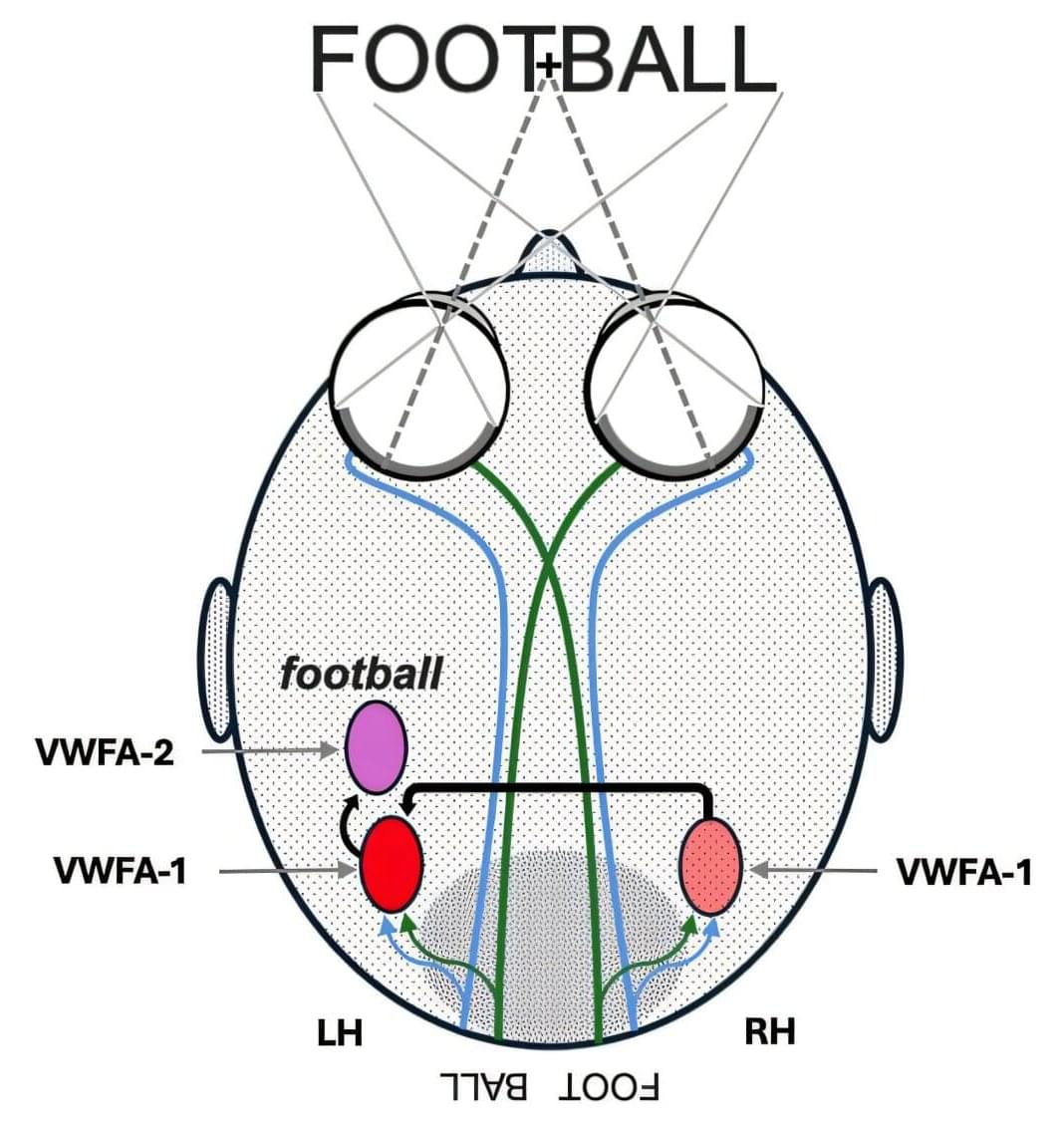
Before you even know what a word means, your brain is already playing a rapid-fire game of linguistic LEGO. Discover how our minds secretly dissect words, piece by orthographic piece, in the blink of an eye.
Imagine catching a flash of the word football on a screen. Before you even register its meaning (“a game” or “a ball”), your brain may have already parsed it into “foot” + “ball.” A clever new experiment used red-and-blue anaglyph glasses and split-second word flashes to probe this. It found that real compound words (like football) are recognized much faster than lookalikes (like shamrock), suggesting our eyes and brain latch onto word form almost instantly.
In the lab, volunteers wore 3D-style red/blue glasses while words appeared for just 60 milliseconds under a mask. Each word was painted half red and half blue, splitting it either at a meaningful break or in the middle of a syllable. For example, “FOOT” might be blue and “BALL” red, or vice versa, sending “foot” to one hemisphere and “ball” to the other. Participants then quickly reported if what they saw was a real word or a made-up one.

Researchers have developed an ultra-thin optical film that improves the quality of the light used in LCD resin-based 3D printers. The advance helps ensure that tiny details are reproduced with precision, which could make it possible to 3D-print medical-grade or industrial-grade products at a lower cost.
Resin-based 3D printing, or vat photopolymerization, uses short-wavelength light to project patterns onto liquid photosensitive resin. Although this additive manufacturing approach enables highly detailed, smooth parts, some low-cost systems rely on LCD backlights that can reduce printing accuracy.
“LCD-based liquid 3D printing suffers from surface roughness or dimensional inaccuracies due to improper light angular distribution from the backlight systems used,” said research team leader Ding-Zheng Lin from National Taiwan University of Science and Technology. “Our goal was to fix these problems without increasing equipment size, thereby elevating print performance to professional grade.”
Mark Brown from Game Maker’s Toolkit released a new video.
Dream Zero: NVIDIA’s latest paradigm where a robot “dreams” its success in a world model before executing the motor commands in reality [[06:12](https://www.youtube.com/watch?v=3Y8aq_ofEVs&t=372)].
Jim Fan, who leads the embodied autonomous research group at Nvidia, returns to AI Ascent to argue that robotics is entering its end game — and that the playbook is already written. He walks through what he calls \.
Thirteen years ago, I sat down with a filmmaker who had spent his life warning us about a future we are now living inside.
Godfrey Reggio is the director of Koyaanisqatsi, Powaqqatsi, and Naqoyqatsi, the Qatsi trilogy. Koyaanisqatsi is a Hopi word. It means life out of balance.
In our conversation, he said something I have never been able to shake:
“It’s our behavior that determines the content of our mind. We become what we do. We become what we see. We become the routine that we are a part of.”
Read that again. Slowly.
Now look at your phone. Look at your feed. Look at the average screen time of the people around you, including yourself.
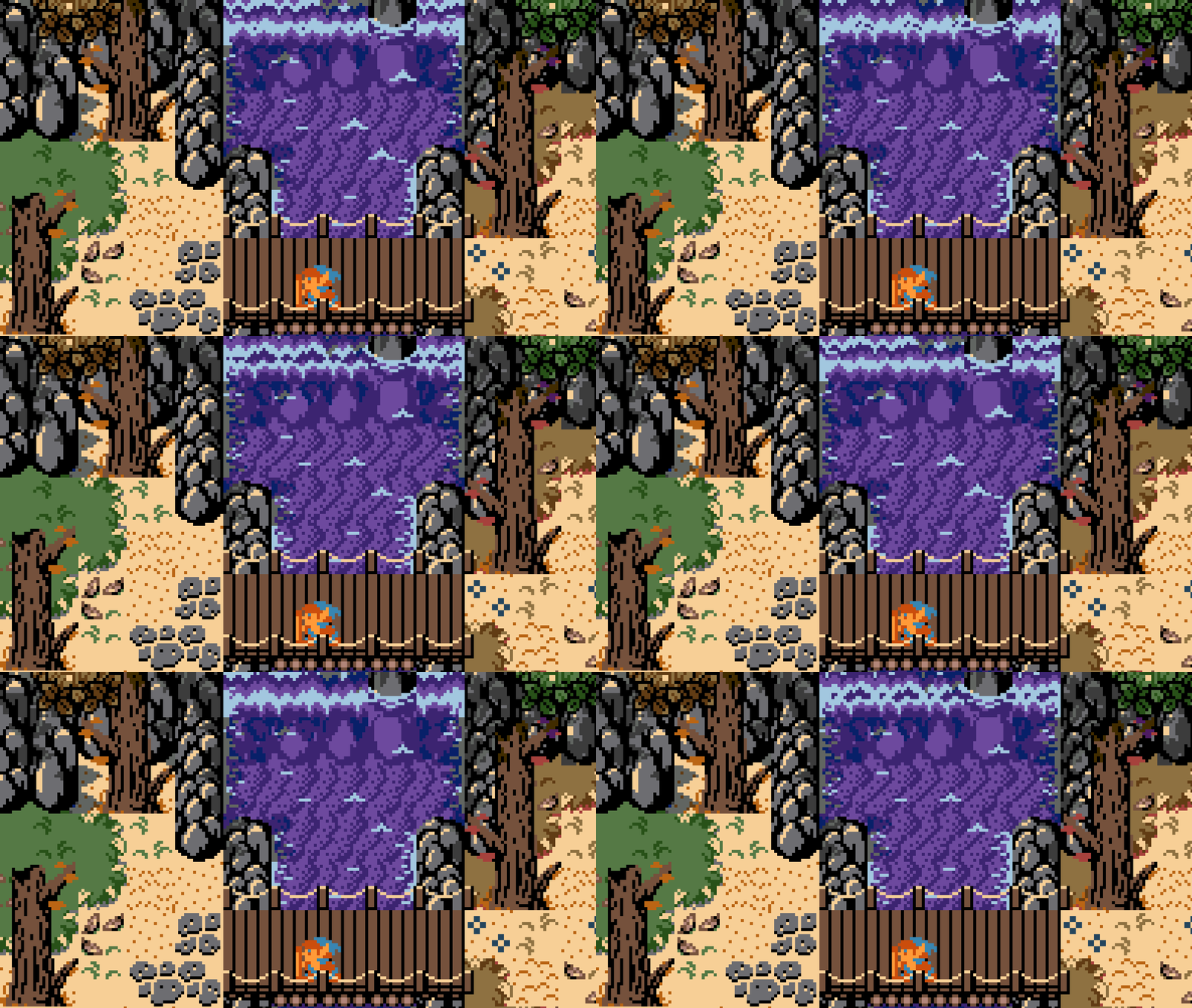
The same way you might play Dragon Quest and rush to assemble a tribute in RPG Maker, players have been making their own old-school adventures in ZQuest for decades. The results range from the quaint to the damn near authentic, and the cream of the crop is collected on a database-slash-forum called PureZC. It’s a visually lean, community-driven treasure trove the likes of which I didn’t think existed on the internet anymore. Custom games, all of which are called “quests” and disseminated as.qst files to be plugged into ZQuest, are split up into a few genres: Metroidvania, NES-style, dungeon romper, randomizer, and so on.
Like Venezia and Clark said, you can go a long way without writing so much as a line of code (though the option is there, should you opt to push the engine beyond its normal scope using the ZScript language). A fan favorite metroidvania quest from 2024, The Deep, features puzzles that incorporate shadows and fog, conveyor belts, a hookshot like you might remember from A Link to the Past, and all sorts of other novelties.
It’s easy to see how it took home the gold in a community contest, but all the more intriguing when you learn it did so in a “non-scripted bracket” and was built in just over three weeks. Bigger, multi-year endeavors like Lost Isle and The Hero of Dreams are lengthy and fully-featured games in their own right—projects that, if you squint, look and feel remarkably like unreleased Game Boy Advance games. While the quests are diverse, numbering over a thousand, reverence for the 40-year-old Nintendo series is the one thing that makes it all cohere.

Recently, Michael Hall, a doctoral candidate in the Comparative Literature and Cultural Studies Program, was invited to present his work exploring representation in gaming, “Dawnbreaker, the Curious Case of Decolonialism and Colonialism in Final Fantasy XIV, Dawntrail,” at the Popular Culture Association National Conference.
This new expansion for Final Fantasy XIV takes place in what is very clearly the Americas. While the story decenters on the individual, putting more focus on community and tradition, it also puts conquistador armor in the Native American expansion.
“Gaming has an issue with representation of non-Western cultures, and it’s good to point that out through a critical lens,” Hall said. “Representation can be done, both poorly and well.”
Following reports of recurring DRM checks, Sony clarifies that digital games only require a single online verification to confirm ownership in a new statement.