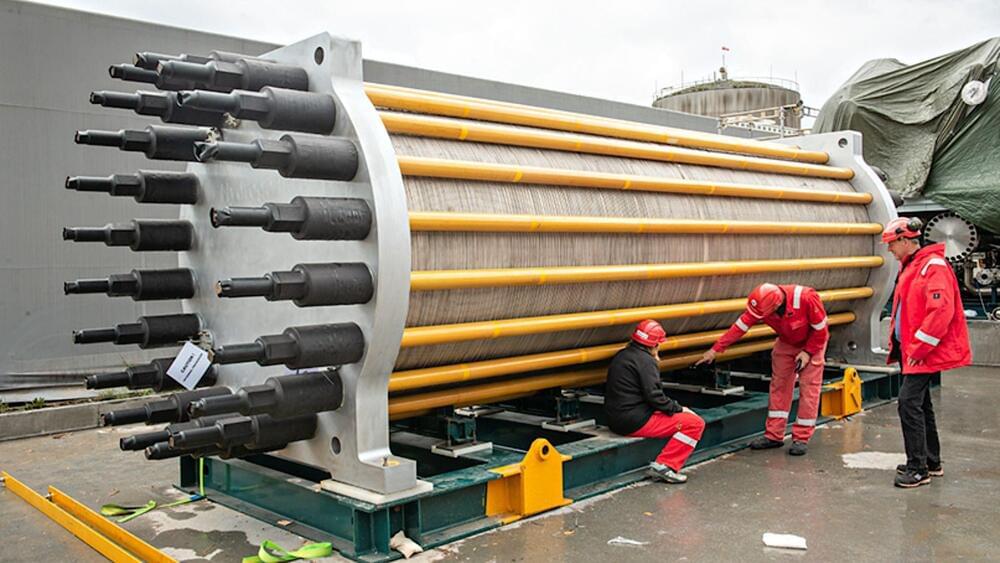
TAE’s latest backers include the likes of Google and Chevron
TAE has earned the backing of forward-thinking investors and, so far, has raised a total of $1.2 billion for its commercial fusion development thanks to a track record of exceeding milestones and performance capability. TAE’s mission is to provide a long-term solution to the world’s rapidly increasing electricity demand while ensuring global energy independence and security.
To that end, the company recently closed its Series G-2 financing round, in which it secured $250 million from investors in the energy, technology, and engineering sectors. By avoiding carbon and particulate emissions, TAE’s safe, non-radioactive method minimizes any negative effects on the environment or the effects of climate change.
Online safety and ethics are serious issues and can adversely affect less experienced users. Researchers have built upon familiar human verification techniques to add an element of discrete learning into the process. This way users can learn about online safety and ethics issues while simultaneously verifying they are human. Trials show that users responded positively to the experience and felt they gained something from these microlearning sessions.
The internet is an integral part of modern living, for work, leisure, shopping, keeping touch with people, and more. It’s hard to imagine that anyone could live in an affluent country, such as Japan, and not use the internet relatively often. Yet despite its ubiquity, the internet is far from risk-free. Issues of safety and security are of great concern, especially for those with less exposure to such things. So a team of researchers from the University of Tokyo including Associate Professor Koji Yatani of the Department for Electrical Engineering and Information Systems set out to help.
Surveys of internet users in Japan suggest that a vast majority have not had much opportunity to learn about ways in which they can stay safe and secure online. But it seems unreasonable to expect this same majority to intentionally seek out the kind of information they would need to educate themselves. To address this, Yatani and his team thought they could instead introduce educational materials about online safety and ethics into a typical user’s daily internet experience. They chose to take advantage of something that many users will come across often during their usual online activities: human verification.
Join our 60min Seminar with Sara Seager, PhD to learn about design, engineering, and upcoming mission of high altitude balloon to sample cloud particles from Venetian atmosphere!
Bill Gates is funding more research into dimming the sun! Check out how solar geoengineering works.
Bill Gates is a man who recently suggested the world should eat 100% synthetic beef, has argued that bitcoin is bad for the planet, co-founded Microsoft, and remains one of the richest people in the world.
He is also very interested in dimming the light from the sun to reduce or delay the effects of climate change, according to a forthcoming study from the Bill Gates-backed Harvard University Solar Geoengineering Research Program — which aims to evaluate the efficacy of blocking sunlight from reaching our planet’s surface.
A new study led by Michigan State University (MSU) has found that locusts can reliably detect through smell a variety of human cancers. The insects can not only “smell” the difference between healthy and cancerous cells, but they can also distinguish between different cancer cell lines. These findings could provide a basis for devices which use locust sensory neurons to enable the early detection of cancer by using only biomarkers in a patient’s breath.
“Noses are still state of the art,” said study senior author Debajit Saha, an assistant professor of Biomedical Engineering at MSU. “There’s really nothing like them when it comes to gas sensing. People have been working on ‘electronic noses’ for more than 15 years, but they’re still not close to achieving what biology can do seamlessly.”
Cancer cells function differently from healthy ones, and create different chemical compounds as they grow. If these chemicals reach the lungs or airways – which happens in most types of cancer – they can be detected in exhaled breath. “Theoretically, you could breathe into a device, and it would be able to detect and differentiate multiple cancer types and even which stage the disease is in. However, such a device isn’t yet close to being used in a clinical setting,” Professor Saha explained.
A new deep dive into this fascinating, possibly game changing tool to RAPIDLY build space infrastructure that would otherwise take far longer and cost more to lift into orbit with rockets.
One of the cornerstones of the implementation of quantum technology is the creation and manipulation of the shape of external fields that can optimize the performance of quantum devices. Known as quantum optimal control, this set of methods comprises a field that has rapidly evolved and expanded over recent years.
A new review paper published in EPJ Quantum Technology and authored by Christiane P. Koch, Dahlem Center for Complex Quantum Systems and Fachbereich Physik, Freie Universität Berlin along with colleagues from across Europe assesses recent progress in the understanding of the controllability of quantum systems as well as the application of quantum control to quantum technologies. As such, it lays out a potential roadmap for future technology.
While quantum optimal control builds on conventional control theory encompassing the interface of applied mathematics, engineering, and physics, it must also factor in the quirks and counter-intuitive nature of quantum physics.
How expensive is it to make a panel that uses e-ink technology? That might depend on how flexible you are. [RBarron] read about reverse engineering point-of-sale shelf labels and found them on eBay for just over a buck apiece. Next thing you know, 20 of them were working together in a single panel.
The panels use RF or NFC programming, normally, but have the capability to use BLE. Naturally you could just address each one in turn, but that isn’t very efficient. The approach here is to use one label as a BLE controller and it then drives the other displays in a serial daisy chain, where each label’s receive pin is set to the previous label’s transmit pin.
Innovative Solutions For Unmet Needs Of Older Adults & Their Caregivers — Keith Camhi, Managing Director, Techstars Future of Longevity Accelerator — A Partnership With Melinda Gates Pivotal Ventures.
Keith Camhi is Managing Director, Techstars Future of Longevity Accelerator (https://www.techstars.com/accelerators/longevity), a program, run in partnership with Pivotal Ventures (https://www.pivotalventures.org/), an investment and incubation company created by Melinda French Gates, focusing on innovative solutions to address the unmet needs of older adults and their caregivers. The longevity accelerator core program themes include: Caregiver Support, Care Coordination, Aging in Place, Financial Wellness and Resilience, Preventive Health (both Physical and Cognitive), and Social Engagement.
Keith was previously the SVP of Accelerators for Techstars globally and was inspired to move to the MD role for the longevity program based on having built a venture-backed startup serving older adults himself, having experienced the gaps in America’s care giving infrastructure firsthand, and wanting to support entrepreneurs who are building solutions to address this substantial market opportunity.
Techstars is a global investment business that provides access to capital, one-on-one mentorship, a worldwide network and customized programming for early-stage entrepreneurs. It was founded in 2006 in Boulder, Colorado. As of May 2022, the company had accepted over 2,900 companies into its accelerator programs with a combined market capitalization of US$71 billion.
Prior to Techstars, Keith founded and led the rapid growth of two tech companies in the health and fitness industry – one that reached #20 on the Deloitte Fast 500, and another that made Entrepreneur’s Franchise 500 three times. He has raised over $50 million in venture funding, holds several patents for sensor and machine vision technology, has been an angel investor and LP in several venture funds, and enjoys mentoring promising startups.