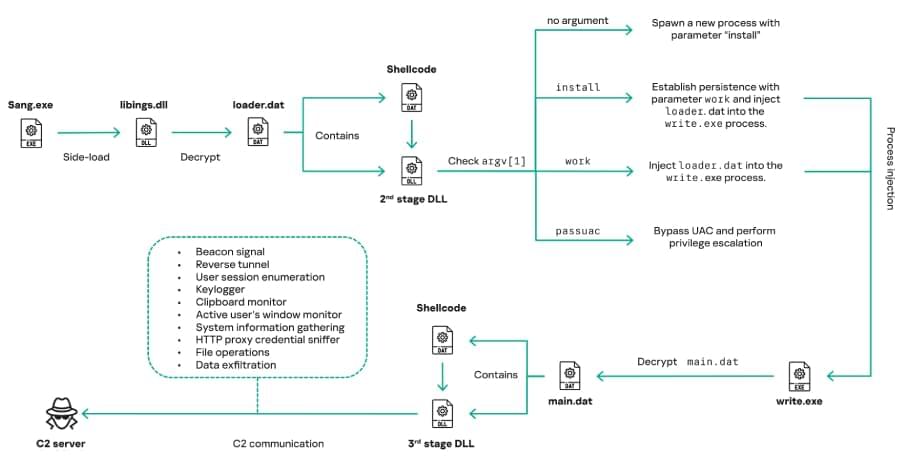
China-linked Mustang Panda used updated COOLCLIENT malware in 2025 espionage to steal data from government and telecom targets across Asia and Russia.

A prolific initial access broker tracked as TA584 has been observed using the Tsundere Bot alongside XWorm remote access trojan to gain network access that could lead to ransomware attacks.
Proofpoint researchers have been tracking TA584’s activity since 2020 and say that the threat actor has significantly increased its operations recently, introducing a continuous attack chain that undermines static detection.
Tsundere Bot was first documented by Kaspersky last year and attributed to a Russian-speaking operator with links to the 123 Stealer malware.

Multiple threat actors, both state-sponsored and financially motivated, are exploiting the CVE-2025–8088 high-severity vulnerability in WinRAR for initial access and to deliver various malicious payloads.
The security issue is a path traversal flaw that leverages Alternate Data Streams (ADS) to write malicious files to arbitrary locations. Attackers have exploited this in the past to plant malware in the Windows Startup folder, for persistence across reboots.
Researchers at cybersecurity company ESET discovered the vulnerability and reported in early August 2025 that the Russia-aligned group RomCom had been exploiting it in zero-day attacks.

Nike is investigating what it described as a “potential cyber security incident” after the World Leaks ransomware gang leaked 1.4 TB of files allegedly stolen from the sportswear giant.
“We always take consumer privacy and data security very seriously,” the company told BleepingComputer in an email statement. “We are investigating a potential cyber security incident and are actively assessing the situation.”
This comes after the extortion group added Nike to its dark web data-leak site, claiming it stole nearly 190,000 files containing corporate data providing information on Nike’s business operations.


A new malicious campaign mixes the ClickFix method with fake CAPTCHA and a signed Microsoft Application Virtualization (App-V) script to ultimately deliver the Amatera infostealing malware.
The Microsoft App-V script acts as a living-off-the-land binary that proxies the execution of PowerShell through a trusted Microsoft component to disguise the malicious activity.
Microsoft Application Virtualization is an enterprise Windows feature that allows applications to be packaged and run in isolated virtual environments without being actually installed on the system.

Internet security watchdog Shadowserver tracks nearly 800,000 IP addresses with Telnet fingerprints amid ongoing attacks exploiting a critical authentication bypass vulnerability in the GNU InetUtils telnetd server.
The security flaw (CVE-2026–24061) impacts GNU InetUtils versions 1.9.3 (released 11 years ago in 2015) through 2.7 and was patched in version 2.8 (released on January 20).
“The telnetd server invokes /usr/bin/login (normally running as root) passing the value of the USER environment variable received from the client as the last parameter,” explained open-source contributor Simon Josefsson, who reported it.