Toggle light / dark theme

Three Kids Are Thriving After Kidney Transplants With No Immunosuppressants

Our bodies can’t plug-and-play organs like replacement computer parts. The first rule of organ transplant is that the donor organs need to “match” with the host to avoid rejection. That is, the protein molecules that help the body discriminate between self and other need to be similar—a trait common (but not guaranteed) among members of the same family.

The key for getting an organ to “take” is reducing destructive immune attacks—the holy grail in transplantation. One idea is to genetically engineer the transplanted organ so that it immunologically “fits” better with the recipient. Another idea is to look beyond the organ itself to the source of rejection: haemopoietic stem cells, nestled inside the bone marrow, that produce blood and immune cells.

DISOT’s theory is simple but clever: swap out the recipient’s immune system with the donor’s, then transplant the organ. The recipient’s bone marrow is destroyed, but quickly repopulates with the donor’s stem cells. Once the new immune system takes over, the organ goes in.

Quantum Circuit Uses Just A Few Atoms

Researchers at the University of New South Wales and a startup company, Silicon Quantum Computing, published results of their quantum dot experiments. The circuits use up to 10 carbon-based quantum dots on a silicon substrate. Metal gates control the flow of electrons. The paper appears in Nature and you can download the full paper from there.

What’s new about this is that the dots are precisely arranged to simulate an organic compound, polyacetylene. This allowed researchers to model the actual molecule. Simulating molecules is important in the study of exotic matter phases, such as superconductivity. The interaction of particles inside, for example, a crystalline structure is difficult to simulate using conventional methods. By building a model using quantum techniques on the same scale and with the same topology as the molecule in question, simulation is simplified.

The SSH (Su-Schreffer-Heeger) model describes a single electron moving along a one-dimensional lattice with staggered tunnel couplings. At least, that’s what the paper says and we have to believe it. Creating such a model for simple systems has been feasible, but for a “many body” problem, conventional computing just isn’t up to the task. Currently, the 10 dot model is right at the limit of what a conventional computer can simulate reasonably. The team plans to build a 20 dot circuit that would allow for unique simulations not feasible with classic computing tech.

2D interfaces in future transistors may not be as flat as previously thought

Transistors are the building blocks of modern electronics, used in everything from televisions to laptops. As transistors have gotten smaller and more compact, so have electronics, which is why your cell phone is a super powerful computer that fits in the palm of your hand.

But there’s a scaling problem: Transistors are now so small that they are difficult to turn off. A key device element is the channel that charge carriers (such as electrons) travel across between electrodes. If that channel gets too short, allow electrons to effectively jump from one side to another even when they shouldn’t.

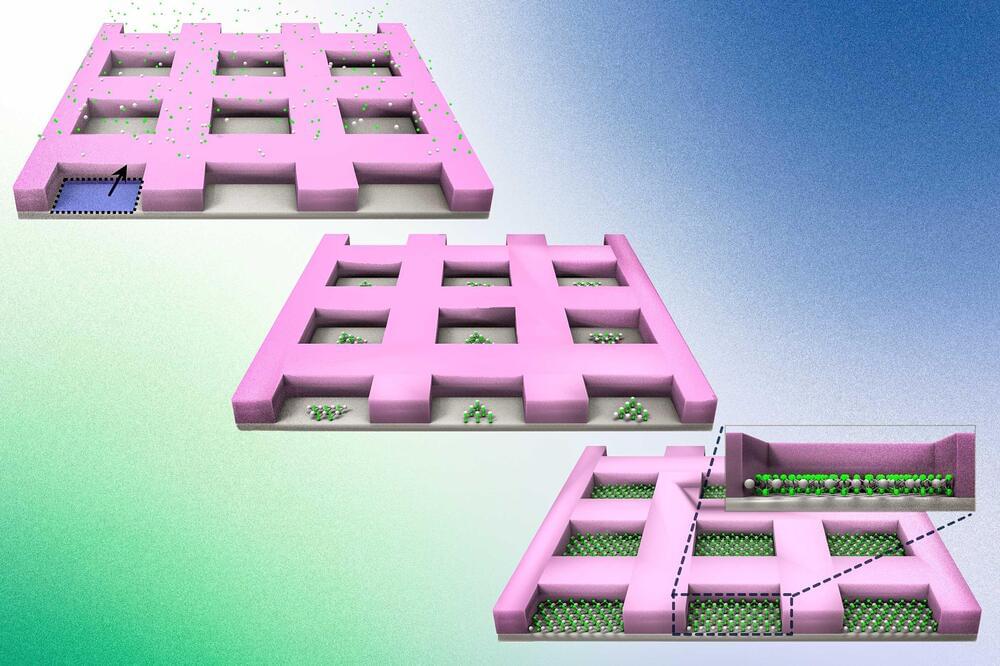
One way to get past this sizing roadblock is to use layers of 2D materials—which are only a single atom thick—as the channel. Atomically thin channels can help enable even smaller transistors by making it harder for the electrons to jump between electrodes. One well-known example of a 2D material is graphene, whose discoverers won the Nobel Prize in Physics in 2010. But there are other 2D materials, and many believe they are the future of transistors, with the promise of scaling channel thickness down from its current 3D limit of a few nanometers (nm, billionths of a meter) to less than a single nanometer thickness.

Incredible Virus Discovery Offers Clues About the Origins of Complex Life

Omuterema AkhahendaAdmin.

I remember when my friends worked at a Motorola Chip fabrication plant in San Antonio. They had the facilities, as well as skilled labor. However, cheaper labor led many to invest abroad. I even changed my major from computer science, as I heard of thi… See more.

Anne KristoffersenWell — Orbital semiconductor fabrication should be pursued, there are so many benefits to making chips in a naturally micro-gravity, hard-vacuum environment.

Notably, you aren’t using any water, and your silicon wafers can be arbitrarily large.… See more.

1 Reply.

View 6 more comments.


Diamond nanothreads could beat batteries for energy storage

Next big thing Haifei Zhan and colleagues reckon that carbon nanothreads have a future in energy storage. (Courtesy: Queensland University of Technology) Computational and theoretical studies of diamond-like carbon nanothreads suggest that…


Computational and theoretical studies of diamond-like carbon nanothreads suggest that they could provide an alternative to batteries by storing energy in a strained mechanical system. The team behind the research says that nanothread devices could power electronics and help with the shift towards renewable sources of energy.

The traditional go-to device for energy storage is the electrochemical battery, which predates even the widespread use of electricity. Despite centuries of technological progress and near ubiquitous use, batteries remain prone to the same inefficiencies and hazards as any device based on chemical reactions – sluggish reactions in the cold, the danger of explosion in the heat and the risk of toxic chemical leakages.

Another way of storing energy is to strain a material that then releases energy as it returns to its unstrained state. The strain could be linear like stretching and then launching a rubber band from your finger; or twisted, like a wind-up clock or toy. More than a decade ago, theoretical work done by researchers at the Massachusetts Institute of Technology suggested that strained chords made from carbon nanotubes could achieve impressive energy-storage densities, on account of the material’s unique mechanical properties.

Atomic quantum processors make their debut

Two research groups demonstrate quantum algorithms using neutral atoms as qubits. Tim Wogan reports.

The first quantum processors that use neutral atoms as qubits have been produced independently by two US-based groups. The result offers the possibility of building quantum computers that could be easier to scale up than current devices.

Two technologies have dominated quantum computing so far, but they are not without issues. Superconducting qubits must be constructed individually, making it nearly impossible to fabricate identical copies, so the probability of the output being correct is reduced – causing what is known as “gate fidelity”. Moreover, each qubit must be cooled close to absolute zero. Trapped ions, on the other hand, have the advantage that each ion is guaranteed to be indistinguishable by the laws of quantum mechanics. But while ions in a vacuum are relatively easy to isolate from thermal noise, they are strongly interacting and so require electric fields to move them around.

Programmable photonic chip lights up quantum computing

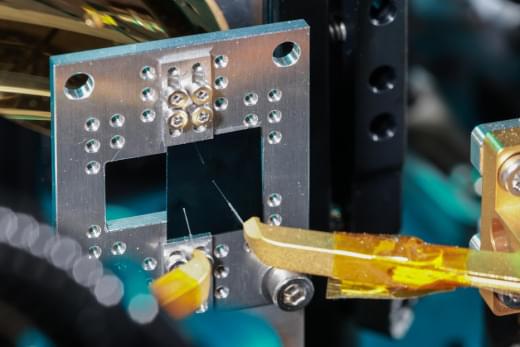
Tight squeeze The Xanadu X8 quantum photonic processor used in the study. (Courtesy: Xanadu) Computers are made of chips, and in the future, some of those chips might use light as their main ingredient. Scientists from the Ontario, Canada-based…


Giant bacteria, Ca. Thiomargarita magnifica, have been found in Guadeloupe. They have organelles, DNA and measure one centimeter long.

Wearable muscles offer an impressive upper-body endurance boost

Researchers at ETH Zurich have developed a lightweight, wearable textile exomuscle that uses sensors embedded in its fabric to detect a user’s movement intentions and chip in extra force as needed. Initial tests show a significant boost in endurance.

Where powered exoskeletons act as both muscle and bone, providing force as well as structural support, exomuscles make use of the body’s own structure and simply chip in with additional force. As a result, they’re much lighter and less bulky, but they’re also limited in how much force they can deliver, since human bones and joints can only take so much.

This “Myoshirt” from ETH Zurich is designed as a vest, with cuffs for the upper arm and forearm. Sensors in the fabric feed data on muscle control impulses to a control box, which processes the information in real time and decides when to actuate the artificial muscles – which are short Dyneema cables aligned parallel with the wearer’s own muscles. By shortening the cables as the muscles contract, the Myoshirt is able to contribute power to your movements in a subtle, discreet, intuitive and tuneable way.

/* */