Toggle light / dark theme

Three-dimensional, multifunctional neural interfaces for cortical spheroids and engineered assembloids

Three-dimensional (3D), submillimeter-scale constructs of neural cells, known as cortical spheroids, are of rapidly growing importance in biological research because these systems reproduce complex features of the brain in vitro. Despite their great potential for studies of neurodevelopment and neurological disease modeling, 3D living objects cannot be studied easily using conventional approaches to neuromodulation, sensing, and manipulation. Here, we introduce classes of microfabricated 3D frameworks as compliant, multifunctional neural interfaces to spheroids and to assembloids. Electrical, optical, chemical, and thermal interfaces to cortical spheroids demonstrate some of the capabilities. Complex architectures and high-resolution features highlight the design versatility. Detailed studies of the spreading of coordinated bursting events across the surface of an isolated cortical spheroid and of the cascade of processes associated with formation and regrowth of bridging tissues across a pair of such spheroids represent two of the many opportunities in basic neuroscience research enabled by these platforms.

Progress in elucidating the development of the human brain increasingly relies on the use of biosystems produced by three-dimensional (3D) neural cultures, in the form of cortical spheroids, organoids, and assembloids (1–3). Precisely monitoring the physiological properties of these and other types of 3D biosystems, especially their electrophysiological behaviors, promises to enhance our understanding of the interactions associated with development of the nervous system, as well as the evolution and origins of aberrant behaviors and disease states (4–8). Conventional multielectrode array (MEA) technologies exist only in rigid, planar, and 2D formats, thereby limiting their functional interfaces to small areas of 3D cultures, typically confined to regions near the bottom contacting surfaces.

Prospective Validation of an Electronic Health Record–Based, Real-Time Suicide Risk Model

Importance Numerous prognostic models of suicide risk have been published, but few have been implemented outside of integrated managed care systems.

Objective To evaluate performance of a suicide attempt risk prediction model implemented in a vendor-supplied electronic health record to predict subsequent suicidal ideation and suicide attempt.

Design, Setting, and Participants This observational cohort study evaluated implementation of a suicide attempt prediction model in live clinical systems without alerting. The cohort comprised patients seen for any reason in adult inpatient, emergency department, and ambulatory surgery settings at an academic medical center in the mid-South from June 2019 to April 2020.

WWII codebreaker Turing honored on UK’s new 50-pound note

LONDON (AP) — The rainbow flag flew proudly Thursday above the Bank of England in the heart of London’s financial district to commemorate World War II codebreaker Alan Turing, the new face of Britain’s 50-pound note.

The design of the bank note was unveiled before it is being formally issued to the public on June 23, Turing’s birthday. The 50-pound note is the most valuable denomination in circulation but is little used during everyday transactions, especially during the coronavirus pandemic as digital payments increasingly replaced the use of cash.

The new note, which is laden with high-level security features and is made of longer-lasting polymer, completes the bank’s rejig of its paper currencies over the past few years. Turing’s image joins that of Winston Churchill on the five-pound note, novelist Jane Austen on the 10-pound note and artist J. M. W. Turner on the 20-pound note.

How Humans Develop Larger Brains Than Other Apes

Summary: Using brain organoid models, researchers have identified how the brain grows much larger and has three times as many neurons, as the brains of chimpanzees and gorillas.

Source: UK Research and Innovation.

A new study is the first to identify how human brains grow much larger, with three times as many neurons, compared with chimpanzee and gorilla brains. The study, led by researchers at the Medical Research Council (MRC) Laboratory of Molecular Biology in Cambridge, UK, identified a key molecular switch that can make ape brain organoids grow more like human organoids, and vice versa.

Medicine 2.0 – Successful Repair of Aging Damage

Antiaging expert Aubrey de Grey says there is a 50% chance that we reach longevity escape velocity by 2035.

I now think there is a 50% chance that we will reach longevity escape velocity by 2036. After that point (the “Methuselarity”), those who regularly receive the latest rejuvenation therapies will never suffer from age-related ill-health at any age.

— Aubrey de Grey (@aubreydegrey) March 142021

More Than Words: Using AI to Map How the Brain Understands Sentences

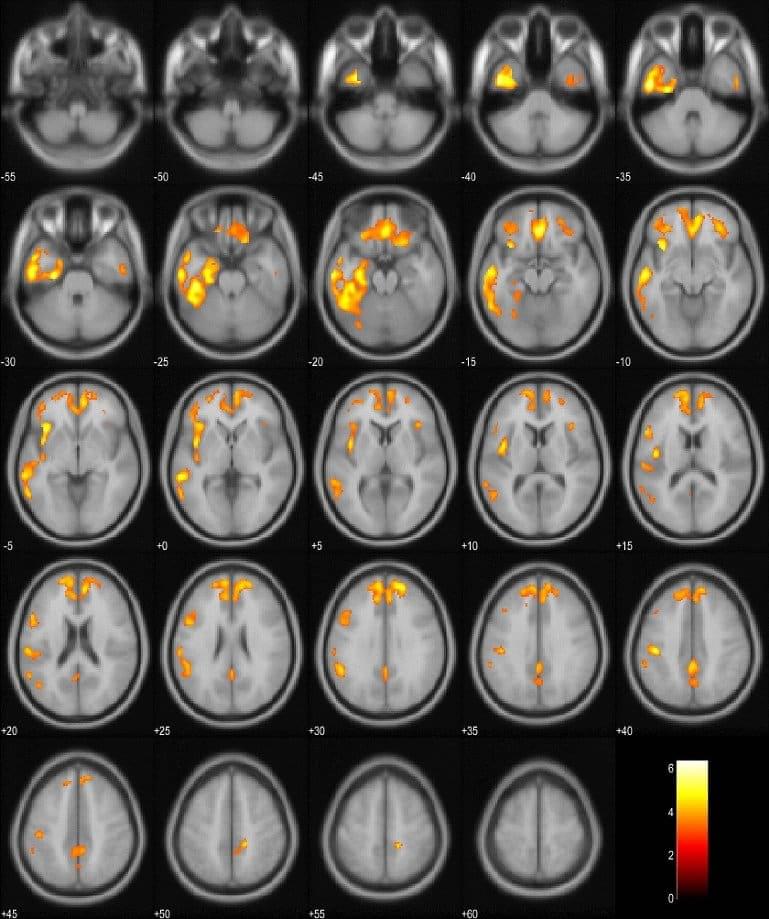
Summary: Combining neuroimaging data with artificial intelligence technology, researchers have identified a complex network within the brain that comprehends the meaning of spoken sentences.

Source: university of rochester medical center.

Have you ever wondered why you are able to hear a sentence and understand its meaning – given that the same words in a different order would have an entirely different meaning?

/* */