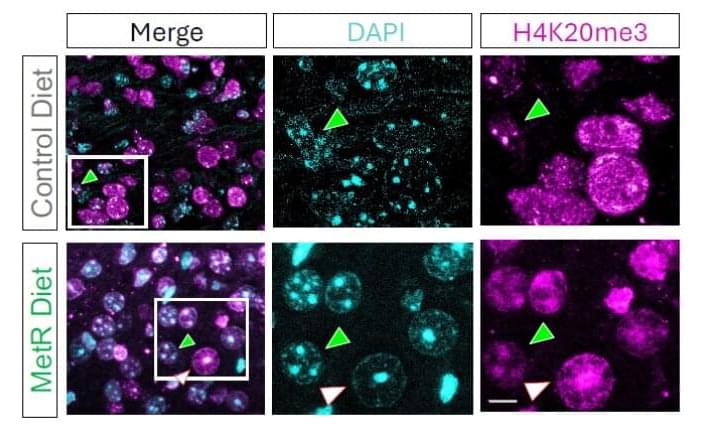
An unexpected lab observation has led a team of scientists to discover how diet can influence survival in animal models of glioma, one of the most aggressive and deadly forms of brain cancer. Researchers at Baylor College of Medicine, the Duncan Neurological Research Institute (Duncan NRI) at Texas Children’s Hospital and collaborating institutions report in the Proceedings of the National Academy of Sciences how limiting a single nutrient, the amino acid methionine, in the diet destabilized DNA organization and led to cancer cell death and increased animal survival. These findings open new possibilities for treating one of the most challenging forms of brain cancer.
“Cancer cells, including gliomas, often depend on methionine. Methionine is an essential amino acid, meaning that the body does not produce it on its own; it must be consumed in the diet. Glioma cells are unusually dependent on methionine to fuel rapid growth and control gene activity,” said corresponding author Dr. Benjamin Deneen, professor and Dr. Russell J. and Marian K. Blattner Chair in the Department of Neurosurgery and director of the Center for Cancer Neuroscience, all at Baylor.
“In the current study, we wanted to know, if tumors depend so much on methionine, what happens if we reduce the supply?” said first author Brittney Lozzi, a graduate student in the Deneen lab.